Burna Boy’s Early Catalogue Is in Legal Limbo, and Here’s What That Actually Means
Damini Ogulu has spent the last five years building toward total control of his music. Grammy Awards winner, Atlantic Records deal, sold-out arenas across five continents. A global brand so large that Recording Academy booked him as the only Afrobeats artist to performance at the show main stage in 2024. Everything pointed in one direction of Burna Boy catalogue at the height of his power, owning what he created,
Then a Nigerian court case started unravelling that picture.
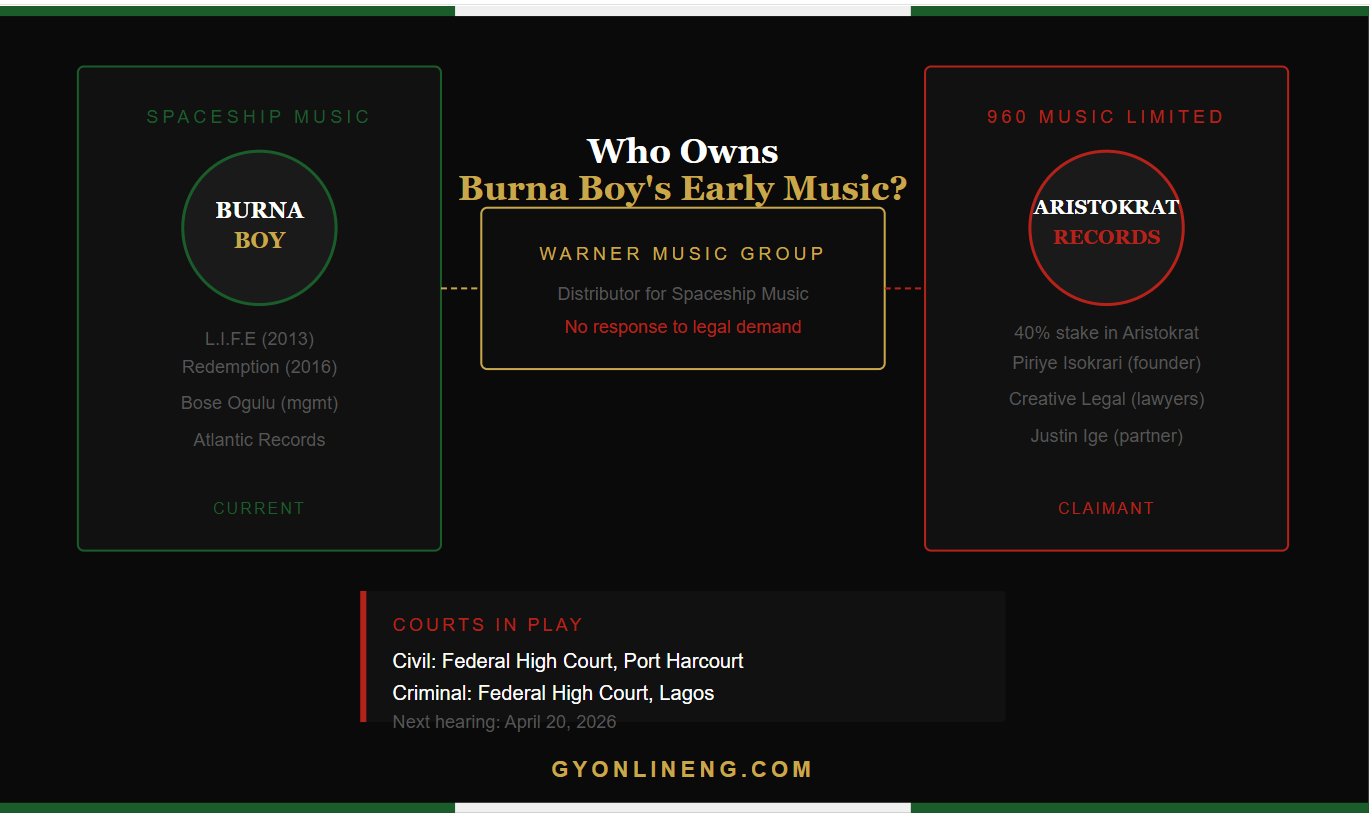
The dispute over Burna Boy‘s early catalogue, specifically L.I.F.E from 2013 and Redemption from 2016, is now one of the most significant music rights cases in Nigerian history. It involves a Grammy-winning artist, his former label, a minority shareholder, a Lagos law firm, Warner Music Group, the Federal High Court in Port Harcourt, a separate criminal proceeding in Lagos and allegations of fraudulent conversion. Every party has something significant to lose.
How This Started: The 2024 Deal That Triggered Everything
The conflict traces back to May and June 2024, when Aristokrat Records, the label that launched Burna Boy‘s career in 2011, allegedly sold his historical intellectual property and master recordings to Spaceship Music, his current imprint led by him and his mother Bose Ogulu.
On the surface that sounds straightforward. Artists reclaiming their masters from early label deals is not unusual Taylor Swift‘s highly publicised attempt to re-record her first six albums brought the issue of master ownership into mainstream conversation globally, and plenty of artists since have tried to find cleaner paths to controlling their catalogues.
The problem here is not the goal. The problem here is how it was allegedly done.
960 Music Limited, which owns a 40% stake in Aristokrat Records, claims it was neither notified of nor consented to the alleged assignment of the catalogue. They further contend the transaction was executed without board or shareholder approval. That is where the legal dispute originates.

960 Music is seeking to void the transaction, recover proceeds from the alleged sale, and has initiated both civil proceedings before the Federal High Court in Port Harcourt and a separate criminal charge involving allegations of fraudulent conversion.
Burna Boy Catalogue: What Is Actually at Stake
L.I.F.E and Redemption are not just historical footnotes. They contain Like to Party, Tonight, and the early catalogue of recordings that established Burna Boy’s sonic identity before the world caught up to him. These albums continue generating streaming, licensing and publishing income across global markets, and their commercial value has risen sharply alongside the artist’s profile since they were released.
If the Port Harcourt court rules in favour of 960 Music, Burna Boy‘s own label could be forced to surrender rights to his breakout hits back to the original partners, placing those masters in legal limbo.
That is the worst-case outcome for the artist. His early catalogue the music that built him potentially passing out of his hands and into an ownership structure he cannot control, at the peak of his commercial career when those recordings are worth more than they have ever been.
Warner Music Gets Pulled In
The legal heat shifted toward Warner Music Group because it is alleged to be involved as distributor for Spaceship Music, Burna Boy’s current label structure.
Lagos-based law firm Creative Legal, acting for 960 Music, formally notified Warner Music and demanded immediate suspension of all distribution, marketing, monetisation, licensing and related commercial activities connected to the disputed works. They also demanded Warner preserve all financial and royalty records and refrain from entering any new agreements tied to the catalogue.
As of the deadline’s expiration, Warner Music had not responded, raising the likelihood of further legal action. Creative Legal confirmed it was considering all options, including adding Warner Music to the suit if the company did not engage reasonably.
For a global entertainment company the size of Warner Music Group 2024 revenues of over $6 billion a Nigerian lawsuit might look like a manageable risk from a distance. But the reputational and operational implications of being drawn into active proceedings over one of the most commercially valuable Afrobeats catalogues in existence are not trivial. Warner’s risk exposure does not require a finding on the underlying merits to become significant the mere association with disputed recordings creates compliance, reputational and commercial complications.

The Criminal Dimension
This is where the story gets more serious than a standard shareholder dispute.
The Force Criminal Investigation Department, FCID, filed charges against Piriye Isokrari, founder of Aristokrat Records, following investigations into allegations of fraud and financial misconduct raised by the investors. Isokrari has missed at least two court appearances, with proceedings in Lagos adjourned to April 20, 2026.
Criminal proceedings in a music rights dispute are unusual. They signal that 960 Music‘s position is not simply about recovering money or renegotiating equity. They are alleging criminal conduct, which changes the stakes for everyone connected to the transaction. Aristokrat Records has not issued a public response. Burna Boy‘s management team has not commented publicly. Warner Music has not responded to the formal legal demand. All parties are staying quiet while the courts proceed.
What This Tells You About Nigerian Music Business
The Burna Boy catalogue dispute is an individual legal case but it is also a reflection of something structural about how the Nigerian music industry operated during the 2010s.
Many of the deals that launched Nigeria’s biggest artists were made without the kind of contract rigour that Western labels apply. Labels signed artists on terms that were often verbal, informal, or poorly documented. Equity stakes were distributed without clear shareholder agreements. Publishing and master rights were bundled together in ways that made them difficult to separate later. None of those label owners expected those artists to become global superstars whose catalogues would be worth millions of dollars.
Then Afrobeats went global. The catalogues became valuable. And every ambiguity in every early contract became a potential legal dispute.
Davido has spoken publicly about the importance of artists owning their masters. Wizkid‘s move to Sony Music was partly about gaining more control over his output. Tems negotiated carefully before her RCA Records deal. The generation of artists coming after Burna Boy, FOLA, Asake, Ayra Starr, are building their careers with a clearer understanding of what ownership means than their predecessors had access to.
But the artists who built Afrobeats in the 2010s, Burna Boy included built it in an environment where the concept of master ownership barely existed as a practical conversation in Nigerian music. The current dispute is partly the cost of that environment catching up with the commercial reality it produced.
What Happens Next
The civil case in Port Harcourt continues. Criminal proceedings in Lagos are adjourned to April 20, 2026. Warner Music’s silence on the formal demand from Creative Legal may force a decision engage or be joined to the suit.
The key unresolved issue is procedural: will Warner Music Group respond formally and adjust its handling of the catalogue, or maintain its current posture and accept the risk of being added to active proceedings?
For Burna Boy personally, the situation is what Channels Television described as a double-edged sword. The 2024 deal was almost certainly intended to give him what every major artist eventually wants control over the recordings that built their career. If the transaction holds up legally, he achieves that. If it does not, those early recordings go back into a disputed ownership structure that he may have less control over than before the deal was attempted.
” Like to Party, Tonight ” The songs that made Lagos know his name before the world did. Right now, who owns them is a matter for Nigerian courts to decide.
Nobody involved in making those records in 2013 could have anticipated that sentence in 2026. It is also a sentence that every emerging Nigerian artist with a catalogue worth protecting should read carefully.