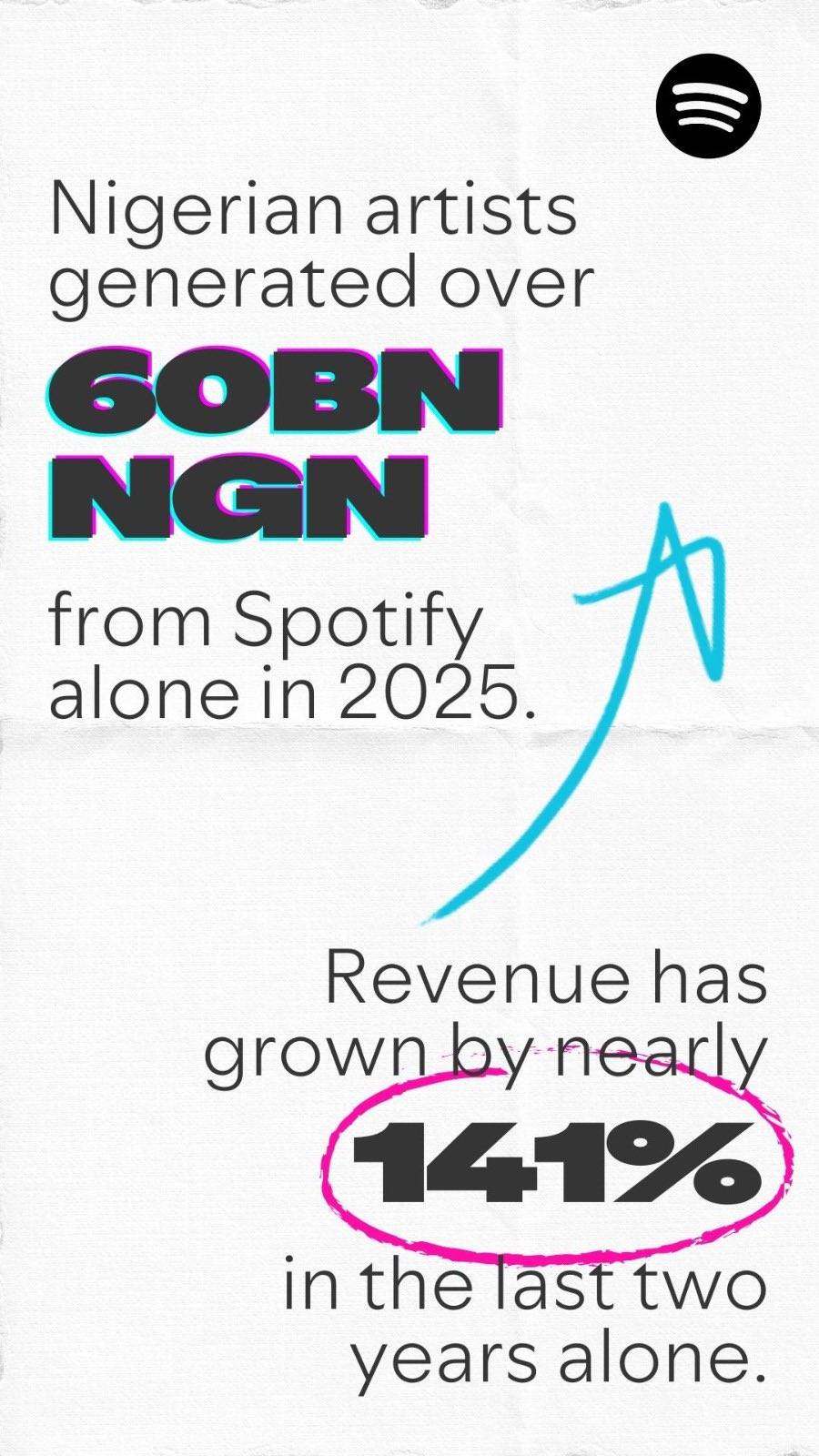
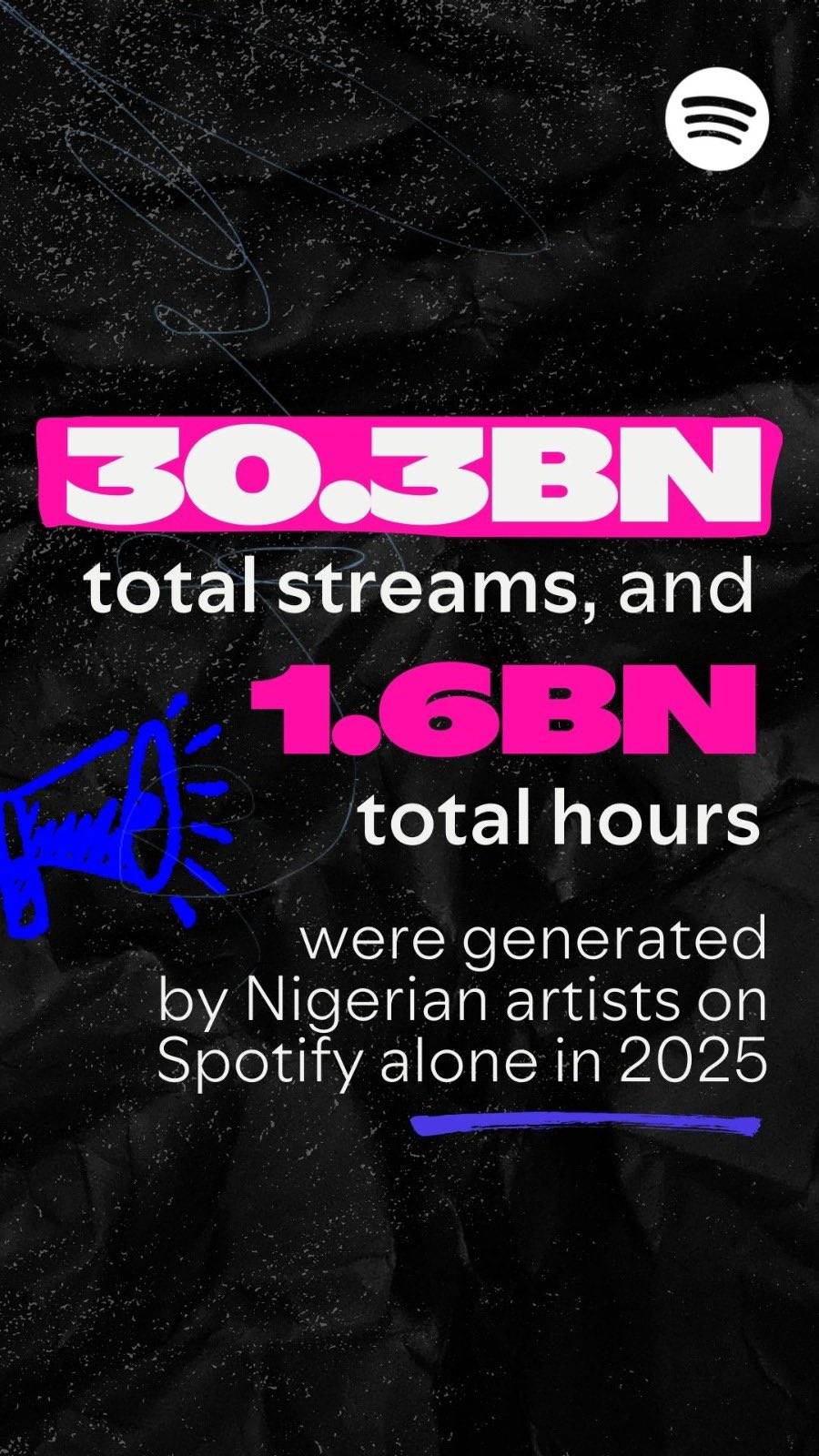
Spotify says Nigerian artists generated more than ₦60 billion in royalties in 2025, alongside 30.3 billion streams and 1.6 billion listening hours. The figures show the scale of listening and the royalties reported in naira. They do not, on their own, tell us how much the business grew after accounting for exchange rates, where streams happened or how the reporting basis compares with earlier years.
To judge growth properly, the naira total needs context: how the figures compare across years, how exchange rates changed and where the streams took place.
Start With What Spotify Actually Reported
Spotify released its Nigeria-specific Loud & Clear data in Lagos on March 17, 2026. The headline figures are real. Nigerian artists generated over N60 billion in royalties on Spotify in 2025. They accumulated 30.3 billion streams and 1.6 billion listening hours. Nigerian music was discovered by first-time listeners more than 1.3 billion times, a 26% increase on 2024. Nigerian artists accounted for over 80% of tracks on Spotify Nigeria’s Daily Top 50.
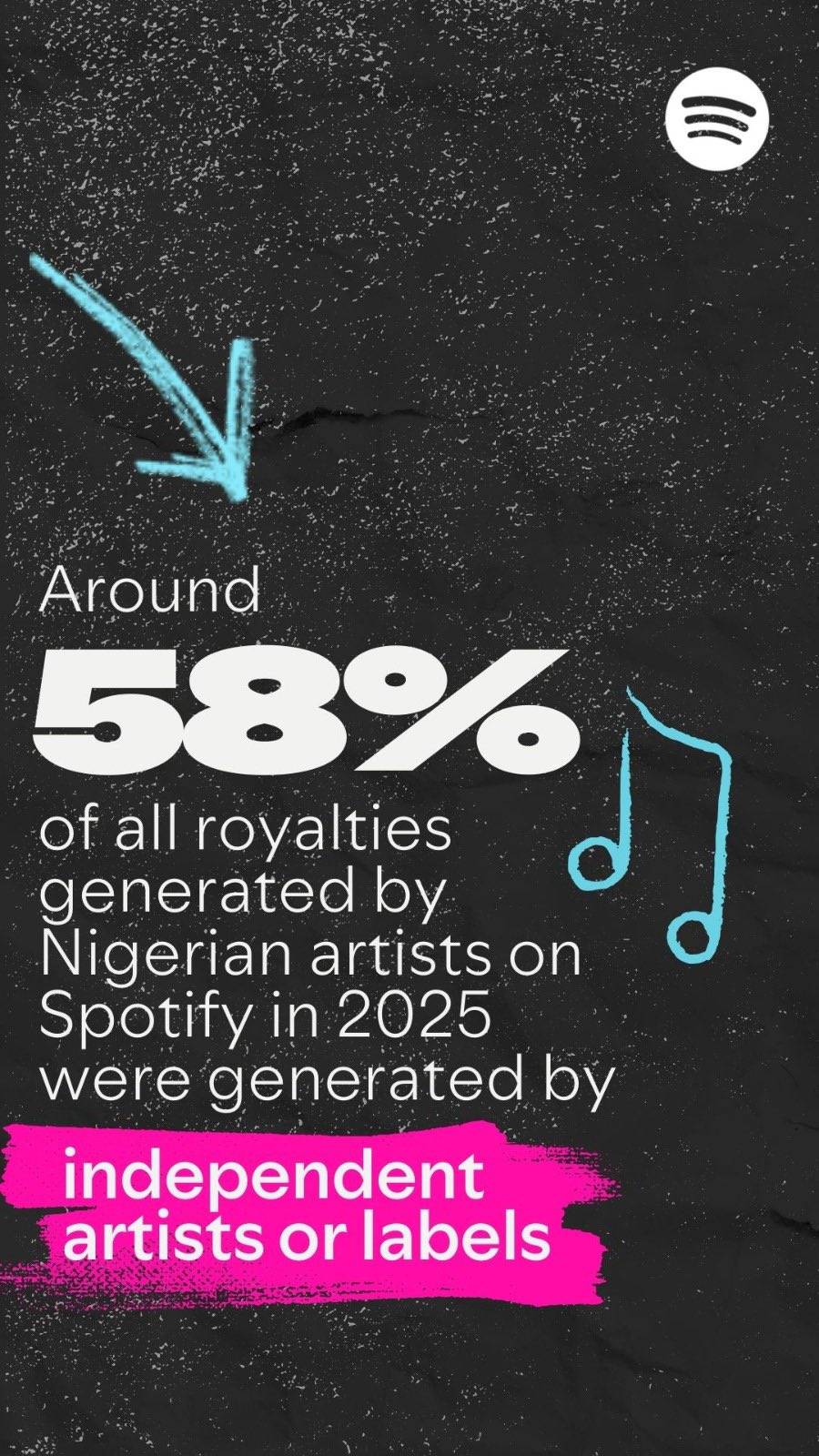
The figures point to growing engagement, both at home and abroad. Spotify reports that local consumption of Nigerian artists grew by 170% year-on-year, female artists’ local streams rose by 55%, and independent artists and labels generated 58% of royalties. That last figure needs careful reading: Spotify’s definition of independent does not mean every recipient is a small or self-managed act.
Jocelyne Muhutu-Remy, Spotify‘s Managing Director for Africa, described Nigeria’s music ecosystem as “building momentum at home, reaching new audiences at scale, and generating growing economic value.” The figures support the case for wider reach, while leaving the questions about the value and distribution of royalties open.
The headline total says little about how evenly those royalties are distributed among artists.
The Number Hidden by the Naira
Spotify’s published Nigeria figures were reported in naira, while media coverage of the announcement also put the 2025 total at about US$43.92 million. That dollar figure is a more direct comparison point than independently converting the naira total with a chosen annual exchange-rate average. The public announcement does not, by itself, provide a full year-by-year dollar series that would establish whether earnings were flat in real terms.
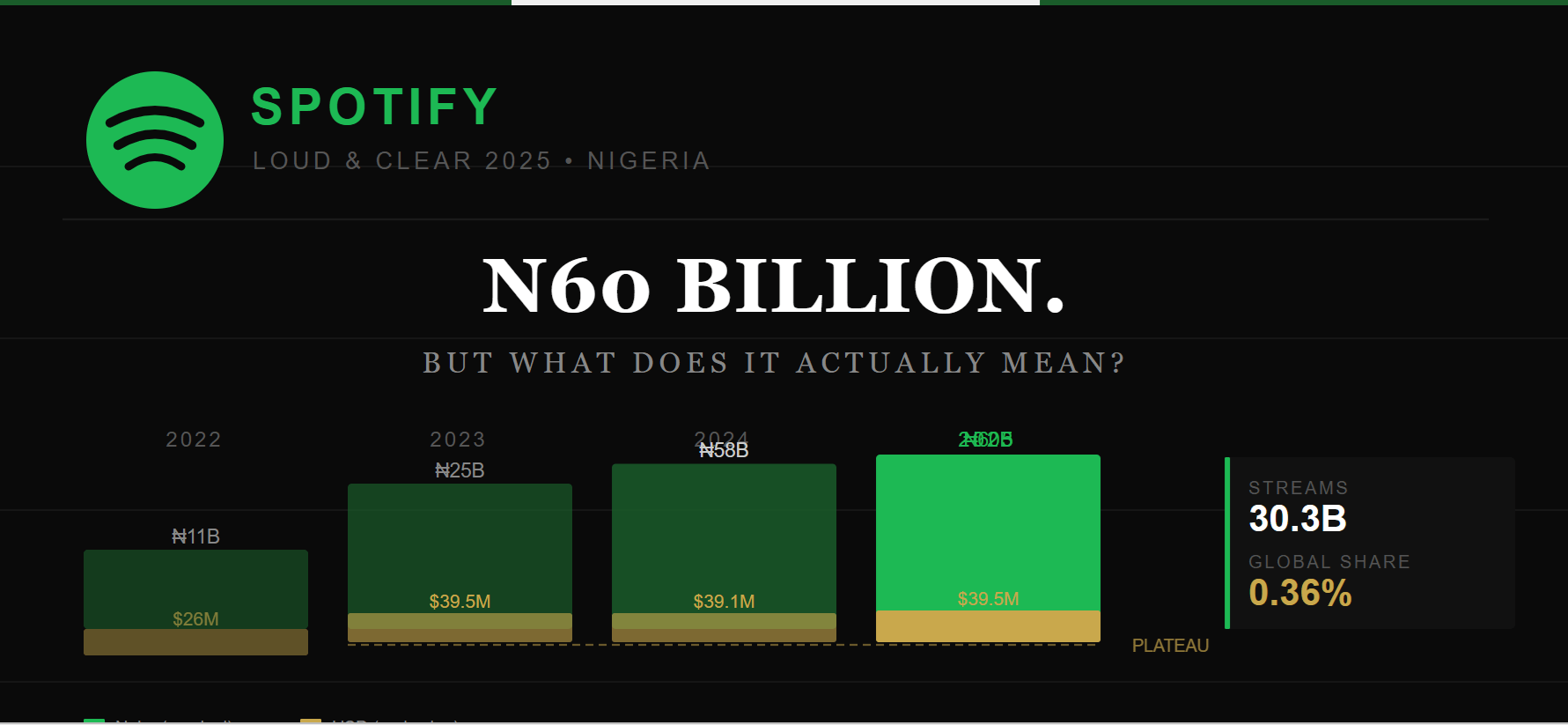
Here is what the naira figures look like when converted using the average annual exchange rate for each year:
The naira totals reported for 2023, 2024 and 2025 were approximately ₦25 billion, ₦58 billion and more than ₦60 billion respectively. Those figures show substantial growth in the naira amount, but they do not establish the same rate of growth in dollar terms. Reports on Spotify’s 2025 announcement put the ₦60 billion figure at about US$43.92 million. To compare years reliably, we would need consistent dollar-denominated figures or a clearly documented conversion method applied to each year’s underlying data.
The naira total alone cannot tell us how much of the increase came from more royalties, exchange-rate movements or changes in how Spotify reported the figures. Without comparable dollar figures for each year, it would be too strong to conclude that Nigerian artists’ Spotify earnings have been stuck at roughly $39 million.
At about US$43.92 million, the reported 2025 Nigerian figure is a small share of Spotify’s global royalty payments. Any precise percentage comparison should use a consistent basis for both figures and distinguish royalties attributed to Nigerian artists from revenue generated in Nigeria; those are not necessarily the same measure.
Why the Same Stream Pays Differently
The size of the audience is only one part of the story; the money depends on where people listen and how the service earns it.
Spotify’s royalty rates are not fixed globally. They vary based on the subscription price in each market, the advertising revenue generated from free-tier listeners, and the overall size of the streaming economy in each country. As of October 2026, Spotify Premium Individual costs ₦1,600 per month in Nigeria, compared with £12.99 in the UK and $12.99 in the United States. These are current list prices for individual plans, not a direct measure of royalty value: subscription revenue is pooled and royalties are allocated under Spotify’s broader system.
A stream from Lagos does not have a fixed payout that can be directly compared with one from London. Spotify pools subscription and advertising revenue, then allocates royalties according to each track’s share of total streams; the listener’s market affects the revenue entering that pool. Lower subscription prices can mean less revenue per listener, but the outcome also depends on free-tier advertising, listening patterns and the rights holders’ agreements. Large Nigerian stream counts therefore do not translate into one predictable naira amount per play.
This is not unique to Spotify. Apple Music, Audiomack and Boomplay also operate within markets shaped by subscription prices, advertising income and local purchasing power, though each service’s business model and royalty arrangements differ.
In general, an artist whose streams are concentrated in lower-priced markets may generate less royalty revenue than an artist with a similar number of streams in higher-priced markets. The difference is not a universal fixed rate per stream; it reflects subscription revenue, advertising and the mix of listening across countries. Rema‘s Calm Down remix with Selena Gomez illustrates why international reach can matter commercially, though the revenue effect depends on the actual audience and rights arrangements.
What “Independent” Means Here
The 58% independent royalty figure deserves more scrutiny than it received in most coverage. Spotify defines independent as any artist or label not owned by the three major global record groups: Universal Music Group, Sony Music Entertainment, and Warner Music Group.
Under that definition, companies like EMPIRE and ONErpm, which distribute music for some of Nigeria’s biggest artists and command significant market share in the Nigerian streaming economy, are classified as independent. They are established label-services businesses with infrastructure, A&R operations and marketing budgets. Their inclusion shows why Spotify’s ‘independent’ category should not be read as a count of small, self-managed artists.
The 58% figure is meaningful, but it does not show that Nigerian music is dominated by small creators operating outside the system. It means independent artists or labels generated that share of Spotify royalties attributed to Nigerian artists in 2025, under Spotify’s definition of independent. It should not be treated as a complete measure of label ownership across Nigeria’s music industry.
What Is Actually Growing
The audience figures are more straightforward to interpret: 30.3 billion streams, 1.6 billion listening hours, more than 1.3 billion first-time listener discoveries (up 26% on 2024), nearly 2,000 Nigerian artists added to Spotify editorial playlists, and Nigerian artists appearing in 320 million user playlists globally. They show activity on the platform, not how much individual artists earned.
These figures point to Nigerian music reaching listeners beyond its home market. Afrobeats, Afropop and newer sounds from Nigerian cities are finding audiences abroad, although platform-wide figures do not show how evenly that reach is distributed among artists. Acts such as Odumodublvck, Seyi Vibez, Asake, Burna Boy and BNXN illustrate the range of artists building audiences beyond Nigeria; their individual results, however, cannot be inferred from the aggregate numbers alone.
The genre data also suggests Nigerian listening is not confined to Afrobeats. Spotify says some of its fastest-growing genres in Nigeria over the past five years include pop urbaine, alternative pop, anime, emo and drill. That is a platform-specific measure, not a complete picture of the country’s listening habits, but it points to a wider range of interests than the global Afrobeats conversation sometimes suggests.
Female artists growing streams by 55% year-on-year is significant. Ayra Starr, Tems and Qing Madi are part of a generation of Nigerian female artists building genuine global careers on their own terms, not as features on male-led tracks.
What the ₦60 Billion Still Doesn’t Tell You
The practical question is how much royalty income Nigerian music earns from all those streams. Subscription prices, advertising revenue and the countries where listeners stream all affect the amount associated with a given level of activity.
International listening can raise the royalty value associated with Nigerian music because subscription prices and advertising markets differ by country. That makes global audience development commercially relevant, though it should not be treated as a substitute for understanding domestic monetisation or as a guarantee that every overseas stream pays a fixed multiple of a Nigerian stream. More international visibility for Davido and Tems’s global recognition can introduce music to new listeners, but the revenue effect depends on where and how those listeners engage.
It also means the conversation about streaming platforms and sustainable royalty infrastructure within Nigeria itself matters. A consistently defined market-revenue series from the International Federation of the Phonographic Industry or another reliable industry source would help establish how domestic recorded-music revenue has moved over time. Spotify’s Loud & Clear figures answer a narrower question about reported royalties on its own service.
N60 billion is a milestone worth acknowledging. It reflects the scale of royalty activity reported for Nigerian artists on Spotify in 2025. The figure alone cannot tell us how much growth came from stream volume, international listening, exchange rates or changes in the reporting basis. A comparable year-by-year dollar series would help answer that question more firmly — and would give the industry a better basis for judging whether streaming revenue is growing as quickly as audience attention.