
The Afrobeats Streaming Revenue Nigerian Artists Are Not Reading
In September 2022, Divine Ikubor, known as Rema, released a remix of “Calm Down” featuring Selena Gomez. The collaboration took a song already familiar to many listeners into a much wider international market, eventually reaching number 3 on the Billboard Hot 100. Its success also raised a less visible business question: how much does the location of a listener matter to the revenue generated by a stream?
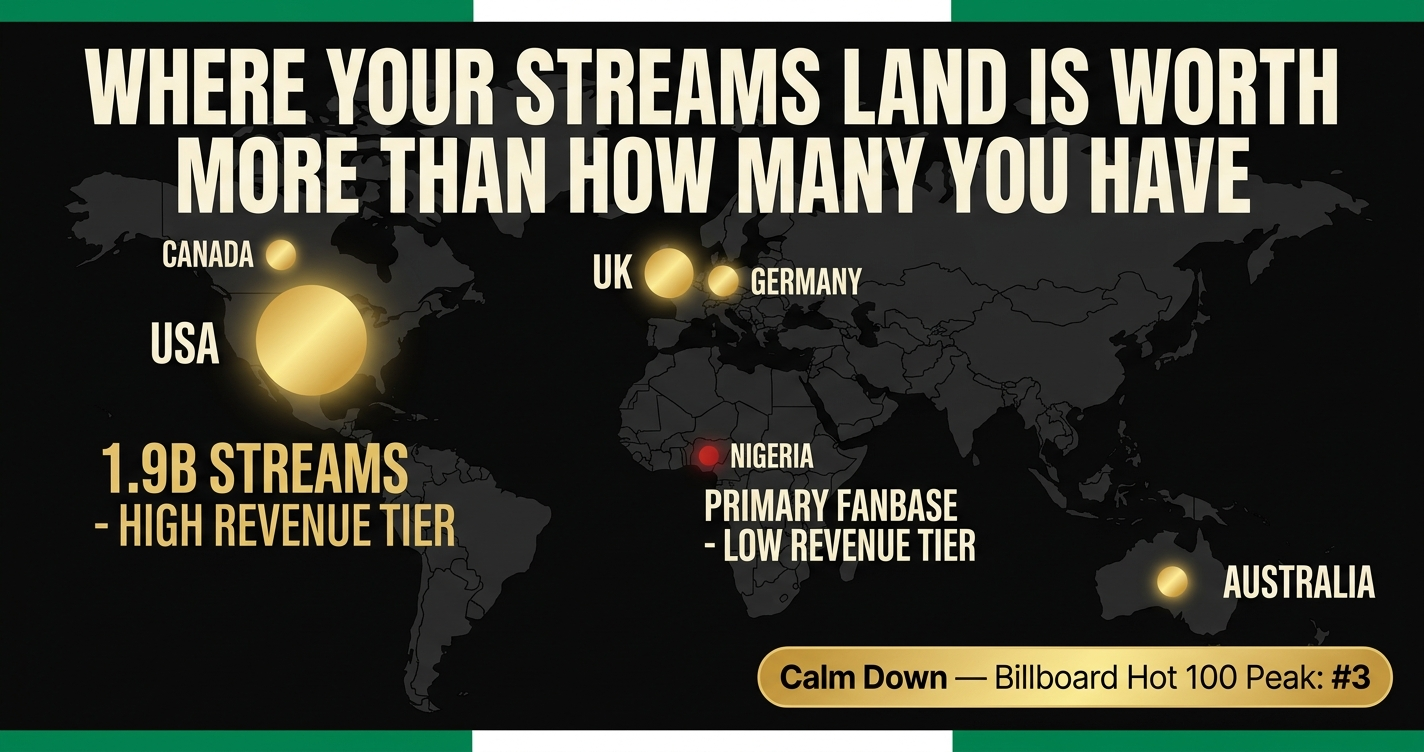
The track peaked at number 3 on the Billboard Hot 100. It charted in Germany, Australia, Canada & France. Within six months, it had crossed 1 billion streams on Spotify a number that sounds enormous until you understand which billion streams they were, and what those streams were actually worth.
Because not all streams are worth the same. And the Nigerian music industry, for all its sophistication, is still having the wrong conversation about this.
What Spotify Actually Pays and Why the Country Matters
Spotify’s royalty system is not a fixed price-per-stream schedule. In broad terms, rights holders receive a share of the relevant royalty pool based on their share of listening, with revenue influenced by subscription and advertising income, the markets where listening happens, and the rights agreements in place. Country-level subscription prices help explain why markets can contribute different amounts of revenue, but they do not let us calculate a precise payout for an individual stream.
The operative word is country.
Spotify’s official Nigeria pricing page lists Premium Individual at ₦1,600 per month. The US subscription price cited in this comparison is $11.99 per month. These prices are a useful illustration of differences between markets, though exchange rates and plan prices can change.
In the United States, the same Premium subscription costs $11.99 per month.
These prices illustrate that subscription markets differ, but the currencies need to be converted on a stated date before their size can be compared directly. Even a currency-adjusted price comparison would not establish what any individual stream earns.
| Market example in this article | Monthly Premium price stated | What the comparison shows |
|---|---|---|
| Nigeria | ₦1,600 | A lower-priced local subscription pool. |
| United States | $11.99 | A higher-priced subscription pool. |
A Nigerian listener paying for Premium contributes to a lower-priced subscription market than a listener paying for Premium in the United States. But the full subscription fee is not assigned to whichever artist that person streams: Spotify pools revenue and allocates royalties according to listening share and the rights arrangements involved. The price gap helps explain why market mix can matter for earnings, but it cannot be used to calculate the value of one fan or one stream.
Ditto Music publishes estimated per-stream figures, but these should not be treated as Spotify’s official rates. Spotify does not set one fixed payment for every stream, and the exact amount attributable to Nigerian listening is not publicly disclosed. Subscription prices show that markets differ; they do not, on their own, establish a precise per-stream payout.
The Rema Case: 1.9 Billion Streams, and Where They Came From
As of May 2026, “Calm Down (with Selena Gomez)” has accumulated 1.9 billion streams on Spotify. Rema has 25.6 million monthly listeners globally and sits at 223rd on Chartmetric’s global artist rankings.
These figures show the scale of the song’s audience, not the revenue it generated. Spotify does not publish the song’s country-by-country royalty breakdown, and stream totals alone cannot establish what Rema or the other rights holders received.

The remix helped “Calm Down” reach a wider international audience. The Billboard Hot 100 peak confirms substantial US chart performance, but it does not disclose the song’s complete streaming geography or royalties attributable to each market. Spotify does not pay a fixed amount for every stream; revenue depends on the relevant royalty pool, streamshare and rights agreements.
The Billboard Hot 100 peak at number 3 confirmed it. That chart is computed from US radio airplay, US streaming data, and US digital sales. You do not reach number 3 without massive US-based activity.
Chartmetric labels Nigeria as Rema’s primary market and the United States as his secondary market. Those labels do not show the share of “Calm Down” streams or royalties by country. Without track-level geographic data, the article cannot establish how much revenue came from higher-priced markets or whether the remix was planned primarily as a revenue strategy.
The Asake Comparison and What Chartmetric Tells Us
Asake’s most recent Chartmetric data (as of May 23, 2026) shows 9 million monthly Spotify listeners. His primary market is Nigeria. His secondary market is the United States. His top tracks, Gratitude and Forgiveness from the M$NEY album, sit at 14.7 million and 14.4 million streams respectively.
The numbers are solid. For a Nigerian artist without a billion-stream crossover hit, 9 million monthly listeners represents real reach.
But look at where the reach is concentrated.
Asake’s discovery playlists on Spotify are dominated by Nigerian-facing editorial slots: Top 50 Nigeria, Hot Hits Naija, African Heat. His “Discovered On” section on Spotify shows Top 100 Nigeria on Apple Music as his primary discovery source. These are not accident — they are the result of a sound and fanbase that is, at this stage, primarily domestic.
This is not a criticism of Asake. His music, his Fuji-influenced Afropop style, the Yoruba language at its centre — these are features, not bugs. They are also currently structural limits on which international subscription markets his streams land in.
A stream from Lagos is a stream. A stream from Los Angeles is a different financial instrument. GYOnlineNG’s broader analysis of the Nigerian music industry examines the infrastructure and market conditions behind that difference.
The Subscription Tier Map Nigerian Artists Are Ignoring
Spotify divides its markets into tiers based on local pricing. Nigeria sits at the lower end of that spectrum. The United Kingdom, Germany, Australia, Canada, and the United States sit at the upper end, where monthly subscriptions run between $9.99 and $12.99.
The countries with large Nigerian diaspora populations the UK, the US, Canada are also the highest-paying Spotify markets. An Afrobeats artist who builds deliberate reach into those diaspora communities is not just growing a fanbase. They are shifting their revenue geography toward higher-paying pools.
This is not coincidental to how Damini Ogulu, known as Burna Boy, built his career. He spent years performing in the United Kingdom, cultivating European radio play, and building an audience in markets where the streaming math worked in his favour. The Grammy nomination for Best Global Music Album did not create his international revenue. His international revenue created the conditions for the Grammy to be relevant to his career.
Rema’s “Calm Down” moment followed a similar logic, compressed into the velocity of a single viral collaboration.
What 25 Million Listeners Actually Means
Rema calm down streams currently has 25.6 million monthly Spotify listeners. Asake has 9 million. The gap looks like a streaming hierarchy. It is actually a geography story.
Rema‘s listener count swelled when “Calm Down” crossed into global pop markets. Many of those 25 million listeners are not in Nigeria. A significant portion are in the US, Europe, and Latin America markets where Selena Gomez‘s audience lives.

Asake‘s 9 million is more concentrated in Nigeria and the Nigerian diaspora in the UK and US.
Neither number tells you how much money was earned. The breakdown of where those listeners are is the only metric that answers the revenue question. Chartmetric makes this data publicly visible. Most Nigerian music commentators are not looking at it.
The Metric That Actually Matters
Stop watching the stream count. Start watching the geography.
For an artist assessing streaming revenue, country-level listening data can help explain where audiences are concentrated. But there is no fixed rate that makes every stream from the United States, United Kingdom, Canada, Germany or Australia worth a set multiple of a Nigerian stream. Subscription prices are one factor alongside advertising revenue, total listening, platform calculations and rights agreements.
Monthly listeners are not the same as streams, and neither figure alone reveals royalties. Comparing two audiences requires country-level stream counts, the relevant platform revenue pools, rights ownership and contract terms.
This is not an argument that Nigerian fans are worth less as human beings. It is an argument that Spotify’s architecture was not designed with Nigerian subscription economics in mind. The platform charges what local markets will bear. That is a business decision that has cascading consequences for African artists who have not broken into global markets.
The “Calm Down” remix with Selena Gomez gave the song access to a wider international audience, including listeners in the United States and other major markets. That makes the collaboration relevant to the song’s geographic reach, but public information does not establish whether the feature was chosen primarily to increase streaming revenue or how revenue was divided between the rights holders.
The artists who figure this out before their label does will have a structural advantage.
The ones who keep counting total streams and calling it success will keep leaving revenue geography on the table.