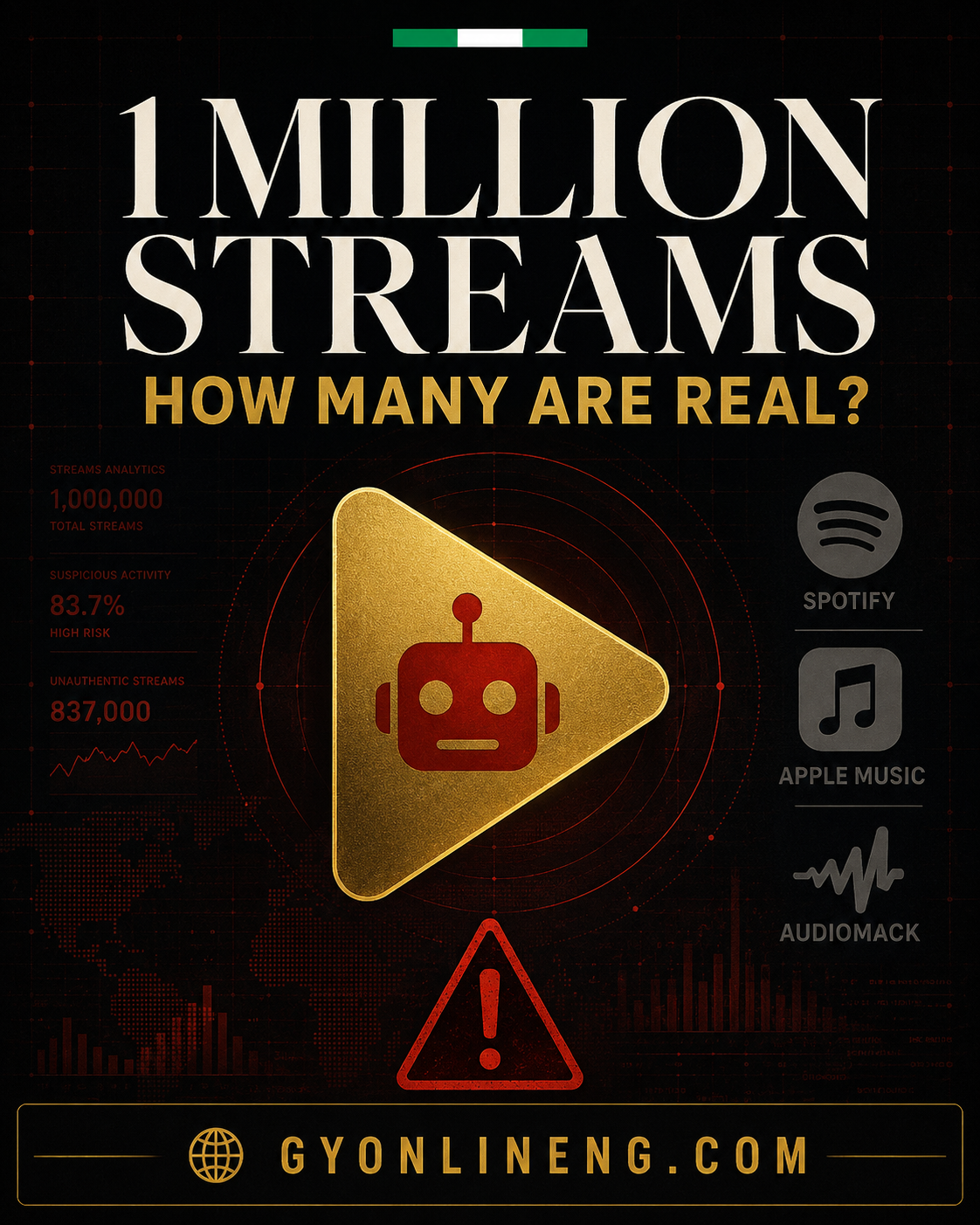
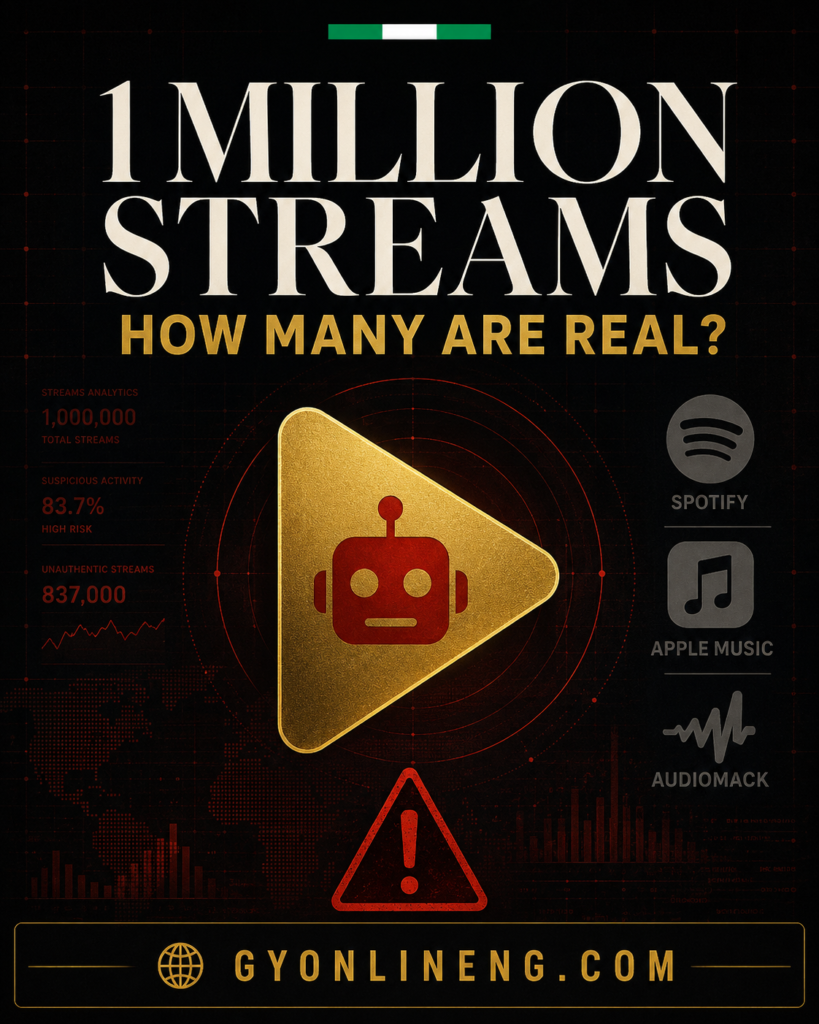
There is a particular kind of message Nigerian artists get once a song starts moving: “100,000 streams guaranteed.” Then another one offering a playlist slot. Then someone promising a TikTok push that will make the record “go viral.” For Nigerian artists paying for music promotion, understanding the difference between legitimate campaigns and artificial streaming can help protect both their budget and their music.
The pitch is usually the same: a fixed number, a fixed price and a promise that the artist will not have to wait for the audience to arrive.
Some of these offers are outright fraudulent, and the risk is larger than wasted marketing spend. An artist can end up with artificial activity attached to a release without realising how the campaign was run.
The difference between music farming and legitimate paid promotion is the most important thing an emerging Nigerian artist can understand right now. Because streaming platforms are no longer just detecting fake streams. They are acting on them. Songs are being removed. Royalties are being withheld. Accounts are being terminated. And the artists whose music is affected often have no idea that the marketing company they hired was running bots instead of campaigns.
| Promotion offer | Risk signal | Safer question to ask |
|---|---|---|
| Guaranteed stream count | Promises a fixed number of streams | How are genuine listeners being reached? |
| Guaranteed playlist placement | Paid placement is presented as guaranteed | Can you show the real playlist, audience and engagement? |
| Black-box campaign | No access to advertising or performance reporting | Will I receive transparent campaign reporting? |
| Real promotion campaign | Outcome depends on audience response | Which channels, audiences and metrics will be measured? |
How to Spot Fake Streams
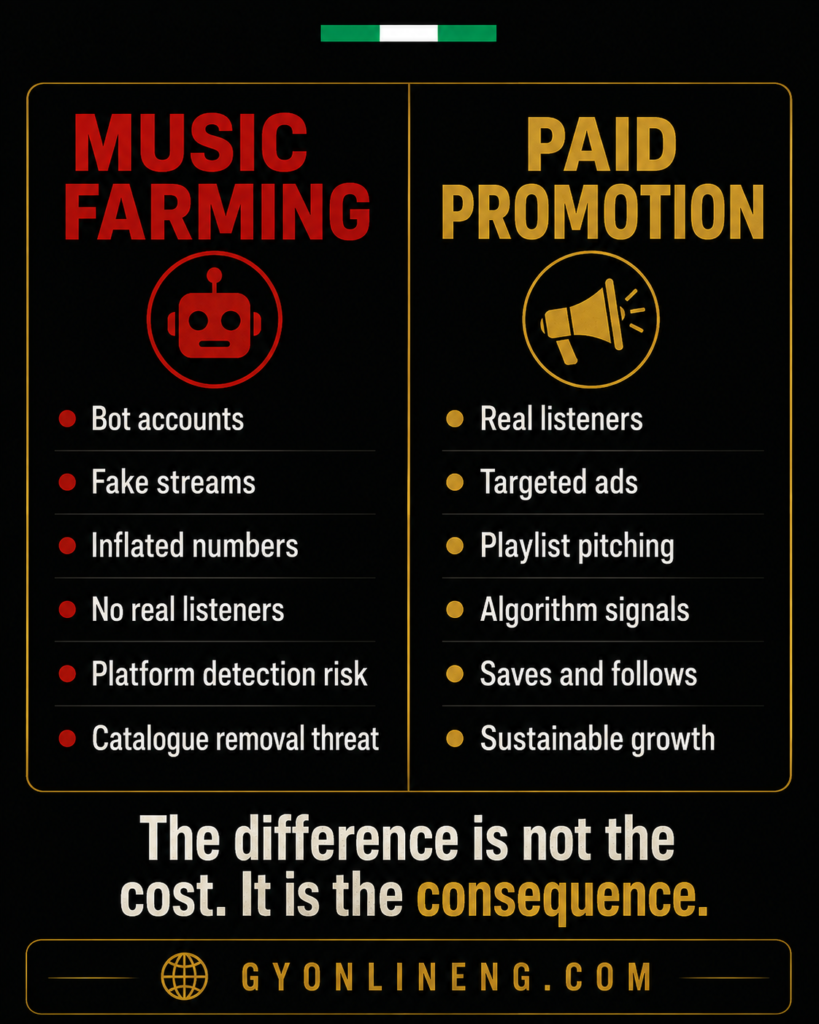
Music farming is the use of automated or coordinated systems — including bots, fake accounts and click farms — to artificially inflate streaming counts. The exact tactics vary by service and platform, but the common feature is that the reported listening does not represent ordinary audience behaviour.
A fake-streaming operation may use automated accounts, coordinated listening or click farms to inflate a track’s numbers. The activity can make an artist’s dashboard look stronger without building a genuine audience. Platforms treat confirmed artificial streams differently from legitimate listening; they may remove them from public counts, withhold related royalties or take other action under their rules. The exact consequences depend on the platform and the case, so a high stream count alone is not proof that a track has been manipulated.
Hotkeed told jbrandy that he can name drop 50 artists in Nigeria that are streaming farming, but will come on the internet to post about their songs going Number 1 pic.twitter.com/fjldLnqgPF
— Dowat 🩶 (@Oye3004) August 27, 2026
Spotify warns artists about third-party services that guarantee streams or paid playlist placement, noting that such services may use artificial methods rather than reach genuine listeners. The platform’s guidance is a warning about the risks of these offers; it does not establish that every company making a promotion pitch uses bots. Artists should ask how a campaign reaches listeners and what transparent reporting they will receive before paying.
Artificial streaming can damage more than an artist’s public numbers. Spotify explains that confirmed artificial streams do not earn royalties and are removed from public metrics. Its guidance also warns against services that guarantee streams or paid playlist placement. Artists should ask how a campaign attracts genuine listeners before paying for promotion.
What Legitimate Paid Promotion Actually Is
Paid music promotion is the funded use of real marketing channels to reach real listeners.
That includes digital advertising: running targeted Facebook, Instagram and TikTok ads that put your song in front of people who are likely to listen and engage based on their demonstrated music preferences. It includes influencer campaigns where content creators with genuine audiences use your music in their content. It can include outreach to independent playlist curators, but paying for guaranteed playlist placement is different from paying for legitimate promotional work. Spotify prohibits services that guarantee playlist placement in exchange for money, including placement on independent playlists.
The difference is that legitimate promotion creates real listeners. A well-targeted Instagram ad can put your song in front of 50,000 people who actually like Afropop and have a history of saving songs they discover through social media. A playlist pitch that lands your song on a playlist with 80,000 genuine followers generates real streams, real saves and potentially real fans who follow your profile and stream your next release.
The vanity metrics from legitimate promotion often look smaller than the fake ones in the short term. A bot farm can deliver 200,000 streams in a week. A proper digital campaign might deliver 30,000 streams in a week, but those 30,000 streams come with listener saves, profile follows, playlist adds and algorithm signals that tell Spotify your music is connecting with real people. That is what triggers Spotify’s discovery algorithms. That is what gets your song pushed to Release Radar and Discover Weekly. Bot streams do none of that.
The Fan War Problem — And Why It Makes Everything Worse
There is a second dimension to streaming manipulation in Nigerian music that almost nobody talks about directly. It sits at the intersection of the Big 3 rivalry — Wizkid, Davido and Burna Boy — and the deeply organised, deeply competitive fandoms that surround them.
Davido said in an interview with Ebuka that the rivalry between him and Wizkid can make both artists bigger. That points to the commercial attention a high-profile rivalry can generate, but it does not establish that the rivalry itself is manufactured or that every participant benefits from prolonging it. The more defensible point is that fan conflict can attract attention that artists, labels, blogs and fan accounts may try to convert into visibility.
What nobody in that conversation will say publicly is that streaming numbers have become weapons in that war.
Davido has revealed that he paid $5,000 to identify an online troll who was being paid by camps allegedly associated with rival artists to attack him online. The troll told Davido that trolling was his means of feeding his family and that he got paid to do it. That is not a fan acting out of passion. That is an organised, funded operation designed to damage another artist’s reputation.
Organised trolling and artificial-streaming allegations can sit inside the same wider fan-war environment, but they should not be treated as the same thing. A sudden streaming spike can justify questions about the quality of the traffic; by itself, it does not prove that an artist, label or fanbase bought fake streams. Without platform data or an independent investigation, the most responsible conclusion is simply that unusual numbers deserve scrutiny.
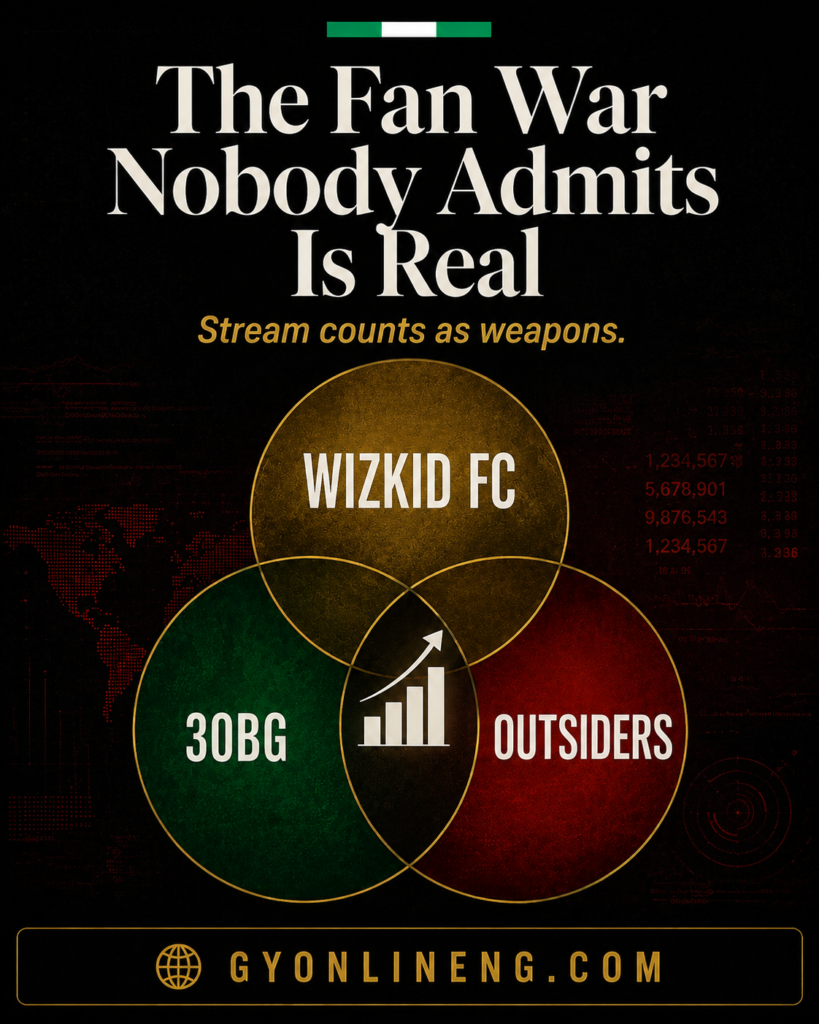
Burna Boy at one point during the fanbase conflicts declared that there is now a “Big 2 and then him,” distancing himself from the Wizkid-Davido rivalry frame entirely. That positioning is partly ego, partly strategy. The Big 3 comparison game runs almost entirely on streaming numbers, chart positions and social media metrics. All of which can be gamed.
There is not enough public evidence to assign fake-stream activity to specific fanbases or artists. What can be said is that highly organised online rivalry creates an environment in which numbers become status symbols and can be treated as weapons in arguments about who is bigger. That makes careful reading of streaming data more important, not less.
What Platforms Are Doing About It
Spotify has publicly described anti-fraud systems designed to identify suspicious streaming patterns and remove confirmed artificial streams. Its published guidance says artificial streams do not earn royalties and can lead to additional account or catalogue consequences. The exact detection signals used in individual cases are not public, so artists should not assume that any single pattern proves fraud.
For an artist who unknowingly used a fraudulent service, this means the stream count on their song can suddenly drop significantly. More seriously, if the platform’s fraud detection links the activity to their account, the consequences can extend to removal from editorial playlisting consideration and in severe cases account termination.
Audiomack, which has deep penetration in the Nigerian market through its free tier, faces a different version of the same problem. Its model of free listening makes it structurally harder to separate bot traffic from genuine listening, and the platform has been slower to implement aggressive fraud detection than Spotify.
Boomplay, which has strong East and West African adoption, has similar challenges. The platforms most used by Nigerian audiences are precisely the ones where detection infrastructure is least developed.
How to Tell a Fake Promotion Service from a Legitimate One
The signals are not subtle once you know what to look for.
A legitimate service should not guarantee a specific stream count. Real marketing reaches an audience, but the audience decides whether to listen, save, follow or ignore the record. A fixed promise of 50,000 streams for a fixed fee is therefore a major warning sign, not proof by itself of exactly how the service operates.
A credible playlist-pitching service should be able to identify the playlists it is pitching, provide available audience and engagement information, and explain its outreach process. If it cannot provide meaningful details, treat that as a warning sign and ask for clarification before paying.
A credible digital advertising service should explain which platforms it will use and provide appropriate reporting, such as access to Meta Ads Manager, TikTok Ads or Google Ads where applicable. If a provider keeps the campaign entirely opaque and reports only stream counts, ask for evidence of the advertising activity before continuing.
Price can be a warning sign, but it is not proof on its own. A campaign promising 100,000 streams for $50 should prompt serious questions about where the plays will come from and whether the service is using artificial activity. Genuine advertising costs vary by market, audience and campaign design, so artists should ask for a clear budget breakdown, access to campaign reporting and an explanation of how listeners will be reached.
What Nigerian Artists Should Actually Do
For emerging artists, the honest path is slower and the numbers look smaller in the short term. Build real listenership through consistent releases, legitimate social media advertising, genuine press coverage, and playlist pitching through credible services.
The Spotify Discovery Mode programme, which allows artists to offer a reduced royalty rate in exchange for algorithmic promotion, is legitimate and worth using for established tracks. Spotify for Artists editorial submission, where you submit unreleased music through your artist dashboard before release, is free and puts your music in front of Spotify’s editorial team for potential playlist consideration.
For the Big 3 conversation specifically, the comparison game built on streaming numbers is not a reliable measure of genuine cultural impact. Wizkid’s 7 billion cumulative Spotify streams, Burna Boy’s Grammy wins, Davido’s 5ive Alive Tour attendance figures. These are all real signals of real achievement. When streaming numbers spike in ways that do not correspond to any real-world activity, they tell you more about the intensity of the fan war than about the actual size of the artist’s audience.
Nigerian music has spent twenty years building the most culturally influential popular music movement in Africa. The artists at the top of that movement have earned their positions through genuine output, genuine tours and genuine fan connection built over years.
Defending those positions with bot farms is not protecting Nigerian music. It is undermining the credibility of the numbers that everyone, artists, labels, streaming platforms and international partners, uses to understand how big this industry actually is.
The fake streams hurt everyone. They hurt the artists who pay for them when platforms catch them. They hurt the legitimate artists whose royalty rates get diluted by fraud. And they make it harder for the industry to have honest conversations about which artists are genuinely the biggest because nobody can fully trust the numbers they are looking at.
The music is real. The audience is real. The numbers should be too.
For related reporting on royalties, distribution and artist strategy, explore our Nigerian music business guides and analysis.