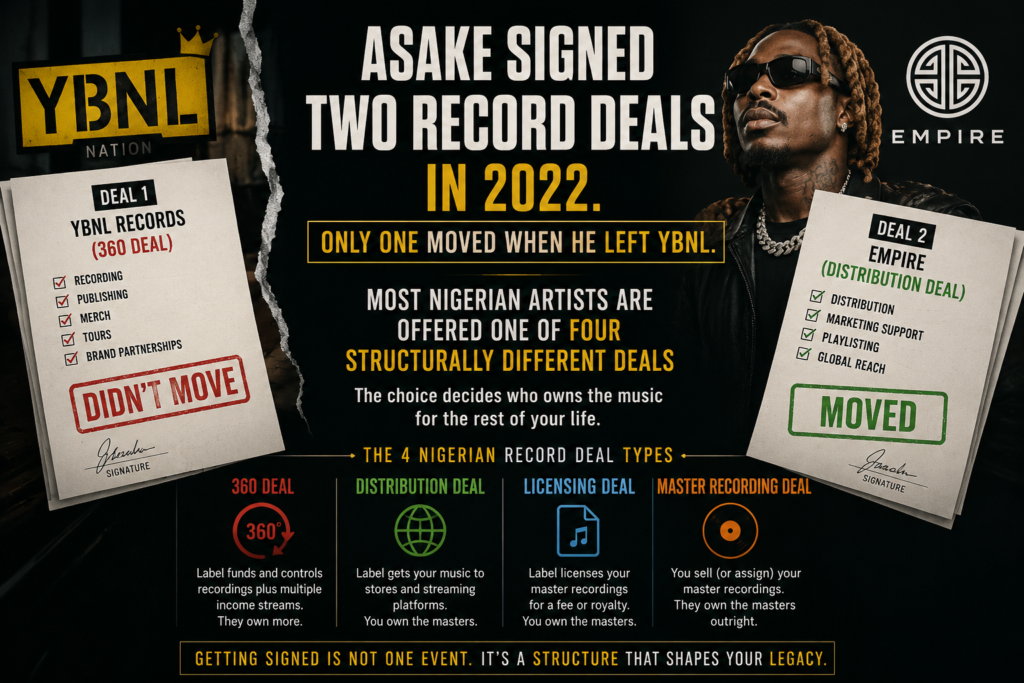
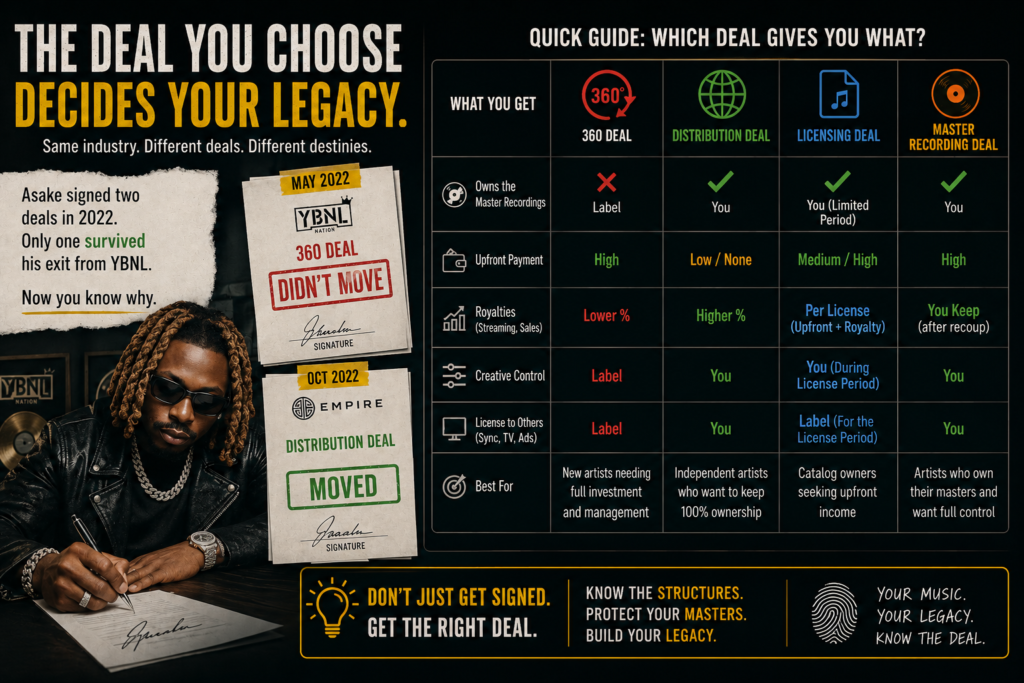
In February 2022, Ahmed Ololade, known professionally as Asake, signed with Olamide‘s YBNL Nation. Five months later, in July 2022, he signed again, this time with EMPIRE, the San Francisco-based distribution company. Most of the coverage at the time treated the second signing as a footnote to the first, a detail folded into the bigger story of YBNL’s new breakout star. In this piece we discussed about the inside knowledge of Nigerian record deal types.
Three years later, when Asake left YBNL Nation to launch his own label, Giran Republic, the EMPIRE deal did not move with him. It did not need to. It had never belonged to YBNL in the first place.
That sequence is the cleanest illustration available of something the Nigerian music conversation gets wrong constantly.
“Getting signed” sounds like one event. It is almost never one event, and the artists who treat it that way are the ones who discover, years later, exactly which piece of paper they should have read more carefully.
The Traditional Deal: The Label Owns What You Made
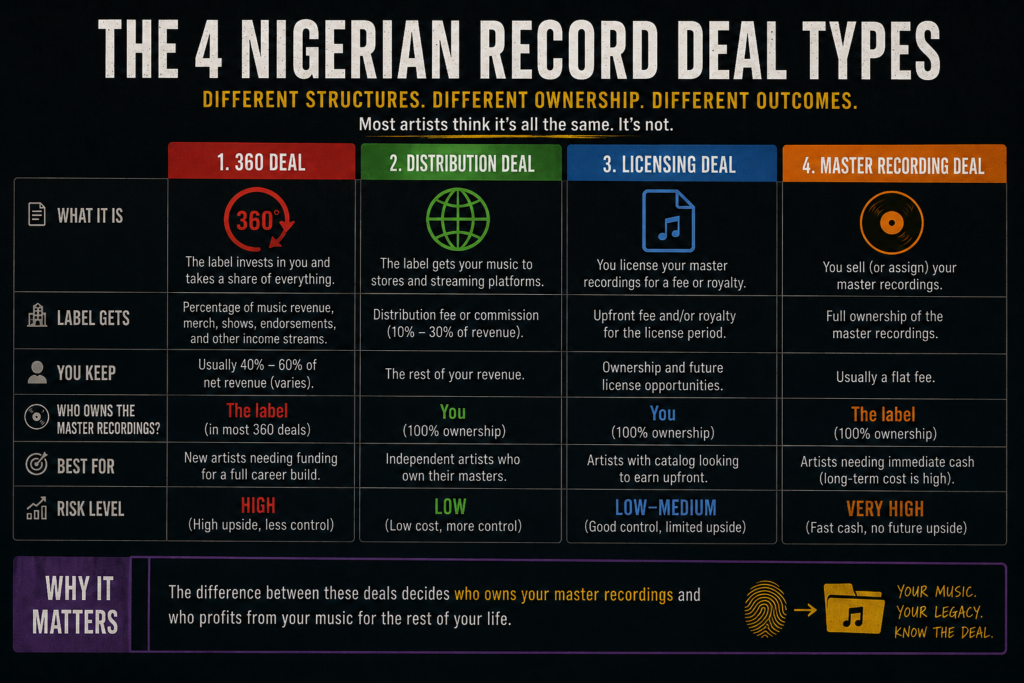
Start with the oldest and most consequential structure. In a traditional label deal, the label pays for recording and marketing, and in exchange it owns the master recordings, usually for the life of the copyright. The artist receives a royalty, commonly somewhere in the range of fifteen to twenty per cent of revenue, but the masters themselves belong to the company that financed them.
Inside Knowledge of Nigerian Record Deal Types
This is the model that built Nigerian music in the nineties and two thousands, before anyone in Lagos was using the word “360.” Labels handed artists an advance, sometimes in cash, sometimes in the form of an apartment, and in return claimed the artist’s output in totality and perpetuity. They recovered that investment through Alaba Market distributors, who paid for the right to press and sell, then made their own money back through CD sales, inflated sales figures, and piracy that nobody fully controlled. It was a crude system, but it was also a clear one: the label owned the work because the label paid for the work.
The same structure still operates at the top of the market today, just with different names attached. International majors including Atlantic Records, Universal Music, and Warner Music have signed Nigerian artists who had already proven themselves at home, and the foundation of those deals is unchanged from the Alaba-era model: the company funds the career, the company owns the master.
The 360 Deal: When the Label Wants Everything Else Too
A 360 deal takes the traditional structure and widens it. The label still owns the masters, but it also claims a percentage of revenue the artist earns outside recorded music: touring, merchandise, endorsements, brand partnerships. As album sales stopped being where the real money lived, labels stopped being satisfied with a cut of album sales alone.
Nigerian labels were arguably running something close to a 360 structure decades before the term reached the country. The advance-for-ownership arrangement of the nineties already extracted value from everything an artist did, not just their recordings, because the label controlled branding, video budgets, and transportation as part of the same package. The label was never just a record company. It was the whole operation.
That instinct has not disappeared. Nigerian distribution companies, the businesses that emerged precisely to offer artists an alternative to full label ownership, are reportedly experimenting with their own 360-style terms now, looking for a better return than a flat distribution fee provides. The structure that artists fled is finding its way back in through the side door.
The Distribution Deal: The One That Outlasts the Relationship
This is the deal that explains Asake‘s two-signature year, and it is the one most often confused with everything above it. In a distribution-only deal, the artist keeps ownership of the masters. The distributor’s job is narrower: get the music onto streaming platforms and into stores, for a fee or a percentage of revenue, without funding the recording and without claiming the composition.
EMPIRE‘s relationship with Asake sits entirely at this layer. It is not a label deal, which is exactly why it had nothing to do with whether he stayed at YBNL Nation. Olamide‘s label itself had its own, separate distribution and publishing arrangement with EMPIRE dating back to 2020, two years before Asake ever joined YBNL. Distribution sits underneath label affiliation, not inside it. An artist can change labels, change managers, even start their own label, and a distribution deal signed years earlier keeps running exactly as written.
The GYOnlineNG piece on Asake’s move to Giran Republic gets into what this actually solved and what it did not. Giran Republic answered the question of who owns Asake’s masters going forward. It did not touch the separate question of who controls the pipeline that turns those masters into money, because that question was never YBNL’s to answer. It belonged to EMPIRE the entire time.
The Licensing Deal: A Lease, Not a Sale
The fourth structure is the one artists most often misunderstand as a weaker version of the traditional deal, when it is closer to its opposite. In a licensing deal, the artist grants a label or distributor the exclusive right to release and promote a recording for a fixed term. Ownership does not transfer permanently. When the license expires, the masters revert to the artist.
This is the structure independent labels increasingly reach for when they want to work with an artist without demanding lifetime ownership in return. It costs the label more certainty, since the relationship has a clock running on it, but it gives the artist something the traditional deal never offers: an end date after which the work is unambiguously theirs again.
Reading Nigeria’s Four Record Deal Types Side by Side
Lay the four next to each other and the real distinction is not how much money each one pays out. It is how long the artist’s name stays attached to ownership of their own work. The traditional deal trades upfront investment for permanent ownership transfer. The 360 deal extends that trade to revenue the label never funded. The distribution deal keeps ownership with the artist from the start and charges only for movement. The licensing deal borrows ownership temporarily and gives it back.
Burna Boy‘s early catalogue ended up in legal limbo for a reason that traces directly back to this confusion: the master-ownership question was never settled with the clarity these four categories demand at the moment of signing. That is not a story about one artist’s bad luck. It is what happens whenever a deal gets treated as a single yes-or-no decision instead of a specific structure with specific, permanent consequences.
Two signatures, five months apart, in the same year, for the same artist. One of them moved when he did. One of them did not. The difference between those two pieces of paper is the only thing worth understanding before anyone in Nigerian music picks up a pen to sign anything.