

In February 2022, Ahmed Ololade, known professionally as Asake, signed with Olamide‘s YBNL Nation. Five months later, in July 2022, he signed again, this time with EMPIRE, the San Francisco-based distribution company. Most of the coverage at the time treated the second signing as a footnote to the first, a detail folded into the bigger story of YBNL’s new breakout star. This guide explains the main Nigerian record deal types and the different roles of labels, distributors and licensing partners.
Three years later, when Asake left YBNL Nation to launch his own label, Giran Republic, the EMPIRE deal did not move with him. It did not need to. It had never belonged to YBNL in the first place.
That sequence is the cleanest illustration available of something the Nigerian music conversation gets wrong constantly.
“Getting signed” sounds like one event. It is almost never one event, and the artists who treat it that way are the ones who discover, years later, exactly which piece of paper they should have read more carefully.
The Traditional Deal: The Label Owns What You Made
In a traditional label deal, the label may fund recording and marketing in exchange for ownership or long-term control of the master recordings. The exact terms depend on the contract; artists may receive royalties, advances and other payments under different accounting rules. A royalty rate in the range of 15–20 per cent is often cited as a broad industry example, not a universal Nigerian standard. The key question is what rights the agreement grants, how revenue is calculated and when the artist is paid.
Inside Knowledge of Nigerian Record Deal Types
In the 1990s and 2000s, record-label arrangements in Nigeria often involved advances or support for recording and promotion in exchange for control over the artist’s recordings. The precise rights varied by agreement, so it is too broad to say every label owned an artist’s output permanently. Physical distributors, including businesses operating through Alaba Market, helped circulate CDs and cassettes; the market also faced widespread piracy and unreliable sales reporting. The contracts and accounting were not always transparent, which could make it difficult for artists to track how their music earned money.
Major international labels still sign Nigerian artists, but the terms vary by artist and deal. Some arrangements involve label funding and master ownership; others use licensing, distribution or services agreements. It is therefore misleading to treat every modern deal as the same model used during the physical-sales era. The rights granted in the contract matter more than the name of the company on the paperwork.
The 360 Deal: When the Label Wants Everything Else Too
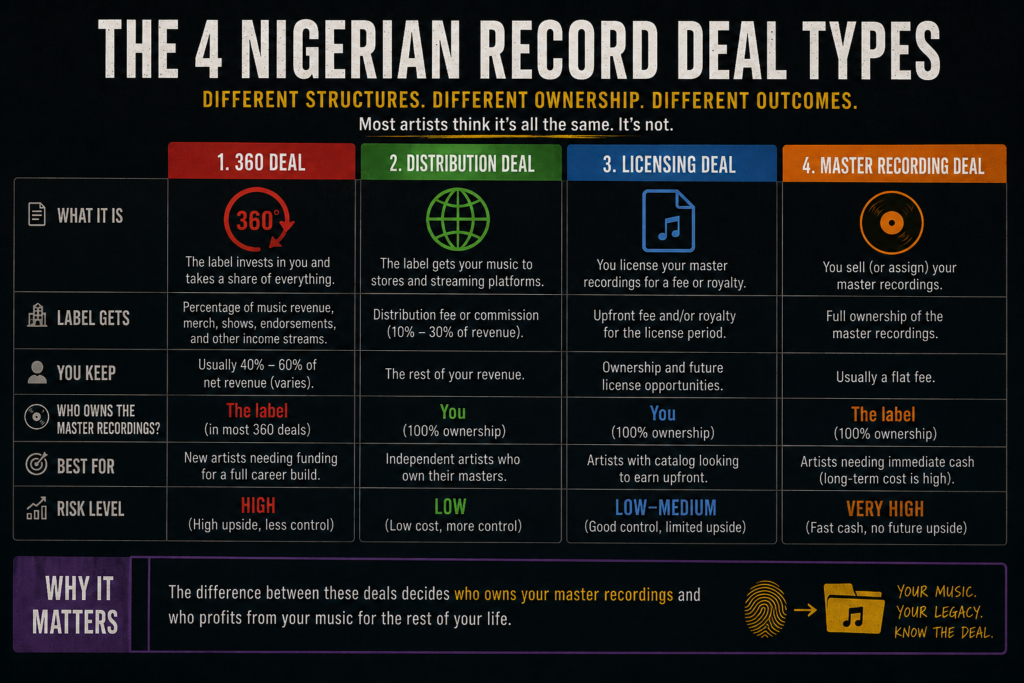
A 360 deal gives a label a share of income from areas beyond recorded music, which may include touring, merchandise, endorsements or brand partnerships. The exact terms vary: a 360 deal does not automatically mean the label owns the masters, and the contract should spell out which income streams are included and what the label provides in return. Labels became more interested in these arrangements as income from physical album sales declined and artists’ businesses expanded into other areas.
Nigerian labels were arguably running something close to a 360 structure decades before the term reached the country. The advance-for-ownership arrangement of the nineties already extracted value from everything an artist did, not just their recordings, because the label controlled branding, video budgets, and transportation as part of the same package. The label was never just a record company. It was the whole operation.
That instinct has not disappeared. Nigerian distribution companies, the businesses that emerged precisely to offer artists an alternative to full label ownership, are reportedly experimenting with their own 360-style terms now, looking for a better return than a flat distribution fee provides. The structure that artists fled is finding its way back in through the side door.
The Distribution Deal: The One That Outlasts the Relationship
This is the deal that helps explain Asake‘s two-signature year, and it is often confused with the arrangements above it. In a distribution-only deal, the artist or label generally retains ownership of the masters while the distributor delivers recordings to streaming platforms and stores in exchange for a fee or share of revenue. But contracts differ, and a distribution agreement can include licensing, marketing, advances or other services. The public announcement of a distribution partnership does not reveal every term.
Public reporting describes EMPIRE‘s relationship with Asake as a distribution partnership, separate from his earlier affiliation with YBNL Nation. The full agreement is not public, so it is not possible to establish every right, obligation or term from the announcement alone. Olamide‘s label also had a separate relationship with EMPIRE dating back to 2020, according to industry reporting. Distribution sits alongside label affiliation, rather than necessarily forming part of it. Whether an agreement continues after an artist changes labels depends on the contract.
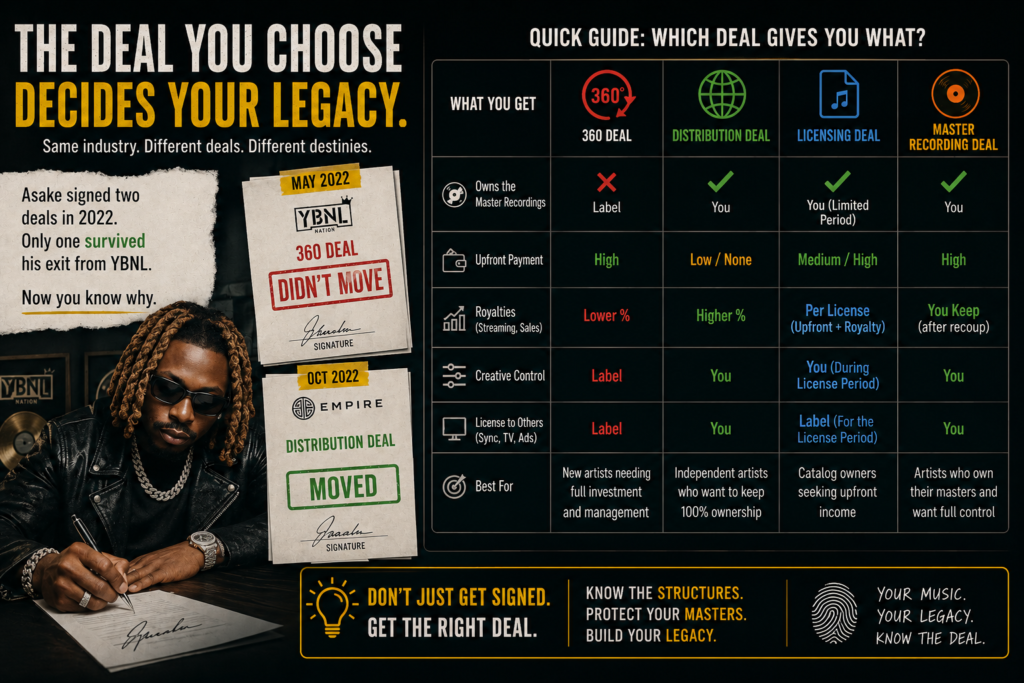
The GYOnlineNG piece on Asake’s move to Giran Republic gets into what this actually solved and what it did not. Giran Republic answered the question of who owns Asake’s masters going forward. It did not touch the separate question of who controls the pipeline that turns those masters into money, because that question was never YBNL’s to answer. It belonged to EMPIRE the entire time.
The Licensing Deal: A Lease, Not a Sale
The fourth structure is the one artists most often misunderstand as a weaker version of the traditional deal, when it can work quite differently. In a licensing deal, an artist or rights holder grants a label or distributor permission to exploit a recording under agreed conditions, often for a defined term. A licence does not necessarily transfer ownership of the master, but its scope, exclusivity, term, renewal and any reversion provisions depend on the contract. Readers should not assume every licence expires on the same schedule or that every agreement uses identical reversion terms.
This is the structure independent labels increasingly reach for when they want to work with an artist without demanding lifetime ownership in return. It costs the label more certainty, since the relationship has a clock running on it, but it gives the artist something the traditional deal never offers: an end date after which the work is unambiguously theirs again.
Reading Nigeria’s Four Record Deal Types Side by Side
Lay the four next to each other and the real distinction is not how much money each one pays out. It is how long the artist’s name stays attached to ownership of their own work. The traditional deal trades upfront investment for permanent ownership transfer. The 360 deal extends that trade to revenue the label never funded. The distribution deal keeps ownership with the artist from the start and charges only for movement. The licensing deal borrows ownership temporarily and gives it back.
Burna Boy‘s early catalogue ended up in legal limbo for a reason that traces directly back to this confusion: the master-ownership question was never settled with the clarity these four categories demand at the moment of signing. That is not a story about one artist’s bad luck. It is what happens whenever a deal gets treated as a single yes-or-no decision instead of a specific structure with specific, permanent consequences.
Two signatures, five months apart, in the same year, for the same artist. One of them moved when he did. One of them did not. The difference between those two pieces of paper is the only thing worth understanding before anyone in Nigerian music picks up a pen to sign anything.
Explore more reporting on ownership, royalties and distribution in our Nigerian music business hub.