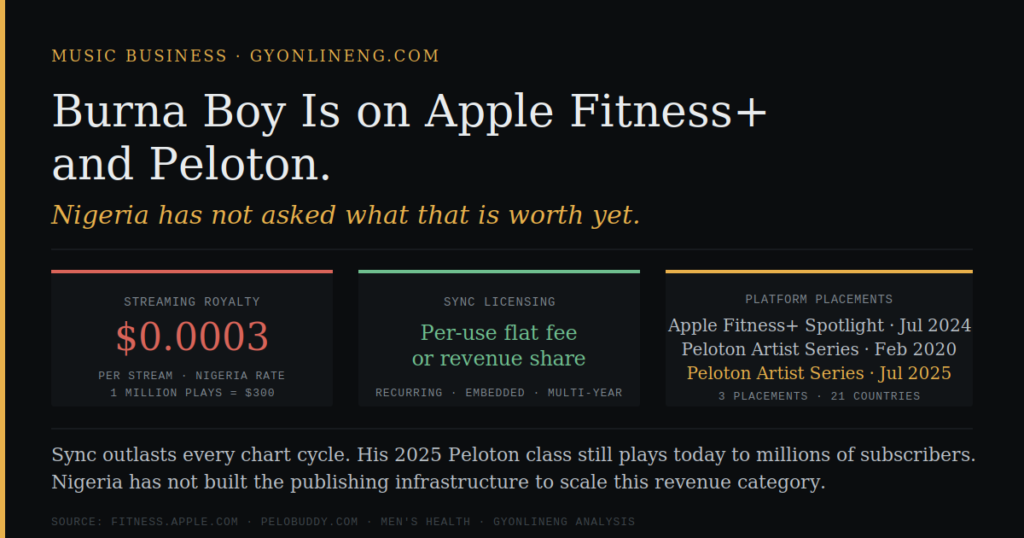
In July 2024, Apple Fitness+ made Burna Boy a spotlight artist. His catalogue was embedded into workout classes delivered to millions of subscribers paying $9.99 per month across 21 countries. Kickboxing trainer Nez Dally, who selected his music for the series, described his sound as “uplifting and never fails to put me in a good mood” — which is precisely the kind of endorsement that fitness platforms pay for in sync licensing arrangements, not the kind that comes with a free press release.
In July 2025, Peloton ran a second dedicated Burna Boy artist series — four classes across cycling, running, and walking — released globally to their on-demand library. The first Peloton Burna Boy series ran in February 2020. His catalogue has now been embedded in two of the world’s most commercially significant fitness platforms twice. This is his second Peloton series and his second Apple Fitness+ spotlight.
The Nigerian music business conversation has not asked what either of those placements is worth. That is the question this article is asking.
What Apple Fitness+ and Peloton Actually Pay For
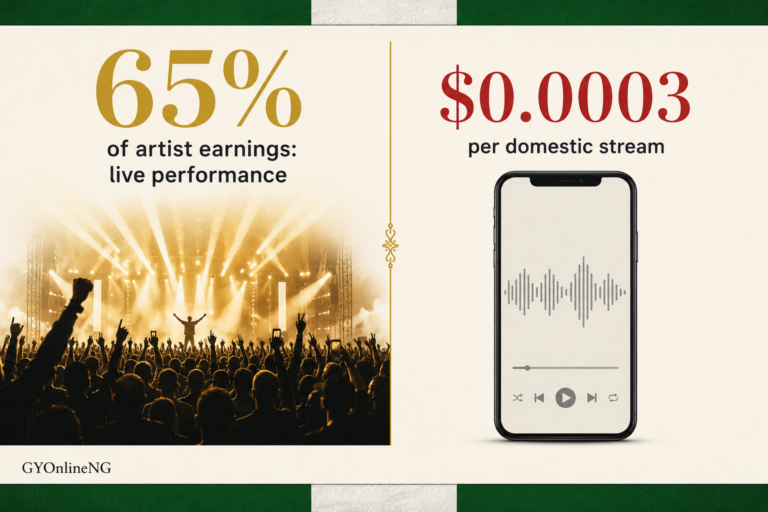
Streaming royalties and sync licensing are different revenue categories with meaningfully different economics. When Burna Boy’s music plays on Spotify, he earns a fraction of a cent per stream — the same rate that has made streaming the central economic problem of the Nigerian music industry, where 30.3 billion domestic streams generated approximately $300 per million plays at the 2025 naira conversion rate.
Sync licensing is not calculated per play. When a platform embeds an artist’s catalogue into a class that will be taken repeatedly by subscribers over months or years, the licensing structure is based on the underlying agreement between the platform and the rights holder — typically a flat fee, a revenue share, or a combination of both, negotiated against projected usage volume. The exact terms of Burna Boy’s Apple Fitness+ and Peloton agreements are not public. What is public is the category of revenue: it is sync, not stream, and sync rates per use are substantially higher than streaming royalty rates across every major licensing market.
Beyond the direct licensing revenue, the placement creates something that streaming charts do not: embedded recurring exposure. A Peloton class featuring Burna Boy’s music does not expire when the chart cycle moves on. A subscriber who discovers his catalogue through a July 2025 cycling class may play it for the next three years. Apple Fitness+ classes similarly remain in on-demand libraries indefinitely. The chart position is a moment. The fitness platform placement is infrastructure.
How Burna Boy Trains — and Why It Connects to This
The fitness platform placement is not a coincidence. It follows from what Burna Boy has built physically and how he has positioned that publicly.
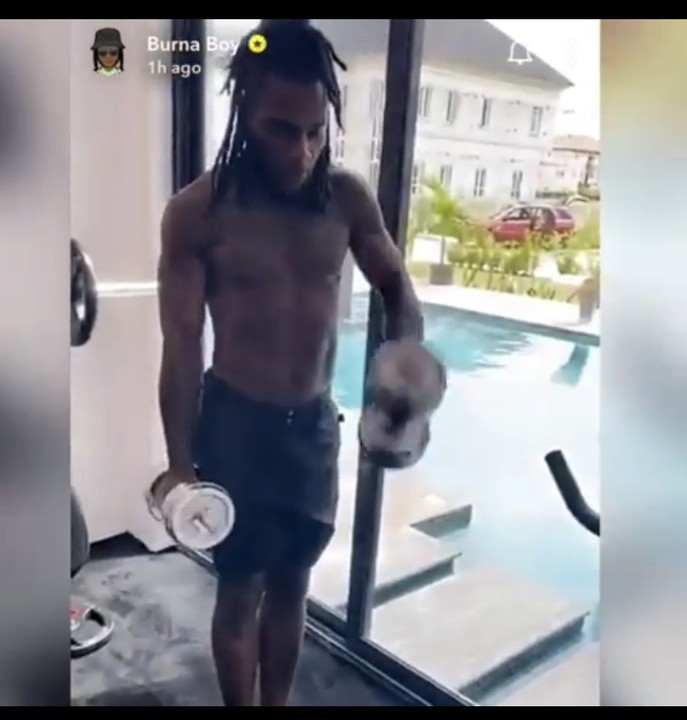
His primary training discipline is boxing. His Lagos training base is Pure Fitness Africa in the Lekki corridor, founded by fitness coach Ekemini Ekerette, known publicly as KemenFitness. In April 2026, he was photographed with Super Eagles veteran Odion Ighalo at a social gathering in their shared Lekki estate — the moment went viral because two of Nigeria’s biggest global exports had apparently lived in the same compound for years without meeting.
What the coverage missed is the more interesting data point: Burna Boy’s physical peer group in Lagos includes a professional athlete who spent the majority of his career in top-tier European football and the Saudi Pro League. That is not a casual social circle. It reflects a seriousness about physical conditioning that tracks with what his stage output demands.
His diet was covered by Men’s Health Magazine in November 2021 — pounded yam, crab cakes, lobster, plantains, and daily water intake as the foundation. The Nigerian and West African dietary base he maintains is the substance behind the “West African Diet Is the Healthiest Cheat Day” framing Men’s Health applied to the feature. The specific point is that his diet is not the imported protein-shake-and-chicken-breast template that Western fitness culture defaults to. It is rooted in Nigerian food tradition, and Men’s Health, one of the world’s most widely read fitness publications, found it significant enough to profile in detail.
Apple Fitness+ does not feature artists arbitrarily. The Burna Boy spotlight page describes him as having “impossibly catchy” music that “infiltrated every corner of mainstream music” — but the placement itself reflects an editorial judgment that his brand and his catalogue are compatible with the fitness and wellness identity Apple Fitness+ is selling to its subscriber base. That judgment is only available to an artist who has built a physical and cultural profile that fits that context. The placement is the output. The years of training and the public positioning of his body and diet are part of the input.
The Revenue Category Nigeria Keeps Missing
The Nigerian music business conversation operates almost entirely within two revenue categories: streaming and live performance. The structural analysis of Afrobeats’ Q1 2026 economics confirms what has been the case for years: streaming generates cultural credibility, live performance generates most of the money, and the gap between the two reflects infrastructure deficits on the domestic side that the global streaming rate cannot compensate for.
Sync licensing — placing music in films, advertising, television, games, and increasingly fitness platforms — is the third category that Nigerian music has been building without the industry building formal frameworks around it. Burna Boy’s Peloton series and Apple Fitness+ spotlight are sync deals. Tems’ placement in Marvel’s Black Panther: Wakanda Forever was a sync deal. Wizkid’s catalogue appearing in international advertising campaigns are sync deals. Each one generates revenue at a rate-per-use that streaming cannot match, and each one expands the catalogue’s reach into audiences that Afrobeats radio and streaming charts do not touch.
A Peloton subscriber in Berlin who discovers Burna Boy through a July 2025 running class is a listener the streaming algorithm may never have surfaced to. A corporate wellness programme in Tokyo that licenses his catalogue for employee workout sessions is a revenue stream that does not appear on any chart. Fitness platform sync is not a niche opportunity. It is a category that the most commercially successful Afrobeats acts are already accessing, quietly, without the industry building the publishing and licensing infrastructure to scale it.
The specific business question the Nigerian music industry has not asked is this: which Afrobeats catalogues are positioned for fitness platform sync, who is negotiating those deals, what is the licensing infrastructure behind them, and are the artists capturing the full value of placements that their physical brand and musical energy make them natural fits for? Burna Boy’s second Peloton series in 2025 is evidence that the market for this exists and is repeating. The industry’s silence on its economics is not evidence that the money is small.
The Body as Business Infrastructure
This is the point the celebrity fitness coverage always stops short of making, so it is worth stating directly: a touring artist’s physical condition is not a lifestyle choice or a personal matter. It is business infrastructure. It determines stage longevity, it influences brand partnership value, it affects what categories of sync licensing a catalogue is attractive for, and it dictates whether an artist can sustain the touring frequency that the global live performance market now requires.
Burna Boy’s fitness platform placements, his Men’s Health diet profile, his boxing training, his Lagos gym base, his physical peer group — these are not separate facts. They are components of the same asset. His body is part of the reason Apple and Peloton came to him twice. The music is the primary reason. The physical brand is the complementary reason that made the fitness context specifically feel right to the platforms making the editorial decision.
Nigerian artists at the global performance level are now operating physical preparation programmes comparable to professional athletes — without the sports science support structures that professional athletes have access to. The supplement question that follows every fitness story about a Nigerian artist is usually answered by whoever is sponsoring the endorsement deal at the moment. The independent alternative tested products, real protocols, published results regardless of outcome is what FormulaTested.com does. For a reader who wants the data rather than the endorsement narrative, the reviews are there.
The wider industry point is not about supplements specifically. It is that the physical dimension of an Afrobeats career at international level has commercial value that the Nigerian entertainment business is not yet measuring, not yet developing formal infrastructure around, and not yet treating as the asset it demonstrably is. Two Peloton series and an Apple Fitness+ spotlight are the evidence. The industry’s response to that evidence should be more than admiration.