
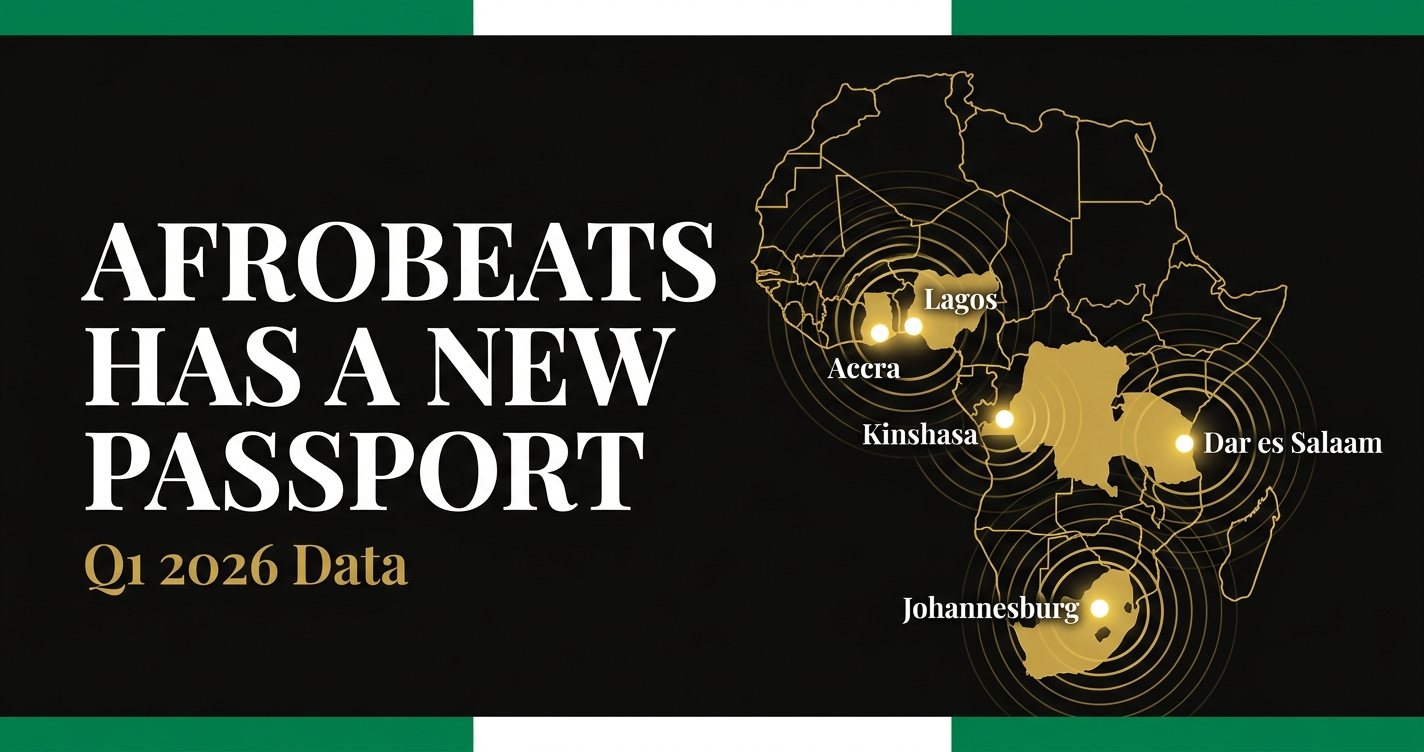
Afrobeats grew into a global genre through Nigerian artists, scenes and sounds, drawing on Afropop, highlife and the wider musical legacy of Fela Anikulapo-Kuti‘s Afrobeat. Artists including Davido Adeleke, Wizkid Balogun and Damini Ogulu, known as Burna Boy, helped carry it to audiences abroad. Nigeria remains central to that history, but a genre’s origin and the nationalities of its current leading artists are not the same thing.
The Afrobeats Q1 2026 Power Rankings, tracked monthly by NotJustOk from January through April, complicate that origin story. The rankings include artists from across the continent, not only Nigeria, and suggest that the audience and commercial conversation around Afrobeats is increasingly pan-African. One quarterly ranking cannot establish the full scale or timing of that shift, but it offers a useful snapshot of a scene whose leading names and audiences cross national borders.
What Tems’ Consistency Actually Shows
Start with the person who did not move, because in a quarter defined by dramatic swings, the fixed point matters most.
Temilade Openiyi, known as Tems, was inside the Top 3 for all four months of Q1. January at number three, February at number one, march at number two, April at number three. While every other name in the upper reaches of the rankings rose and fell with individual release cycles, she held. The Q1 streaming data published alongside the rankings confirmed it from a separate direction: Tems led all African artists with over 1.02 billion streams across the first four months of 2026.
| Artist / signal | Q1 2026 evidence described |
|---|---|
| Tems | Top 3 in all four months; over 1.02 billion streams in the first four months. |
| Omah Lay | Moved from ninth in January to first in April. |
| Mavo | Reached number one in March and sixth in April. |
| Tyla | Reached number two in April; identified as a South African artist. |
Tems remained in the rankings’ top three throughout the four-month period and also led the separate streaming measure cited in the report. That is stronger evidence of sustained performance than a single chart appearance, although the rankings and streaming figures measure different things.

The Two Breakout Stories
Stanley Omah Didia, known as Omah Lay, provides the quarter’s clearest narrative arc. He entered January at ninth. Fell back to ninth in March after a February at fourth. In a different story, that dip would have been written as a ceiling. It was a runway. His album CLARITY OF MIND had been building pressure under the surface. April: number one. The movement from ninth to first, with a stumble in between that turned out to be a recalibration, is the kind of trajectory that only makes sense looking backward.
Mavo was the quarter’s other useful surprise. He moved from 14th in January to 13th in February, reached number one in March and finished sixth in April. A four-month snapshot cannot tell us whether that run becomes a long career, but it does show that the upper end of the genre is still capable of producing a new name quickly.
What the Numbers Say About Women in the Top 10
By April 2026, three women occupied the Top 10 simultaneously. That had not happened before in the rankings’ history.
Ayra Starr was among the women contributing to the stronger female presence in the rankings. Tyla Seethal, the South African artist, climbed to number two in April; the article’s cited streaming figures also put her at 755 million streams across the first four months of 2026. Moliy maintained Top 10 visibility across the quarter. Alongside Tems, these artists helped make the female presence in the rankings more substantial, though the precise share should be checked against the full monthly tables rather than inferred from a few individual placements.
The presence of three women in the April Top 10 is notable, but one quarter of rankings is not enough on its own to establish a lasting structural change. It does provide a concrete basis for asking whether the visibility reflected in streaming and chart positions is matched by booking opportunities, headline slots and label investment.
The question the Nigerian music industry should now be asking is not whether female artists have arrived in Afrobeats. That question was already answered by the numbers. The question is whether booking fees, headline slots, and label budgets are catching up to what the streaming data has been saying for two consecutive quarters. In our Afrobeats and the Grammy problem analysis, we argued that recognition follows infrastructure. That argument applies here.

The Ranking Is No Longer Nigeria-Only
Tyla Seethal is from South Africa. She is a Johannesburg artist, she peaked at number two in April.
François Honoré Luambo Makiadi, known as Fally Ipupa, is from Kinshasa in the Democratic Republic of Congo. He debuted at fourth in April, riding the momentum from his feature on Wizkid Balogun’s REAL Vol 1 collaboration with Ahmed Ololade, known as Asake.
Diamond Platnumz Nassib climbed steadily into the upper Top 15. Zuhura Othman, known as Zuchu, maintained visibility across the quarter. These artists are not footnotes in a Nigerian story. They are principals in an African one.
The bigger change is geographic. Artists from Dar es Salaam, Kinshasa and Johannesburg are no longer being treated as side stories in a Nigerian genre. They are part of the main ranking. The music started with a Nigerian centre, but the market around it has become much wider.
That does not make Afrobeats less Nigerian. It means the commercial category has outgrown the country that gave it its strongest early identity.
What Happened to the Established Names
The Q1 data records its tension points too. Wizkid Balogun‘s 696 million Q1 streams placed him third among the most-streamed Afrobeats artists, and his power ranking arc January at one, April at five tells the story of a catalogue-deep superstar coexisting with a generation that grew up on his music. That is not decline. That is the natural physics of a crowded room where everyone has grown taller.
Davido Adeleke drifted from 13th in January to 17th in April. CKay, whose Love Nwantiti rewrote what an Afrobeats song could reach globally, finished April at 29th a position we examined separately in our CKay African Girls piece. Shallipopi moved from 22nd to 34th. Legacy, the Q1 data confirms, is not a seat. It is something you have to keep earning.
FOLA, Kidd Carter, Famous Pluto, and the Abuja-based artist 6uff are all gaining ground. Mavo already reached the top. The new names are not waiting.

What the Quarter Actually Means
Read month by month, the rankings are a list of winners and losers. Read across the quarter, they show a market becoming harder to describe as one country’s chart.
Afrobeats grew by making Nigeria legible to the world. The language, the rhythms, the cultural texture all of it came from a specific geography and turned that specificity into a global asset. The story that built the genre was a Nigerian story.
That expansion is the logical consequence of a genre becoming commercially useful outside its original market. Tyla and Fally Ipupa do not need to displace Nigerian artists to matter; their presence shows that the category now has enough reach to support artists with different national identities.
Nigeria built the sound, it no longer owns the map. That is what success looks like when it matures beyond its origin. The most dangerous position for Nigerian artists, and for the industry that supports them, is to stand still in 2026 and call it loyalty to where the music came from.
The rankings offer a snapshot of a genre whose commercial audience increasingly crosses national borders. The next question is whether the industry’s investment and infrastructure reflect that wider market.