
The headline sounds bigger than the market actually is: Nollywood is ahead of Hollywood at the Nigerian box office.
That would have been hard to write in 2019. Hollywood took roughly 70 percent of Nigerian box-office revenue that year. By 2025 the split was about even. In the first half of 2026, local films moved in front.
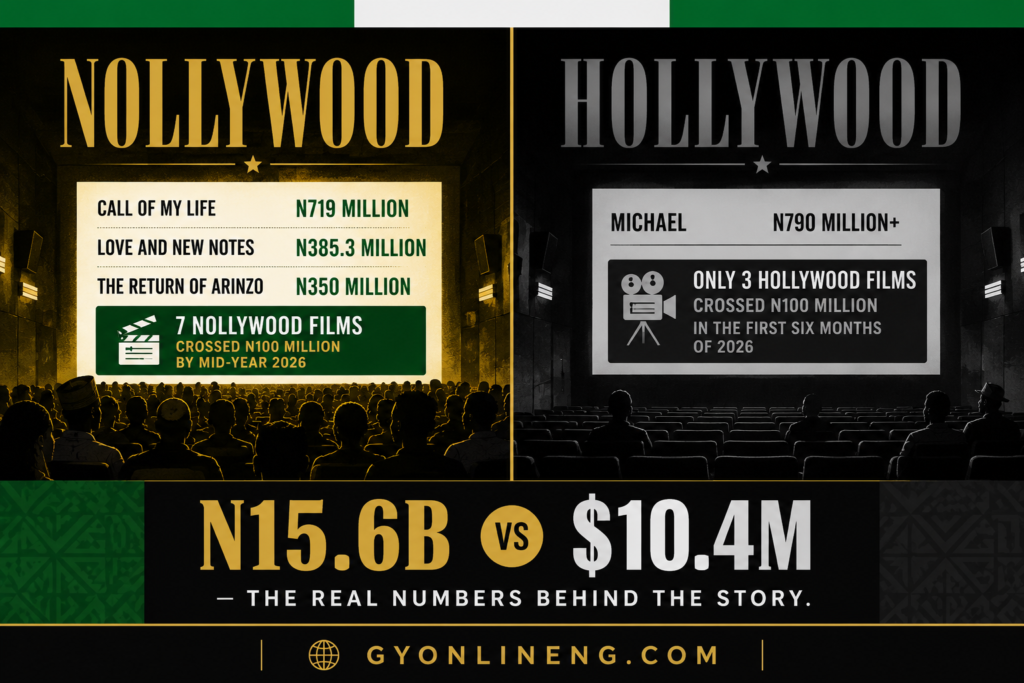
The names are telling. Call of My Life generated N719 million. Love and New Notes reached N385.3 million. The Return of Arinzo took N350 million. On the Hollywood side, Michael was the clear standout at roughly N790 million. Seven Nollywood films had already crossed N100 million by mid-year; only three Hollywood titles had done the same.
There is another number that matters more than the headline. Nigeria recorded 752,136 cinema admissions in Q1 2026, the strongest first quarter in six years. The market reached N8.8 billion in the first half of the year.
So yes, this is a milestone. But it is not a victory lap. The interesting question is what kind of market produces these numbers — and what the numbers are hiding.
Nigeria Cinema Data: The Core Market Trend
For the underlying revenue, admissions and average-ticket series, see GYOnlineNG’s Nigeria cinema data reference. It keeps the market figures, definitions and scope together so the headline box-office story can be read against the underlying measurements.
| Year | Gross box office | Paid admissions | Average ticket price |
|---|---|---|---|
| 2021 | ₦5.00bn | 3,305,511 | ₦1,512 |
| 2022 | ₦6.90bn | 3,190,249 | ₦2,163 |
| 2023 | ₦7.36bn | 2,604,408 | ₦2,825 |
| 2024 | ₦11.58bn | 2,668,146 | ₦4,341 |
| 2025 | ₦15.64bn | 2,795,276 | ₦5,596 |
How the Market Changed
Look past the 2026 headline and the shape of the recovery is fairly clear. The market fell hard during the pandemic, then came back with a mix of higher ticket prices, stronger local titles and a smaller but more valuable cinema audience.
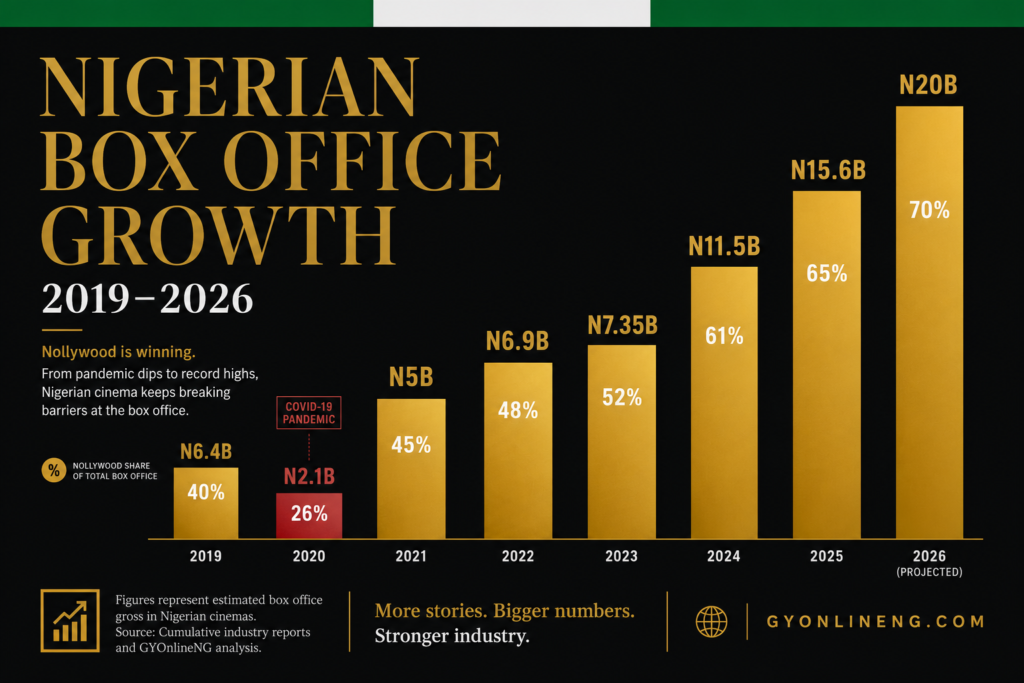
In 2019, the total West African box office gross was N6.4 billion. The average cinema ticket cost N1,238. Nollywood held a minority position in its own domestic market. Cinema admissions, the actual number of people buying tickets, stood at a baseline that the COVID-19 pandemic would nearly destroy the following year.
By 2020 the market collapsed to N2.1 billion as cinemas closed across Nigeria and the world. The recovery began in 2021 at N5 billion, grew to N6.9 billion in 2022, then N7.35 billion in 2023. In 2025 the market hit N15.6 billion, more than double the pre-pandemic peak in six years.
The 2025 Nigeria Box Office Yearbook published by FilmOne Entertainment shows the market recorded 2.79 million admissions across 248 new releases screened in 122 cinemas spanning Nigeria, Ghana and Liberia.
The average ticket price in 2025 was N5,596. In 2019 it was N1,450. That is a 286 percent increase in six years. During that same period the naira lost more than 70 percent of its value against the dollar. Nigerian audiences are paying significantly more in real terms for a cinema ticket than they were in 2019. And they are still coming.
The rise in ticket prices is one possible part of the explanation, alongside the performance of local releases and changes in audience habits. The figures show the market has grown in nominal naira terms, but they do not by themselves tell us how much of that growth comes from higher prices rather than more people attending.
What the Audience Is Actually Telling the Industry
Naz Onuzo, co-founder of Inkblot Productions, put the context plainly on X:
“Nollywood attendance is higher now than it was in 2019. Hollywood ticket sales have fallen by almost two thirds in the same period. Nigerians have significantly reduced their watching of Hollywood in cinemas post-COVID.”
The framing matters. Nollywood has improved, but that is only half of the story. Hollywood has also become less dominant in Nigerian cinemas, while local films have become better at making the theatrical experience feel recognisably Nigerian.
The titles that led the 2025 box office tell the story by example. Behind The Scenes, directed byFunke Akindele and produced by Tunde Olaoye generated N2 billion. Everybody Loves Jenifa, Funke Akindele‘s franchise extension, drew massive audiences. Oversabi Aunty by Toyin Abraham demonstrated strong audience loyalty with Timini Egbuson in the lead role. None of these films were made for an international market. They were made for the specific emotional and cultural vocabulary of Nigerian urban and semi-urban audiences: the Lagos experience, the family dynamics, the social class comedy, the romantic comedy built around characters who look and sound like the people buying the tickets.
Hollywood’s best 2026 entries, Michael at N790 million, Mortal Kombat II at N215.7 million and The Devil Wears Prada II at N168.7 million, were global titles with existing international audiences. They performed, but they did not dominate the Nigerian market in the period covered here. The figures are consistent with a stronger local position, although they do not by themselves prove a permanent shift in audience loyalty.
There is also a practical reason the theatrical format can work for local releases: the communal cinema experience — going with family, watching with a crowd that reacts to the same cultural reference at the same moment — is easy for a Nigerian film to build around. The box-office figures suggest that this kind of local relevance is commercially useful, even though they cannot isolate it as the only cause of the difference.
The Infrastructure Ceiling Nobody Is Celebrating
This is where the headline starts to lose some of its shine.
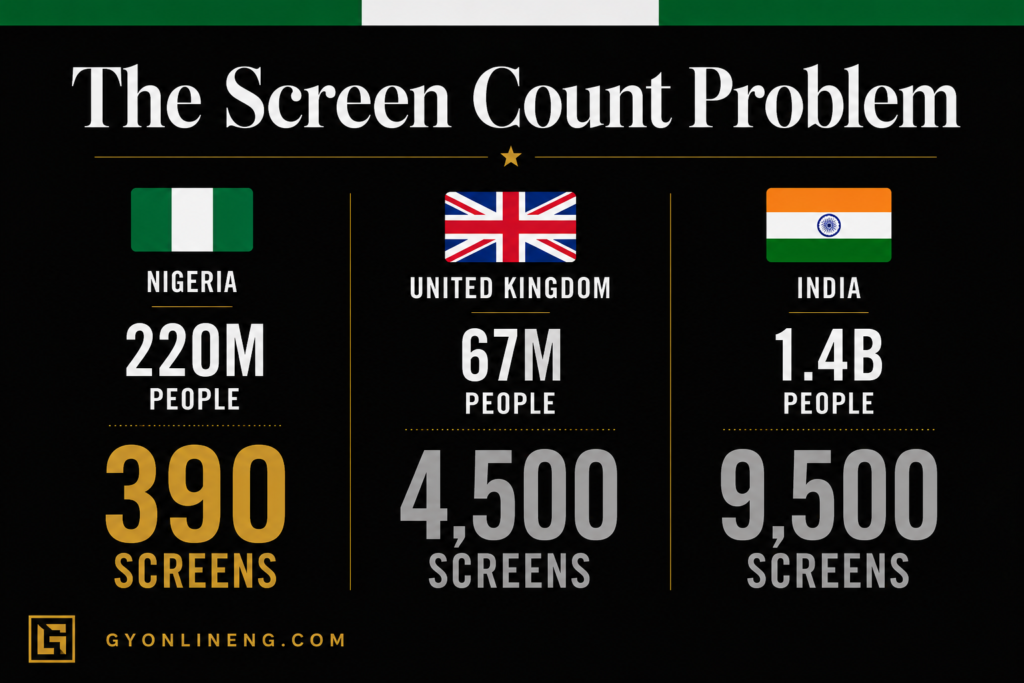
Nigeria had 369 cinema screens in 2025. By 2026 that figure is projected to reach 390. For a country of 220 million people, 390 screens is not a cinema industry. It is a cinema industry’s beginning.
The United Kingdom, with a population of 67 million, has approximately 4,500 screens. India, with a population roughly six times Nigeria’s, has over 9,500 screens. Even South Africa, whose music market is larger than Nigeria’s on a per capita basis, has significantly higher screen density relative to population.
Audience growth is forecast to remain modest. Overall cinema admissions are projected to rise from 2.6 million in 2023 to 2.95 million in 2026. That is approximately 2.95 million people watching films in Nigerian cinemas across an entire year, in a country of 220 million people.
The arithmetic points to a constraint. Nollywood cannot keep expanding theatrical revenue at the same pace if the physical infrastructure reaches only a small share of the potential audience. The projected 2.95 million admissions for 2026 equal roughly 1.3 percent of Nigeria’s population when admissions are divided by the population estimate. This is only a scale comparison, not a measure of unique people: one person can account for several admissions. The figures nevertheless point to a limited theatrical footprint relative to the country’s population, with access shaped by cinema locations, screen capacity and what households can afford.
The expansion pace of cinema sites is slowing as rising operating costs, currency pressures and competition from alternative entertainment options reshape investment priorities. Operators are adding screens incrementally rather than aggressively. The economics of building and running a cinema in Nigeria: generator costs, import costs on projection equipment, security costs, staffing costs. These have become significantly more expensive as the naira has depreciated. The same economic pressure that is driving Nigerian audiences toward Nollywood productions is making it harder to build the infrastructure that would allow Nollywood to serve a larger version of that audience.
The Ticket Price Paradox
The box office revenue growth and the ticket price increase are not the same story even though they happen simultaneously.
When the average cinema ticket costs N5,596, the ticket can still be a significant discretionary expense for households dealing with higher living and transport costs. The dollar conversion is useful for international comparison, but it does not tell us whether the ticket is affordable to the Nigerian household making the purchase.
The audience that can regularly afford N5,596 cinema tickets is already the audience that Nigerian cinemas have. Expanding the market to include the broader Nigerian population, the students, the working class families, the residents of cities without cinema infrastructure, requires either lower ticket prices, which the economics of the current infrastructure do not support, or more cinemas closer to where people actually live, which the economics of construction and operation do not currently incentivise.
This is why the admission numbers are growing modestly while the revenue numbers are growing sharply. More expensive tickets bought by roughly the same population of cinema-going Nigerians produces revenue growth without audience growth. Sustainable in the short term. Not a growing market in the structural sense.
What FilmOne Built and Why It Matters
FilmOne Entertainment emerged as the highest-grossing distributor in 2025, led by Behind The Scenes at N2 billion. In 2026 FilmOne has continued to distribute the majority of major theatrical releases including Call of My Life and Love and New Notes.
FilmOne’s position is one of the reasons this market is difficult to read from box-office headlines alone. It is not simply a distributor. It sits close to the distribution network, the exhibition data and the yearbook that much of the sector relies on. That gives it unusual visibility into the market — and raises reasonable questions about concentration.
FilmOne’s annual yearbook is the primary data source for every box office analysis published in Nigeria, including this one. The Cinema Exhibitors Association of Nigeria, known as CEAN, data flows through FilmOne’s reporting infrastructure. The weekly box office numbers that industry observers track come from FilmOne’s tracking systems.
That level of infrastructure ownership is both Nollywood’s greatest current asset and a structural concentration risk. A distribution sector that runs through one primary infrastructure provider is not a competitive market. It is a dependency. The independent producers who need FilmOne’s distribution network to reach the 122 cinemas in the West African market do not negotiate with FilmOne from equal positions. They negotiate as suppliers to the primary infrastructure owner of their distribution chain, not as equals.
The parallel to how EMPIRE and Universal control 68 percent of Nigerian music streaming distribution is not coincidental. Both industries built their content on strong creative foundations and then allowed the distribution infrastructure layer to concentrate in ways that give a small number of players structural leverage over the broader ecosystem.
The Comparison That Reveals the Real Gap
The ₦15.6 billion total box office in 2025 translates to roughly US$10.7 million using the exchange rate presented in FilmOne’s 2025 yearbook.
Hollywood’s global box office is measured on a much larger scale, but a direct comparison needs care: the markets differ in screen availability, ticket prices, currency conditions and reporting scope. The useful point is not that the two industries are equivalent, but that Nigeria’s growing local share is being achieved within a comparatively small theatrical market.
The point is not to talk Nollywood’s achievement down. It is to put it in the right frame. Beating Hollywood in Nigeria tells us something important about audience preference. It does not mean the Nigerian theatrical market is suddenly large by global standards.
India’s Bollywood generates approximately $2.5 billion annually from domestic theatrical revenue alone. South Korea’s film industry generates over $1 billion. Nigeria’s film industry, producing more than 2,500 films annually and delivering one of the most culturally resonant cinema experiences in Africa, generates $10 million.
The screen count explains most of the gap. The rest is explained by pricing power constrained by purchasing power, infrastructure investment constrained by currency risk, and market access constrained by geography.
What Comes After the Milestone
The N20 billion total gross that 2026 is projected to achieve will be celebrated as another milestone for Nollywood. It will be worth celebrating. The trajectory from N6.4 billion in 2019 to N20 billion in 2026, from a market where Hollywood dominated to one where Nollywood leads. That is a genuine industry achievement that reflects years of investment in production quality, marketing sophistication and audience development.
The questions that follow the milestone matter more than the milestone itself.
How does Nollywood convert box office success in 122 cinemas into a market that reaches the 218 million Nigerians who do not go to those cinemas? How does the industry fund the screen expansion that would make the audience growth currently missing from the revenue growth? How does the downstream streaming and licensing market develop to capture the full value of theatrical hits rather than losing them to piracy weeks after release?
And critically, as Hollywood pulls back from Nigerian cinema, who fills the gap in production funding, international distribution relationships and technical expertise that American studios brought alongside their films? The vacuum Hollywood is leaving is not only a market share opportunity. It is an infrastructure challenge that the domestic industry has not yet addressed directly.
Nollywood is beating Hollywood at the Nigerian box office in 2026. That sentence is true and it matters. The industry that delivers that result is still operating on screens that reach 1.3 percent of the population it serves, at ticket prices that concentrate its audience in the middle class, through distribution infrastructure that routes through a single primary provider, in a market whose total annual revenue would not cover the production budget of a mid-tier Hollywood franchise.
The milestone is real. The work that follows it is the actual story.