
Tems has multiple routes to recognition at the 2027 Grammy Awards, but the number of categories in which her music has reportedly been submitted tells only part of the story. Her prospects will depend on the strength of each recording, the competition it faces and how Recording Academy voters respond to the work.
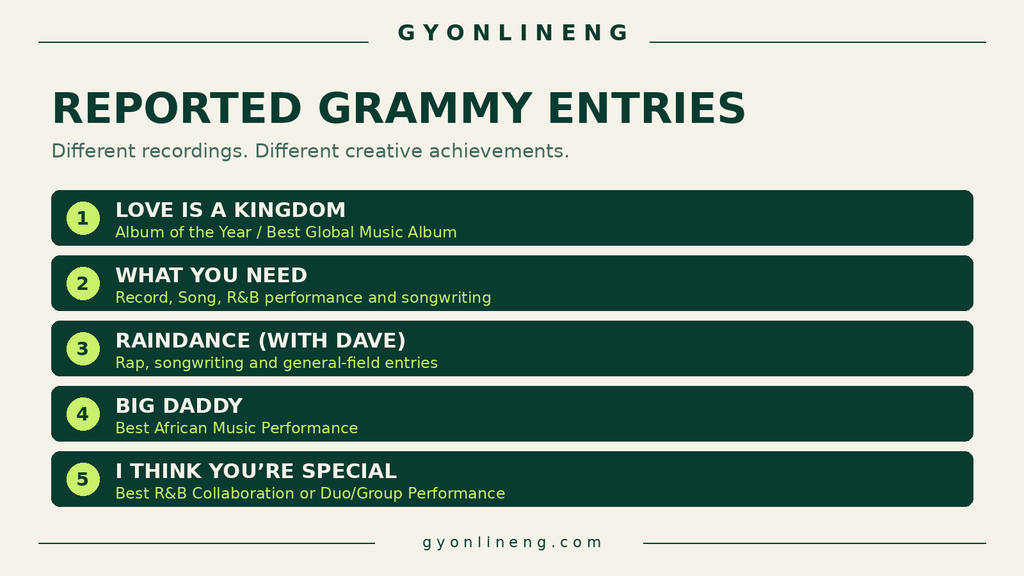
According to Premium Times, Tems has reportedly entered Love Is a Kingdom for Album of the Year and Best Global Music Album, alongside entries for several individual songs, including “What You Need,” “Raindance” with Dave, “Big Daddy” and “I Think You’re Special” featuring Justin Bieber. These reported submissions cover a range of categories, from R&B and rap to the general field.
That breadth creates opportunities, but it is not evidence of impending success. The submissions must pass through the Academy’s eligibility and voting processes before the official nominations are announced. The 2027 Grammy nominations are scheduled to be announced on 16 November 2026.
For Tems, the more useful question is not how many awards she could win, but which submissions make the strongest cases for recognition.
The Album Question: Can Love Is a Kingdom Cross Over?
Tems’ reported submissions for Album of the Year and Best Global Music Album place Love Is a Kingdom in two different competitive environments.
Album of the Year is one of the Grammys’ most visible awards. It brings together projects from across genres, meaning an album must compete beyond the audience and traditions associated with its primary sound. Artistic execution, songwriting, production and the overall listening experience all matter.
Pitchfork’s September 2026 editorial selections identified Geese’s Getting Killed, Olivia Dean’s The Art of Loving, Rosalía’s LUX, Olivia Rodrigo’s You Seem Pretty Sad for a Girl So in Love, Phoebe Bridgers’ Lost Weekend, Madonna’s Confessions II and Mavis Staples’ Sad and Beautiful World as potential Album of the Year contenders. These are editorial predictions, not confirmed nominations.
The list illustrates the breadth of the potential competition. The projects represent different musical traditions and artistic approaches. Tems would need Love Is a Kingdom to make a convincing case within that wider field rather than rely solely on her international profile.
However, the available predictions do not establish that these albums will be nominated or that any one of them is stronger than Tems’ project. A meaningful comparison would require closer examination of the albums themselves, their critical reception and their artistic achievements.
Best Global Music Album offers a different test. Rather than competing across the entire musical landscape, the project would be assessed within a category designed to recognise music from global traditions.
Tems may also face competition from other Nigerian artists whose submissions have been reported. Premium Times reports that Davido entered Oriadé, Asake entered M$NEY and Ayra Starr entered Starrgirl for consideration in the category.
These projects provide relevant regional comparisons, but their presence alone does not establish which album has the strongest prospects. The assessment must consider each project’s musical identity, artistic execution and reception.
Without a detailed comparison of the albums, it would be premature to place Tems ahead of her Nigerian counterparts.
“What You Need”: Two Different Routes to Recognition
“What You Need” has reportedly been submitted for Record of the Year, Song of the Year, Best R&B Solo Performance, Best R&B Song and Best Music Video. The range of entries allows different aspects of the recording to be considered, but each category requires a separate assessment.
The distinction between Record of the Year and Song of the Year is particularly important.
Record of the Year recognises the overall achievement of a recording, including the performance, production and engineering. Song of the Year recognises songwriting, with the award going to the songwriters responsible for the composition.
A recording can therefore make a strong case in one category without necessarily making an equally strong case in the other. A compelling vocal performance and polished production do not automatically establish the strength of the songwriting.
The potential competition illustrates why these distinctions matter.
Pitchfork’s September selections included RAYE’s “Where Is My Husband!” and Olivia Dean’s “Man I Need” among its potential Record of the Year contenders. Both songs also appeared in its early Song of the Year predictions.
These predictions illustrate the breadth of the potential competition, but they do not establish the complete eligible field. Nor do they prove that either recording will become an official nominee.
A meaningful comparison with “What You Need” would require examining the performances, production and songwriting of the individual recordings. Without that analysis, it would be difficult to argue convincingly that Tems has a stronger chance than any particular competitor.
The R&B categories offer a more focused assessment.
Best R&B Solo Performance would evaluate Tems’ vocal delivery and the effectiveness of the performance within contemporary R&B. Best R&B Song would place greater emphasis on composition, including melody, lyrics and the contributions of credited songwriters.
These categories connect directly with Tems’ established musical identity. However, familiarity with a category does not automatically make an artist more competitive within it.
The strongest argument for “What You Need” must therefore rest on the recording itself and how it compares with other eligible R&B works.
“Raindance”: Can Tems Compete Beyond R&B?
Tems’ collaboration with British rapper Dave, “Raindance,” has reportedly been submitted for Record of the Year, Song of the Year, Best Melodic Rap Performance, Best Rap Song and Best Music Video.
The collaboration creates an opportunity to assess Tems in a musical setting that differs from her solo R&B work. Its prospects, however, depend on the category being considered.
Best Melodic Rap Performance requires a recording to stand out among eligible performances that combine rap with melodic elements. The effectiveness of the vocal performances, the musical arrangement and the recording’s overall execution would all matter.
Dave’s involvement gives the track a clear collaborative identity, but a recognised collaborator is not an automatic advantage. The recording still has to compete on its own merits.
Best Rap Song introduces a different consideration: songwriting. The quality of the composition and the contributions of its credited songwriters would matter independently of the recording’s performance.
The same caution applies to Record of the Year and Song of the Year. Pitchfork’s early predictions include recordings such as RAYE’s “Where Is My Husband!” and Olivia Dean’s “Man I Need” in the general-field conversation. These examples illustrate the range of potential competition, but they cannot establish the strength of “Raindance” against the full eligible field.
For Best Melodic Rap Performance and Best Rap Song, a stronger assessment would require category-specific research into competing entries. The available evidence does not establish a sufficiently comprehensive list of potential contenders to support a confident ranking.
The prospects for Best Music Video would require a separate assessment of the eligible visual works and their creative execution.
Best African Music Performance: Previous Success Is Not a Guarantee
Tems has already won Best African Music Performance for “Love Me JeJe” at the 2025 Grammy Awards. She also won Best Melodic Rap Performance in 2023 for her contribution to Future’s “Wait for U,” featuring Drake. Those victories establish her as a Grammy-winning artist, but they do not guarantee future recognition.
Her reported submission of “Big Daddy” for Best African Music Performance gives her another opportunity in a category with particular significance for African music.
The competition extends well beyond her previous achievements.
According to Premium Times, Davido submitted “B4 B4,” featuring Mayorkun and FOLA, and “Nakupenda,” featuring several African artists. Asake submitted “Gratitude” and “Jogodo,” his collaboration with Wizkid. Ayra Starr’s reported entries include “Aye Kan (Are You Coming Back?),” featuring Angélique Kidjo. Seun Kuti has also reportedly submitted “Na Dem” and “Problems” for consideration in the category.
These reported submissions offer a useful starting point for assessing the category’s musical diversity.
“B4 B4” brings together Davido, Mayorkun and FOLA, connecting artists with different positions within Nigerian popular music. “Jogodo” combines Asake and Wizkid, two established names whose collaboration creates its own expectations.
Meanwhile, “Aye Kan” brings Ayra Starr together with Angélique Kidjo, connecting contemporary Nigerian pop with a performer whose career spans several decades of African music. Seun Kuti’s entries provide another point of comparison, representing a different musical tradition from contemporary Afrobeats releases.
These distinctions matter because Best African Music Performance should not be reduced to a contest between artists with the largest international profiles. A meaningful comparison must examine the recordings themselves, including their musical identity, performance quality, artistic execution and reception.
There is also a limitation to the available evidence. Reported submissions do not establish which recordings will advance through the Academy’s process, and the list may not represent every eligible entry. The available reporting also does not provide a consistent basis for comparing the reception of every recording.
Tems’ previous victory gives her a relevant history in the category. It does not establish that “Big Daddy” is stronger than “B4 B4,” “Gratitude,” “Jogodo” or “Aye Kan.”
The most defensible conclusion is that Tems belongs in the conversation because of her previous recognition and current submission, not that she is necessarily ahead of the competition.
The New R&B Category Could Create Another Opportunity
One of Tems’ reported submissions is “I Think You’re Special,” featuring Justin Bieber. The recording has reportedly been entered for the R&B collaboration category.
The Recording Academy introduced Best R&B Collaboration or Duo/Group Performance for the 2027 Grammy Awards. The category recognises excellence in contemporary R&B performances by established duos and groups, as well as collaborations involving solo artists, duos and groups. The focus is on the performance itself.
The new category matters because it gives eligible collaborative R&B recordings a dedicated space in which to compete.
For “I Think You’re Special,” the central question is whether the collaboration delivers a compelling contemporary R&B performance. Tems and Bieber bring international recognition to the recording, but their profiles cannot substitute for an assessment of the music.
A new category also introduces uncertainty. There is no history of nominees and winners in this specific category from which to identify recurring patterns. Previous R&B collaboration awards in other categories may offer context, but they cannot establish how voters will approach this new award.
The available reporting does not establish a comprehensive list of competing submissions to the new category. Without that information, it would be misleading to claim that “I Think You’re Special” has a stronger chance of winning here than in the established R&B categories.
What the Grammy Process Means for Tems’ Chances
Understanding the reported submissions requires understanding how the Grammys work.
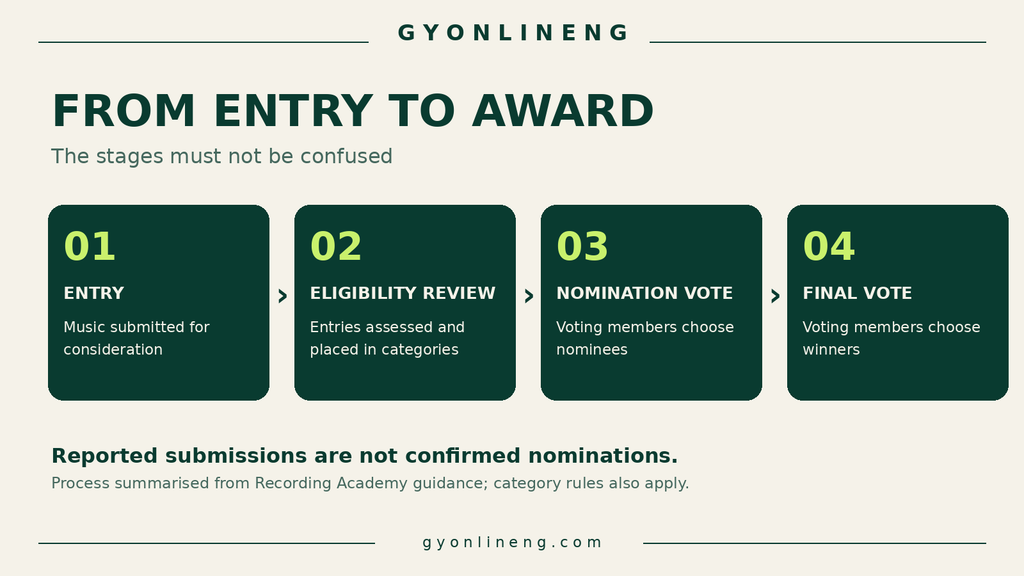
The Recording Academy accepts entries from eligible members and registered media companies. Submissions undergo eligibility review and category screening before voting members determine the nominees. A subsequent voting round determines the winners.
This process has several implications for Tems.
First, a submission is not an official nomination. The reported entries must pass through the Academy’s process before their final status can be established.
Second, accurate credits matter. Artists, songwriters, producers and other contributors must be correctly identified where relevant to the category and its eligibility requirements. Credits help establish who qualifies for recognition and which creative contributions are being considered.
Third, category placement matters. A recording’s prospects can differ depending on the field in which it competes. This is particularly relevant for Tems, whose reported entries span R&B, rap, African music and the general field.
Finally, professional representation can help an artist organise submissions, verify credits and communicate a project’s artistic merits through permitted industry channels. It cannot guarantee a nomination or win.
For an artist with submissions across several categories, the challenge is not simply to achieve visibility. It is to ensure that every entry is correctly presented and can make a convincing case on its own terms.
So, Which Categories Offer Tems Her Best Chances?
Tems’ reported 2027 Grammy submissions create several potential routes to recognition. However, the available evidence does not support a definitive ranking of her chances across every category.
Best African Music Performance: A meaningful opportunity, but a competitive field.
Tems has previous success in the category, and “Big Daddy” gives her another opportunity to compete for recognition in African music. However, reported submissions from Davido, Asake, Ayra Starr and Seun Kuti demonstrate that the field includes artists working across different musical traditions. Without a closer comparison of the recordings, Tems’ previous win is not enough to place her ahead of the competition.
Best R&B Solo Performance and Best R&B Song: Categories closely connected to her musical identity.
“What You Need” offers opportunities to assess Tems as a performer and songwriter. These categories provide a direct setting for evaluating her R&B work, but the available evidence does not establish how her recording compares with the strongest eligible competitors. They are relevant categories to watch rather than confirmed stronger prospects.
“Raindance”: An opportunity to demonstrate versatility.
The collaboration with Dave places Tems in a different musical setting and gives her potential routes through both performance and songwriting categories. However, the evidence currently available is insufficient to rank its prospects confidently in Best Melodic Rap Performance or Best Rap Song. The general-field categories also require a broader comparison.
Best Global Music Album: A relevant category with regional competition.
Love Is a Kingdom has reportedly been entered alongside other reported submissions from Davido, Asake and Ayra Starr. Tems’ international profile makes the submission noteworthy, but it does not establish that the album has a stronger chance than the other projects. A closer assessment of the albums’ artistic strengths and reception is necessary.
Album of the Year: A broader field that is difficult to assess.
Early predictions from publications such as Pitchfork illustrate the range of potential competitors. Those predictions are not official nominations, and the available evidence does not justify placing Tems among the likely winners.
Best R&B Collaboration or Duo/Group Performance: An opportunity without an established precedent.
“I Think You’re Special” could benefit from the introduction of a category dedicated to collaborative contemporary R&B performances. However, the absence of historical results and a verified comparison of eligible submissions makes its prospects difficult to assess.
The distinction between these assessments is important. A category can suit an artist’s musical identity without necessarily offering that artist a stronger chance of winning. Likewise, a previous Grammy victory establishes a record of recognition, not a guarantee of future success.
Tems has already established an important place in contemporary African music and at the Grammys. The 2027 awards cycle will present another opportunity for recognition, but the strength of each submission must be assessed independently.
For now, the most credible conclusion is not that Tems is likely to win in a particular category. It is that she has several meaningful opportunities, some of which align more directly with her established musical identity, while the available evidence remains insufficient to rank her chances confidently.
That is the difference between counting possibilities and making a credible prediction.