
Michael Smith collected more than $8 million in fraudulent streaming royalties before his scheme ended in an 18-month prison sentence. The American musician used bots to manufacture billions of plays, including streams of AI-generated recordings. He was sentenced on 6 October 2026 after pleading guilty to conspiracy to commit wire fraud, according to the US Department of Justice.
For artists whose earnings depend on genuine listening, there is an obvious reason to want that activity stopped. The difficulty comes when an artist disputes a platform’s finding and cannot get enough information to challenge it.
Who should explain the decision? Has money been withheld, or were streams excluded before royalties were calculated? And how far can a Nigerian artist afford to pursue a company overseas?
GYOnlineNG asked Deezer and entertainment lawyer Adebayo Ishola about the process, and also received a written response from Ditto Music. Their comments show why an artist first needs to establish exactly what happened to the payment. Even that can require dealing with more than one company.
After the fan argument
On 2 May 2025, Charts Africa claimed that Davido’s 5ive had lost more than 18 million Spotify streams. The post was reproduced in subsequent coverage. It was a claim about stream deductions, not a royalty statement or an explanation from Spotify establishing the cause.
Burna Boy’s numbers have attracted a different explanation. The fan-run site BurnaBoyStats attributes a February 2026 drop in his displayed total to the separation of counts for two remixes and their original recordings. That account has not been independently confirmed by GYOnlineNG or established through a Spotify response. It should not be presented as proof of either a fraud penalty or a royalty loss.
Wizkid’s “Kese (Dance)” disappeared from Apple Music Nigeria’s Top 100 in November 2024 before returning. Reports recorded speculation about manipulation, but the chart movement did not establish that explanation.
These are different events. A chart position, a displayed stream count and a royalty statement cannot be treated as interchangeable evidence. We do not know what correspondence took place privately with the artists’ teams. The absence of a public statement does not establish that a team accepted a decision or did nothing.
For a manager facing an actual payment restriction, the work begins with the notice and the statement. Which release is affected? Which reporting period? Did the streaming service exclude the listening, or is the distributor holding money it received?
Deezer explains where it removes streams
Deezer told GYOnlineNG that it removes streams identified as manipulated before allocating royalties.
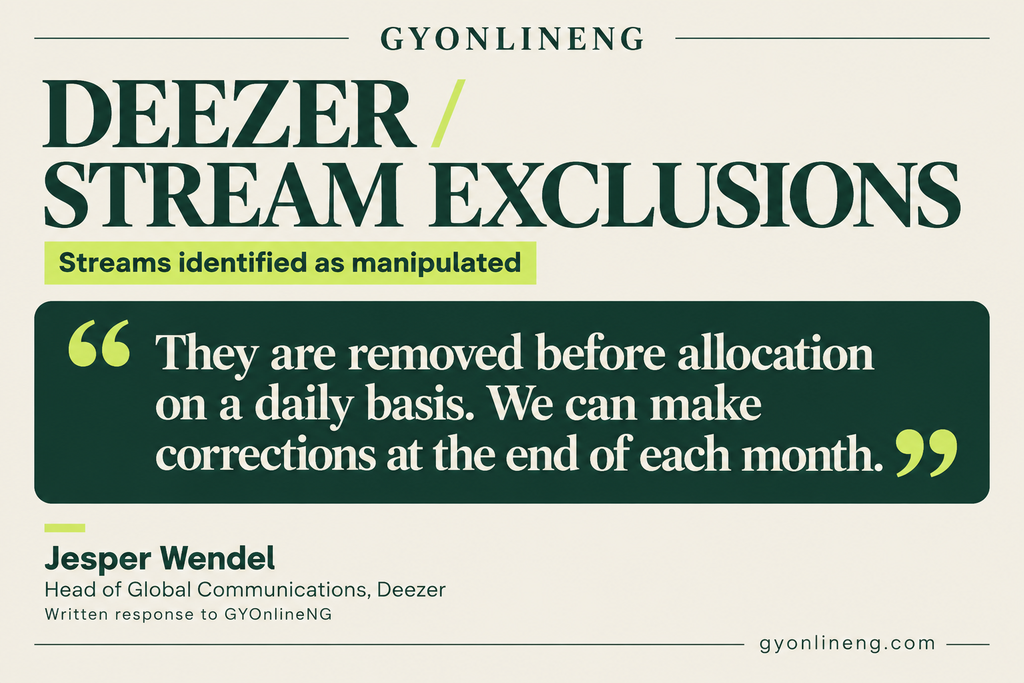
“They are removed before allocation on a daily basis,” said Jesper Wendel, the company’s head of global communications. “We can make corrections at the end of each month.”
Under that process, a distributor may never receive money for the excluded listening. An artist asking it to release those earnings would first need the platform’s exclusion reviewed. A distributor holding money already received is a different situation. The artist would need to ask why it is holding the payment, under which contractual provision and what must happen before it can be released.
Withheld Streaming Royalties
Wendel also clarified that an AI-generated recording can earn royalties on Deezer.
“AI-generated tracks are remunerated in the same way as any other tracks, but they are excluded from algorithmic recommendations so that people can make an active choice if they want to listen to AI-generated music,” he said.
“Streams are only excluded from royalty payments if we detect streaming manipulation.”
Deezer’s explanation separates how a recording was made from whether its listening was manipulated. Its recommendation policy is a further decision about how the music reaches listeners. The company says it examines suspicious listening behaviour and excludes streams only when it is highly confident manipulation occurred. GYOnlineNG has not independently assessed its detection accuracy.
According to Wendel, rights holders receive information about excluded streams through regular reporting and can contact the company with questions. His responses did not specify how much supporting evidence they receive when contesting a finding, or a deadline for completing a review. The company can correct allocations at month-end; that does not mean every dispute will be resolved by then.
The distributor may not have the evidence either
The artist’s distributor is an obvious place to seek an explanation. It may also be trying to obtain one.
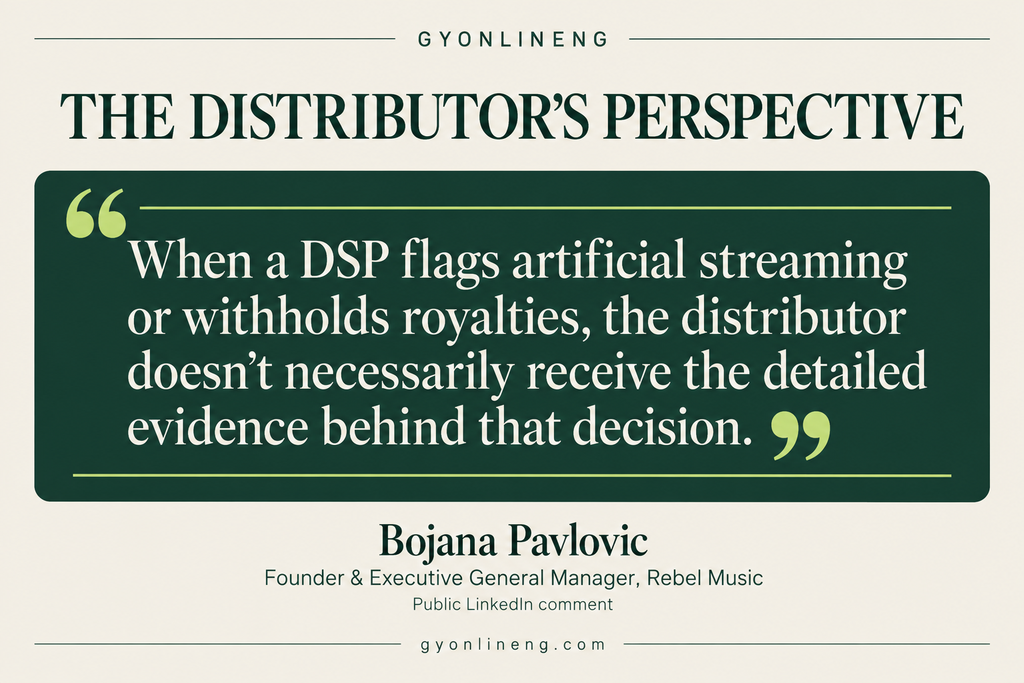
In a public LinkedIn comment, Bojana Pavlovic, whose profile identifies her as founder and executive general manager of Rebel Music, described the difficulty from the distributor’s side:
“When a DSP flags artificial streaming or withholds royalties, the distributor doesn’t necessarily receive the detailed evidence behind that decision,” she wrote. “Yet we’re often the ones expected to explain it to the artist.”
Pavlovic argued that distributors should be accountable for their own actions, while platforms should answer for their decisions and the information they share. She was commenting on the industry generally, not responding to Deezer or speaking in an interview for this article.
Her observation helps explain why notification alone may leave an artist dissatisfied. A distributor can know which streams were excluded without knowing enough to explain the finding. The artist can ask whether it will request further information, submit campaign records or seek another review, and who will communicate the outcome.
What Ditto Music tells artists challenging a streaming flag
Ditto Music says streaming platforms do not always tell distributors what specific activity led to an artificial-streaming flag.
“Stores don’t inform us specifically what action caused them to flag your content, just that your content falls under their umbrella of artificial streaming,” a Ditto Music representative identified as Yevhenii told GYOnlineNG in a written response.

The explanation is consistent with the difficulty described by Bojana Pavlovic of Rebel Music, who said distributors may be expected to explain platform decisions without receiving the evidence behind them.
Ditto also outlined what artists may need to provide when disputing a flag. The distributor may request details of playlists carrying the affected recordings, the names and contact information of promotional companies, campaign reports showing how listeners were targeted, and social media activity indicating genuine fan engagement.
According to Yevhenii, Ditto can forward those materials to the streaming platform for further review.
The process gives artists a way to present evidence about how their music was promoted. It does not establish whether the platform will disclose the activity that triggered its decision or explain why an appeal has been rejected.
Ditto’s representative also warned that an artist’s account balance may be frozen during an investigation and that streaming services may impose financial penalties for artificial streaming.
The response did not clearly explain when access to frozen earnings would be restored or whether a penalty could be reversed after a successful challenge.
Ditto’s published guidance on streaming promotion advises artists to avoid artificial methods of generating plays, including promotional services promising guaranteed streams.
For artists who have paid third parties to promote their music, Ditto’s response identifies records worth keeping before a dispute arises. But the company did not specify how long a platform’s review normally takes, whether it receives a detailed explanation of the outcome, or whether a restriction on one release can affect earnings from other recordings.
What the artist can ask for
The evidence Ditto may request from an artist is one part of a dispute. Another is the information the artist can obtain from the distributor and the contractual provisions governing any restriction on payment.
Adebayo Ishola, an entertainment lawyer and chief legal officer at Inspivia, said artists should begin by requesting a written explanation and the contractual provision relied upon. They should ask for an accounting showing the affected amounts and the basis for any adjustment. The scope of the restriction matters too: a problem with one release does not tell the artist whether earnings from the rest of the catalogue remain payable.
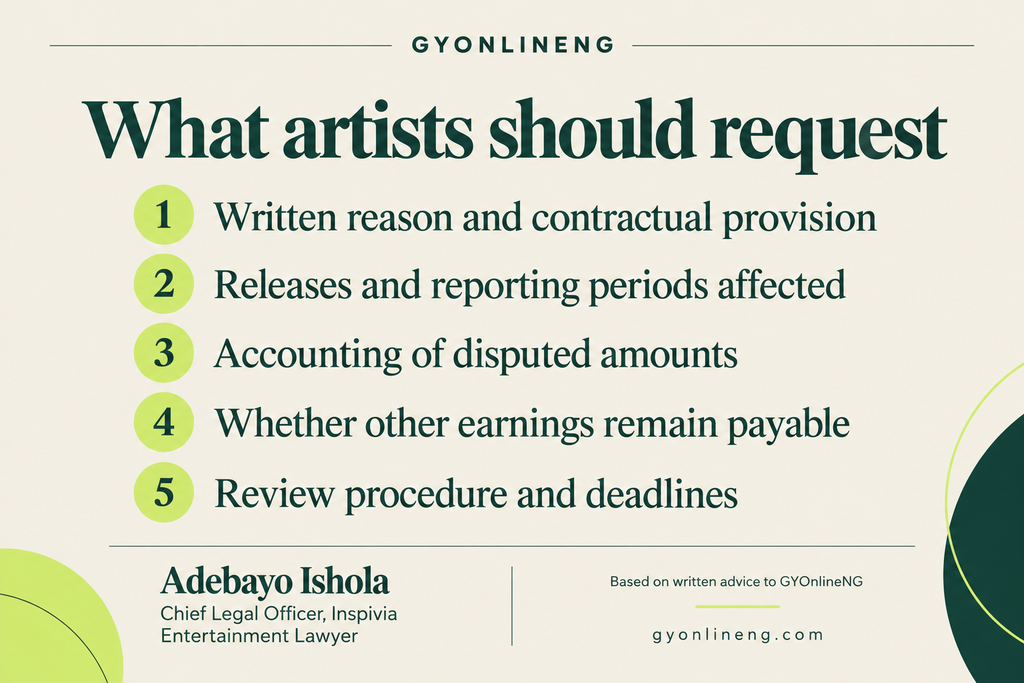
Where reasonably available, Ishola said artists should request information about the suspected irregularity, including affected platforms or territories and any promotional activity under review. A company may have legitimate reasons to protect its detection methods or information that could compromise an investigation. That still leaves a need for a meaningful explanation and review.
“The precise rights to information, accounting and payment will depend on the agreement and applicable law.”
Artists can request more information than a company is legally obliged to provide. Understanding that difference requires examining the agreement. Ishola clarified that he has not personally advised on a disputed streaming-fraud flag or royalty hold of the specific kind discussed here; his comments address the contractual and commercial questions.
He suggested DistroKid’s public distribution agreement as a useful reference. The version reviewed on 17 October 2026, labelled “As of June 8, 2021,” permits action following a claim or notice, or reasonable suspicion of specified breaches, disputes or misconduct. Section 7(g) includes powers to withhold payments in amounts reasonably attributable, in DistroKid’s discretion, to the relevant recordings, material and activity until claims or conduct are favourably resolved to its reasonable satisfaction. It also provides for related legal-cost deductions and forfeiture of money attributable to fraud, infringement or other illegal activity. Section 10(h) specifies New York law and courts in New York County.
Those provisions do not establish whether a particular restriction is justified. Artists need to check the terms governing their own accounts. The agreement may allow action while an allegation remains unresolved. GYONLINENG’s guide to record labels, distribution and licensing deals provides background on the different relationships an artist may enter. The provisions governing payment and disputes deserve attention alongside ownership.
What if the promoter caused it?
An artist may have commissioned legitimate promotion and later discovered activity they never authorised. Their agreement with the distributor still needs to be examined. Ishola said hiring a promoter does not conclusively establish either responsibility or a lack of responsibility for artificial streaming. The assessment depends on the contract, the promoter’s authority and the evidence connecting the artist to the activity.
Some distribution agreements impose obligations concerning marketing agencies or other contractors. An artist’s lack of knowledge may matter without resolving their contractual exposure.
Routine campaign paperwork can help. The brief records what the artist commissioned. Messages can establish what the promoter promised, while invoices and payment records document the arrangement. Advertising reports and audience data may help explain where listeners came from. An artist will struggle to account for a campaign if the promoter supplied only a stream total and an assurance that everything was legitimate.
Ishola advised preserving campaign materials and the distributor’s notices, and submitting any appeal within the applicable deadline. Artists should not delete records or manipulate data after receiving a flag. The aim is to give the reviewer a documented account of the promotion, starting with what the artist commissioned and what the promoter delivered.
When pursuing the money costs too much
For a Nigerian artist dealing with an overseas distributor, a rejected appeal can introduce an expensive decision. Ishola said the artist should establish which legal entity they contracted with, the governing law and the procedure for resolving disputes. The agreement may require internal steps or negotiation before arbitration or court proceedings. Living in Nigeria does not automatically mean the dispute can be litigated here.
“The practical challenge is that even a potentially valid claim may be commercially difficult to pursue if the amount withheld is modest relative to the cost of cross-border proceedings,” he said.
An artist can believe they have a strong case and still decide that pursuing it makes little financial sense. That possibility deserves attention when choosing a distributor, before there is a payment to argue over.
It also gives the ordinary review process considerable commercial importance. Can the artist submit records to someone who will examine them? Will the answer address those records? If the decision changes, when will the accounting be corrected?
We have not established how often Nigerian artists suffer mistaken restrictions. The celebrity disputes discussed publicly do not supply that evidence.
Deezer has described when it excludes streams and when corrections are possible. The missing detail is what a rights holder receives when challenging a finding and what evidence could lead to a different result. Artists should be able to obtain that explanation without demanding access to the detection system itself. A workable review needs to identify the disputed activity and give them a chance to answer it.
For a Nigerian artist with a modest sum at stake, that may be their only affordable opportunity to have the complaint examined.
Editor’s note (17 October 2026): This article was updated to include Ditto Music’s written response on artificial-streaming notifications, the evidence artists may submit when challenging a flag, and possible restrictions on their earnings.
Reporting note: Deezer’s statements are attributed to Jesper Wendel. Comments on contractual options are attributed to entertainment lawyer Adebayo Ishola, who said he had not personally advised on a disputed streaming-fraud flag or royalty hold of this specific kind. Bojana Pavlovic’s comment was public and general, not a response to Deezer. The article does not establish that the artist examples discussed lost royalties.