Before Spotify & Apple Music, There Were Four Blogs, Nigerian Music Owes Them Everything
To understand what NotJustOk, TooXclusive, 360Nobs and Naijaloaded built, you have to go back to Alaba because we can talk about Nigerian music blogs. Not as a footnote. As the full story.
Alaba International Market. Ojo, Lagos. 1980s through the mid-2000s.
If you made music in Nigeria and wanted anyone outside your street to hear it, Alaba was not one option among many. It was the only option. The market in Ojo, on the southwestern edge of Lagos, housed thousands of traders who pressed, duplicated and distributed cassettes and later CDs across Nigeria and into the West African diaspora. Every notable artist of the pre-internet era passed through Alaba in some form. It was not glamorous. It was not artist-friendly. But it worked, and nothing else did.
King Sunny Ade, who had been recording since the 1960s and built one of the most loyal touring audiences in Yoruba music history, understood by the 1980s that his recordings circulated on physical formats through networks like Alaba. His Juju music reached the UK and eventually Island Records not through digital pathways but through cassettes that moved hand to hand, market stall to market stall, until a diaspora community carried them abroad. Fela Anikulapo-Kuti operated differently his Kalakuta Republic and his own pressing plant gave him unusual independence from market distributors but even his records moved through the Alaba ecosystem when they moved at all commercially.
By the 1990s the market was the undisputed chokepoint. Piracy was endemic and the same traders who distributed legitimate releases duplicated unauthorised copies alongside them, often indistinguishably. Artists lost money to piracy at Alaba even as they depended on the same infrastructure to reach audiences. Eedris Abdulkareem, who emerged in the late 1990s as one of Nigeria’s most commercially aggressive rap artists, understood this tension intimately. His 2003 album Jaga Jaga whose title track became one of the most politically charged Nigerian songs of its era moved through Alaba with the piracy and distribution happening almost simultaneously. The album reached millions of Nigerians. Eedris received a fraction of what it was worth.
D’banj and Don Jazzy launched Mohits Records in 2004 and pressed their early catalogue through physical distribution channels, including Alaba networks, while simultaneously pursuing radio and TV placement. Their 2005 single Tongolo and the releases that followed built a fanbase that was real and measurable in shows and street recognition before the digital economy existed to quantify it. P-Square, Peter and Paul Okoye from Anambra State were perhaps the most strategically brilliant navigators of the Alaba era. Their 2003 debut album Last Nite and their 2005 follow-up Get Squared moved through physical distribution while the brothers worked television relentlessly, performing on every platform available. They understood that Alaba was distribution infrastructure but that visibility came from television. The combination worked. By the mid-2000s they were the biggest Nigerian music act by almost every commercial measure.
Then there was 2Face Idibia. His 2004 debut album Face 2 Face, released on Kennis Music one of the few Nigerian labels with functional distribution infrastructure sold over a million copies. That number sounds clean until you understand that it was measured in physical units through a system where piracy was simultaneous with legitimate sales and nobody had an accurate count. The Alaba traders who duplicated Face 2 Face without authorisation helped spread 2Face’s music to audiences who would later become paying concert attendees. It was a broken system that worked anyway, for the artist if not for the accounting.
The DJ Mix as Informal A&R
Alongside Alaba, there was another distribution system that almost nobody documents properly but that every Nigerian music insider of that era understood the DJ mix.
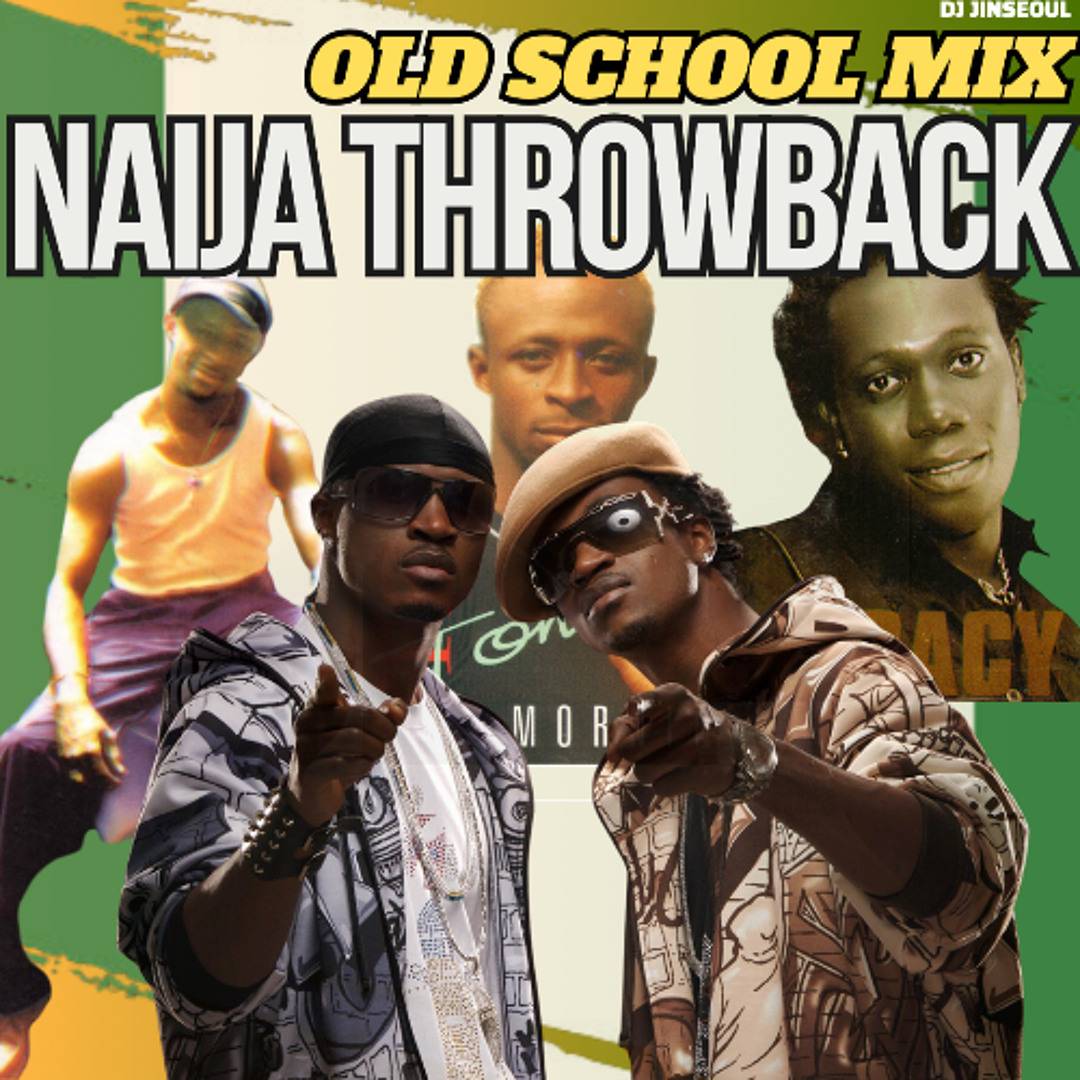
Before streaming algorithms decided what music people heard next, before editorial playlists existed, before Shazam could identify a song playing in a bus, the DJ mix was Nigeria’s primary tool for music discovery and informal market testing. DJ Jimmy Jatt, DJ Kaywise, DJ Neptune, DJ Consequence and dozens of city-specific DJs across Lagos, Abuja, Port Harcourt and the diaspora compiled mixes that functioned as the first exposure millions of Nigerians had to new music.
A record label releasing a single in 2003 would press physical copies for radio, negotiate placement with TV channels, get the CD into Alaba distribution and send the track to key DJs. If DJ Jimmy Jatt included your song on his mix tape, you had audience validation that no label A&R could manufacture. If the mix circulated and people started asking about the track by name, you had your market signal. The DJ mix was A&R by crowd reaction, distribution by hand-to-hand circulation and music journalism by word of mouth all operating as one unofficial institution.
Mix tapes by 2003 and 2004 were being sold at Alaba alongside legitimate releases. Nigerian DJs who went to the UK and US would return with mix tapes featuring British and American artists alongside Nigerian tracks, and those same DJs would take Nigerian music abroad and play it for diaspora communities who had no other way to hear what was happening at home. The DJ mix was the original streaming recommendation algorithm. It ran on human judgment instead of data.
This system worked until it didn’t. By 2006 and 2007, the cracks were widening. Mobile phone penetration in Nigeria was growing rapidly 2001 saw the launch of MTN, Airtel and Glo’s predecessors into the market, and by 2005 Nigeria had over 20 million mobile subscribers. Those phones could receive Bluetooth transfers. They could connect to the early internet at the cybercafes spreading through Lagos, Abuja and university towns. Music was starting to move as a file rather than a physical object, and neither Alaba nor the DJ distribution system had been built for files.
The music was ready to go digital. The infrastructure to take it there did not yet exist.
That is the vacuum into which NotJustOk launched in June 2006. Then TooXclusive in 2010. Then 360Nobs in April 2010. Then Naijaloaded on October 1, 2009.
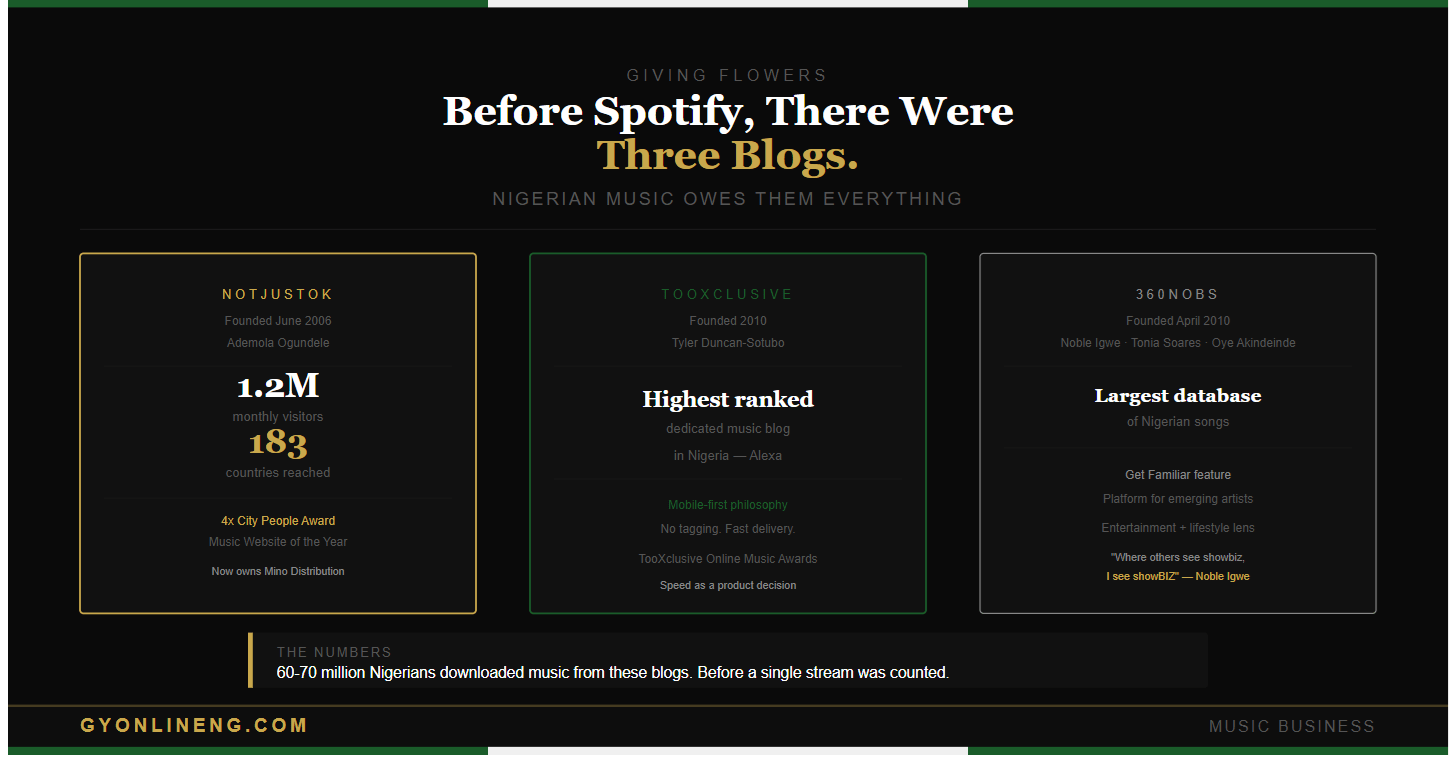
Over 60 to 70 million Nigerians would eventually download music from these platforms. The number sits alongside Alaba’s best years without apology.
NotJustOk: The One That Set the Standard
NotJustOk was founded in June 2006 by Ademola Ogundele. He built it into the most visited Nigerian music website at a time when building anything on the Nigerian internet required a specific kind of stubborn optimism.
The NotJustOk music tag could be heard almost anywhere Nigerian music was played, even on radio stations. That detail carries the full weight of what NotJustOk built. When your watermark ends up on radio a medium that had previously been the gatekeeper you were trying to bypass you have done something genuinely significant.
NotJustOk won City People Entertainment Awards for Music Website of the Year in 2011, 2012, 2013 and 2014. It won Nigeria Entertainment Awards Blog of the Year in 2013 and the Black Weblog Award Best Music Blog in 2014. Four consecutive years at the top of the same award. That is not luck. That is the result of Ogundele understanding his audience better than anyone else and serving them consistently.
Notjustok retained the most premieres and exclusivity of songs. Other music blogs copied from them. In the economics of music discovery, the premiere is everything. It is the signal that an artist has been validated, that their music is worth the audience’s time before they have heard a single second of it. NotJustOk held that power for a decade and used it to launch careers.
NotJustOk now owns Mino, a distribution service. The blog that was once the distribution workaround built its own distribution company. The full circle of that trajectory is one of Nigerian internet’s best business stories.
TooXclusive: Speed as a Philosophy
In 2010, Olutayo Tyler Duncan-Sotubo established TooXclusive. He entered a space NotJustOk already dominated and found a completely different lane.
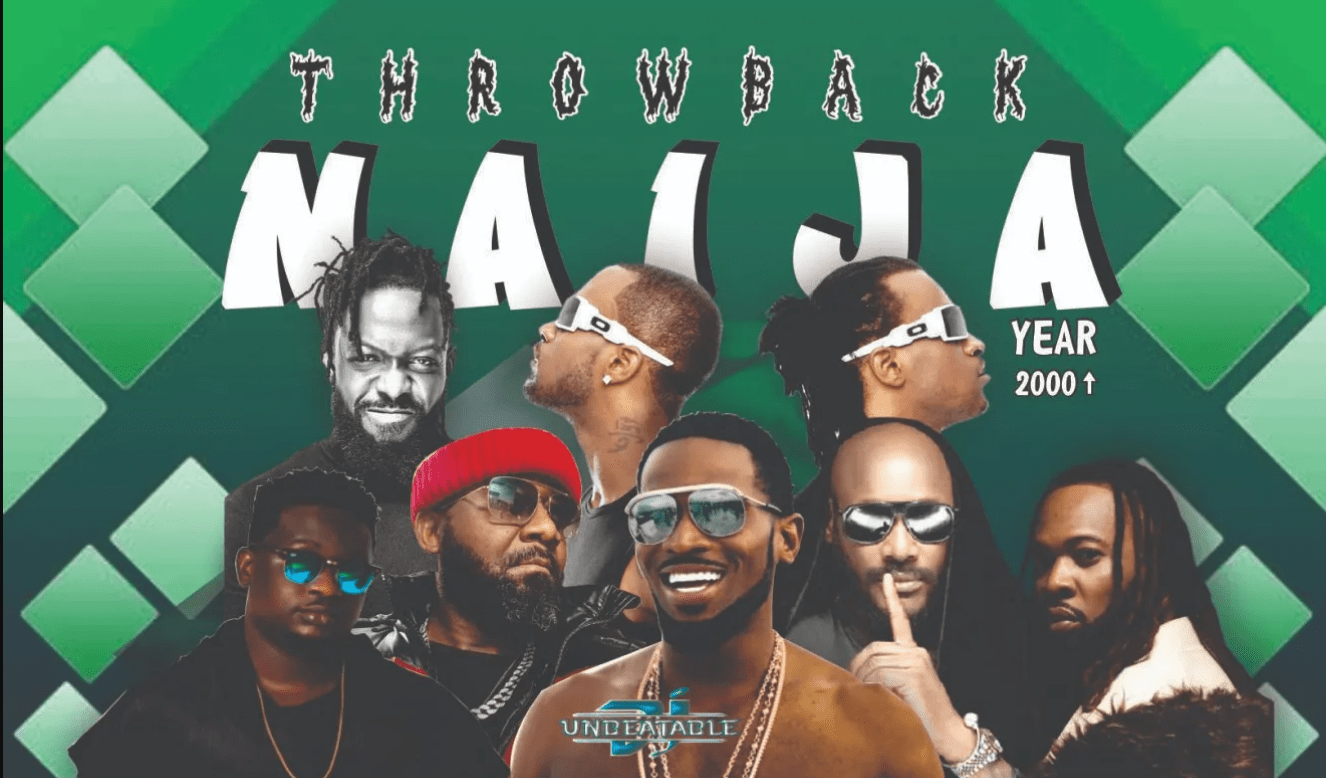
TooXclusive is faster than NotJustOk and they rarely tag audio files. It is mobile friendly, and it is an exclusive music blog. Mobile users love TooXclusive because it seems more focused on getting the song to you than anything else.
That reading of the Nigerian mobile internet user was commercially brilliant. In 2010, the majority of Nigerians accessing the internet were doing so on mobile phones with limited data and inconsistent connections. A music blog that loaded fast, didn’t force you through unnecessary steps, and delivered the file quickly was not just a preference it was a necessity. TooXclusive understood that before most people had articulated it as a market insight.
The title of the best music blog has always been between TooXclusive and NotJustOk. NotJustOk had more industry insights and received more visitors, while TooXclusive was fast and provided listeners with a fast, mobile-friendly website. That rivalry was productive for everyone. Competition between the two platforms drove both to improve constantly. Artists benefited from having multiple serious platforms bidding for their premieres. Listeners got better, faster access to music.
TooXclusive also built the yearly TooXclusive Online Music Awards, which gave the blog its own award infrastructure and created a reason for artists, labels and industry figures to engage with the platform on terms beyond simple distribution.
360Nobs: The Culture Lens
360Nobs was founded in April 2010 by Noble Igwe, Tonia Soares and Oye Akindeinde. Where NotJustOk and TooXclusive were primarily music platforms, 360Nobs built around a wider cultural frame entertainment, lifestyle, celebrity, and music as one connected conversation.
360Nobs holds the largest database of Nigerian songs and runs a good music chart that is regularly updated. Their Get Familiar feature provides a platform for many upcoming artists making Nigerian music around the world.
Get Familiar was the detail that separated 360Nobs from the others on the emerging artist question. It was not just a slot on a website. It was a curatorial statement — these artists are worth your attention before the rest of the industry has figured that out. That kind of intentional platform for discovery is what separates a content platform from an infrastructure platform. 360Nobs chose to be infrastructure.
Noble Igwe once said: where others see showbiz, I see showBIZ. That framing captures exactly what made 360Nobs distinct. Igwe treated the business of Nigerian entertainment with the seriousness it deserved at a time when most people were treating it as a side conversation.
Naijaloaded: The One That Changed the Game Entirely
If NotJustOk set the standard, TooXclusive set the pace, and 360Nobs set the cultural frame, Naijaloaded rewrote what a Nigerian music platform could actually become.
Launched on October 1, 2009 by Makinde Azeez, Naijaloaded did not just compete in the music blog space. It outgrew it. At its peak the site ranked in the top 35 most visited websites in Nigeria, above LinkedIn, above Paystack, sitting alongside banks and telecoms companies in the conversation about where Nigerians spent their internet time. That is not a music industry metric. That is a national infrastructure metric.
But traffic was not the real story. The real story was what Naijaloaded did with it.
Every other music blog of that era operated as distribution. You came, you downloaded, you left. Naijaloaded understood something different. It understood that tens of millions of monthly visitors was not just a download channel. It was an attention asset. And attention, packaged and targeted correctly, is a marketing funnel.
Artists and labels began approaching Naijaloaded not just for uploads but for promotional placements, exclusive premieres with interview tie-ins, banner campaigns, featured post slots and coordinated release strategy. A record label that wanted to move a single in 2012 did not just need radio and TV. It needed Naijaloaded. The platform had built the kind of captive, engaged, music-specific audience that made every promotional placement directly trackable in download numbers and social conversation. That feedback loop, from placement to download to social buzz, was what a professional marketing funnel looks like. Naijaloaded built it before most Nigerian labels had the language to describe what they were buying.
Then streaming arrived. And Naijaloaded did something most of its competitors did not. It became the bridge.
When Audiomack entered Nigeria, Naijaloaded was part of the conversation. When Boomplay launched its African expansion, Naijaloaded was in the room. When Apple Music and Spotify began their Nigerian market push, building local awareness required reaching the audience that had been downloading music from Naijaloaded for a decade. The platform transitioned from competing with streaming to directing its audience toward it. Upload posts became hybrid format, the download option alongside a Spotify link, an Apple Music link, a Boomplay link. The blog that had replaced Alaba as distribution infrastructure became the onboarding channel for the streaming economy.
That arc, from scrappy download site to marketing funnel to streaming gateway, is one of the most important and least told stories in the business of Nigerian music. Makinde Azeez did not just build a website. He built the institution that handed an audience of tens of millions from the download era to the streaming era, and helped the industry find its footing in the transition.
Mp3Bullet, Jaguda and the Ones Who Also Showed Up
Mp3Bullet deserves its name on this list. Fully dedicated to Nigerian songs, it built a Twitter following of over 130,000 at a time when that kind of social reach was significant for a niche platform. What separated Mp3Bullet from the platforms that came and went was consistency. It stayed focused on one thing and kept showing up. Most of its contemporaries chased scope. Mp3Bullet chose depth and held it.
Jaguda built the Bubbling Under feature, which gave emerging artists a structured curatorial slot before the industry had formalised the idea of editorial playlists. Worldfamousnaijablog predated even NotJustOk as one of the earliest Nigerian music blogs, establishing in the early 2000s that there was an audience for Nigerian music online before anyone was prepared to treat that audience as a market.
The full list is longer than any single article can do justice to. But the names matter. They were building something real before anyone in the Nigerian music establishment was paying attention.
What They Were Actually Doing
The blogs worked for the Nigerian internet user of that era precisely because they did not require what the Nigerian internet of that era could not reliably provide. No streaming buffers. No subscription payments requiring international cards. No app downloads. You found the song, you clicked, you got the file. It worked in cybercafes. It worked on Nokia feature phones. It worked in Kano and Benin City and Port Harcourt the same way it worked in Lagos.
NotJustOk alone had over 1 million monthly unique viewers across 183 countries. From a Nigerian music blog built on a personal server before cloud hosting was standard practice. That reach was the early Afrobeats diaspora infrastructure. The Nigerian communities in the UK, US, Canada and across Europe who stayed connected to Nigerian music in the 2000s and early 2010s did so largely through these platforms. Radio could not reach the Nigerian in London searching for Afrobeats at 2am. These blogs could.
The Industry Ignored Them While They Carried It
Here is the part that deserves saying directly.
Nigerian music labels, management companies and industry figures who benefited enormously from the distribution these blogs provided rarely acknowledged that benefit explicitly. They used the platforms the way infrastructure gets used — as background, as assumed, as something that was simply there. When streaming arrived and the blogs became less central, the conversation moved on without pausing to document what had been built and who had built it.
The pattern repeated across the industry’s biggest moments. A major label release would drop on a Friday. By Saturday morning it was on every blog without a formal licensing arrangement. By Sunday the label’s social media was reposting the download numbers as proof of audience demand. The blogs absorbed the legal risk of distribution. The labels absorbed the commercial benefit. Nobody wanted to formalise that arrangement because formalising it meant paying for it.
The blogs had to manage genuine legal and ethical complexity. They were distributing music that artists and labels had not always formally authorised for free download. The economics of that arrangement were permanently unresolved. The labels that complained about piracy were also quietly grateful for the promotion. The artists who benefited from the exposure rarely turned down the feature requests. The relationship was complicated and nobody wanted to examine it too closely while it was working.