Showmax is gone from Nigeria. Netflix is commissioning less. YouTube is still here. That is a much more interesting picture than the simple “streaming is dead” story.
On March 5, 2026, MultiChoice announced that Showmax would be discontinued, citing unsustainable annual losses. The useful question is not whether the audience disappeared. It is who still has a workable way to monetise it.
What Changed at Showmax, IROKOtv and Netflix
Showmax’s board decided to phase out the service after a review of its streaming business. The March 2026 announcement also said CANAL+ would continue investing in premium content for MultiChoice subscribers. The closure of one service should therefore be distinguished from the group abandoning African production altogether.
IROKOtv’s experience needs a different timeline. In a March 11, 2025 account of the business, founder Jason Njoku said it had exited Nigeria in 2023 and had stopped processing naira payments. He described roughly $100 million spent from revenues and venture capital over its first ten years, including $35 million raised from investors. That account does not establish that the entire IROKOtv service closed in June 2025.
Netflix’s position also requires precision. Semafor reported on December 5, 2024 that Nigerian filmmakers had seen original projects put on hold or shelved. Netflix told the publication it was not exiting Nigeria and would continue investing in Nigerian stories. A reduction in commissions, a licensing deal and the withdrawal of a viewing service are three different things.
For a filmmaker, those distinctions matter. A commission can help finance production before release. A licence can pay for the right to show an existing film for an agreed period. Losing access to one arrangement does not automatically remove the other, but it can change who must find the money to make the next film.
Nollywood Streaming Revenue: What the Numbers Can Tell Us
YouTube has become a visible outlet for Nigerian films, but a widely repeated estimate putting annual Nollywood YouTube earnings near $200 million lacks a transparent, independently verifiable calculation. It should not be treated as an established industry total or used to claim that YouTube pays four times as much as subscription platforms.
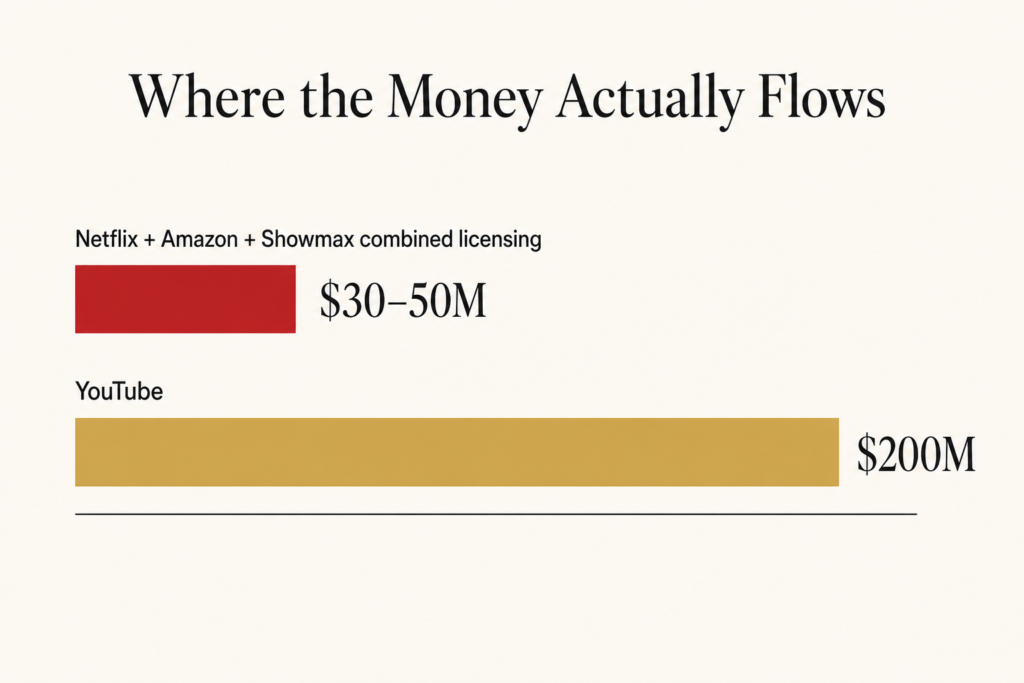
The basic comparison remains useful without an unsupported headline number. A licensing fee is a contractual payment. Advertising income depends on monetised viewing and the revenue earned from those ads. Box-office gross is ticket revenue before the deductions that determine a producer’s return. Adding or comparing these figures without matching their definitions can give a misleading picture.
YouTube’s published partner terms say eligible partners who accept the Watch Page Monetisation Module receive 55% of net revenue from ads displayed or streamed on their public watch-page videos. The platform does not guarantee a particular payment. This is more precise than treating every view as a fixed amount of income.
A free-to-watch film removes the subscription charge for the viewer, but it does not remove the cost of internet access. It also leaves the producer responsible for financing the film unless another investor or commercial partner is involved. Distribution access is valuable; it is not a guarantee of recovering the production budget.
What Nollywood Can Build on YouTube
A producer can use a channel to publish films, build a returning audience and maintain a catalogue that viewers can discover after the opening week. Older films can continue earning when they attract monetised viewing, but neither continued views nor continued income is automatic.
Audience location matters. YouTube explains that advertising rates vary by geography, among other factors. A change in where viewers watch can therefore change earnings even when total views look similar. A universal claim that diaspora viewers supply 40% of Nollywood advertising income would need evidence covering the channels and period being measured.
For producers, the useful measures are their own revenue reports, production and marketing costs, returning viewers, rights position and cash received. A large public view count can show reach. It cannot, by itself, establish profit or tell another filmmaker what a similar release will earn.
Cinema Is Still Part of the Picture
Cinema remains another route to an audience, but ticket sales should not be treated as money paid directly to a producer. Our guide to the Nollywood box office split explains why gross receipts and producer earnings differ. For the underlying revenue, admissions and average-ticket series, see GYOnlineNG’s Nigeria cinema data reference.
Cinema Revenue and Streaming Revenue Are Not the Same Measure
| Channel | Common public measure | What it does not establish by itself |
|---|---|---|
| Cinema | Gross ticket revenue and paid admissions | Producer profit or unique viewers |
| YouTube | Views, watch time and monetised advertising revenue | A fixed income per view or total industry earnings |
| Subscription platforms | Licensing, commissions or contractual payments | A comparable public revenue figure for every title |
Comparisons also need consistent scope: revenue from all films shown in a market is different from revenue from Nigerian films alone, and a regional total is different from a Nigeria-only figure. Higher ticket receipts do not by themselves prove that attendance increased or that streaming cutbacks caused a cinema recovery.
The practical choice is not necessarily cinema or YouTube forever. Where rights and contracts permit, a film can move through different release windows. Producers need to compare the likely audience, marketing spend, payment timetable and exclusivity requirements of each route before treating any one platform as the answer.
The Platform Risk Nollywood Must Manage
YouTube offers distribution infrastructure and a route to advertising income, while the platform controls its monetisation rules and recommendation systems. A channel that depends on that income is exposed to changes in viewing behaviour, advertiser demand and platform policy.
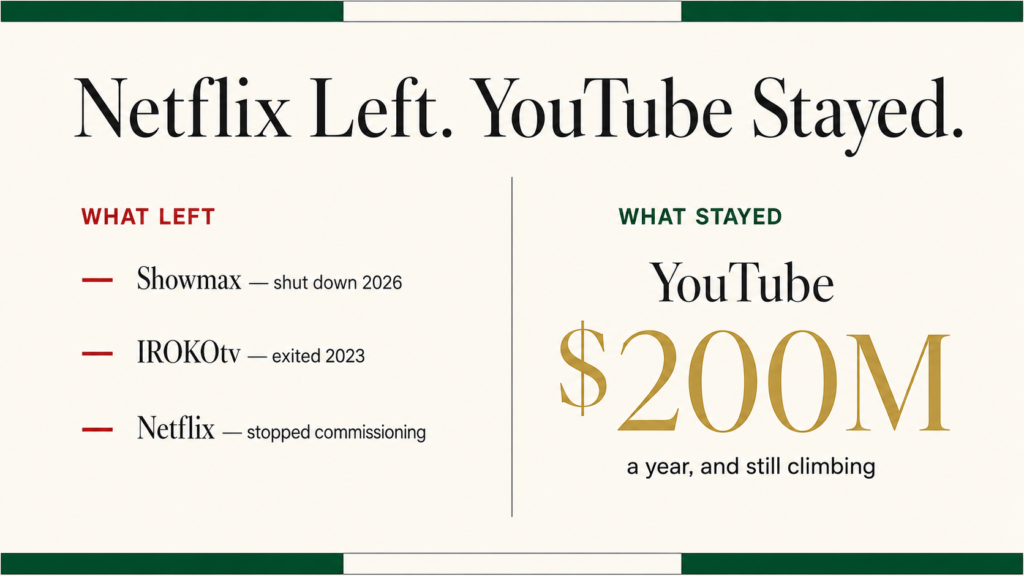
That is a reason to diversify, not evidence that every filmmaker earns less than the platform. The producer’s result depends on the contract or revenue-sharing arrangement and the cost of making and promoting the work. Claims about who captures most of Nollywood’s value need financial evidence, not just large audience numbers.
The sustainable version of what Nollywood needs includes stronger distribution choices: theatrical networks, viable local services, licensing partners and direct audience relationships. A locally owned platform still has to solve the same difficult questions about pricing, payments, discovery and costs. Ownership alone does not make the economics work.
What Comes Next for the Nollywood Streaming Economy
The lesson from these changes is to keep audience demand separate from the business model used to serve it. A platform can struggle financially while films continue finding viewers elsewhere. Equally, a successful release on YouTube does not prove that the same approach will fund every type of production.
Nollywood’s opportunity is to negotiate better, keep clear records of rights and revenues, and build several routes to its audience. That argument is strong enough without declaring that Netflix left Nigeria or presenting uncertain YouTube estimates as audited earnings.
For more reporting on distribution, production and film revenue, explore our Nollywood Business coverage.
Correction, October 5, 2026: This article has been revised to distinguish Netflix’s reported commissioning cutbacks from a market exit, correct the scope and timing of IROKOtv’s Nigerian withdrawal, and remove unsupported revenue comparisons and other unsourced figures.