
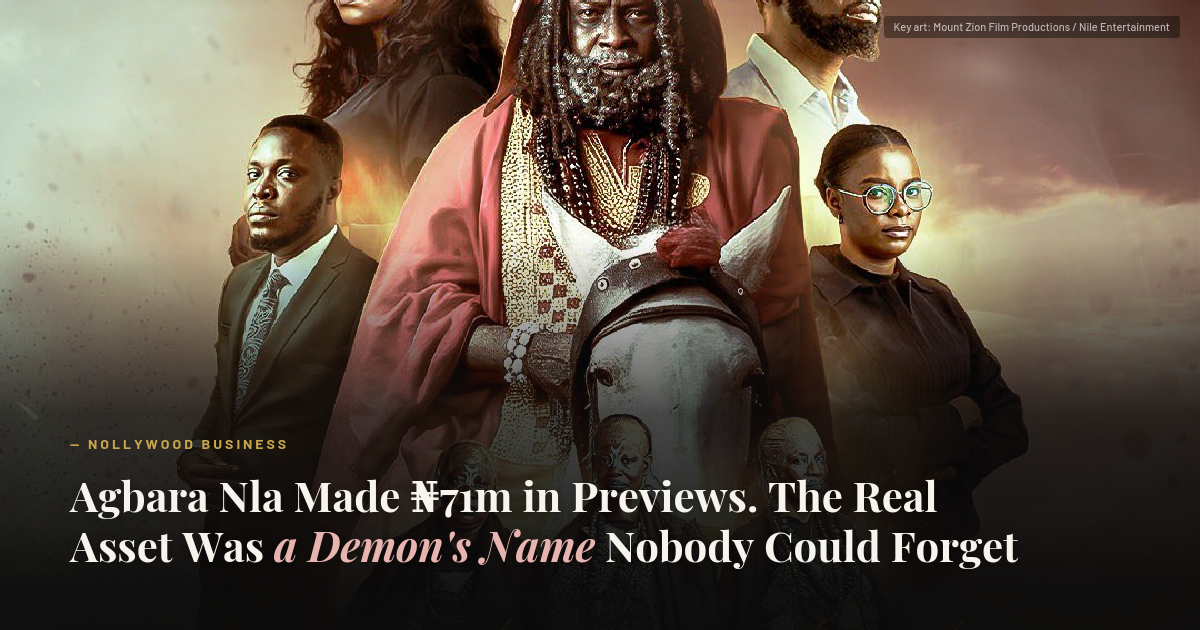
Ask anyone who grew up Nigerian and Christian in the 1990s what “Ayamatanga” means and watch what happens to their face. It’s a demon’s name from the original Agbara Nla, and academics have written about it in actual peer-reviewed text, a Cambridge University Press chapter on Pentecostal media describes Ayamatanga as having “possessed a raucous and mocking laugh” through millions of TV sets, a figure that became shorthand for real dread, not movie-popcorn fear. Thirty years later, people are still trading Ayamatanga stories in listicles with titles like “Nigerian movies that scarred our childhood.”
That recognition was not created by the remake’s marketing campaign. It had accumulated over decades through television broadcasts, family stories and memories of the original film. The commercial question is whether that familiarity could bring people back to cinemas in 2026.
On October 2, Nile Entertainment announced that Agbara Nla: The Return had made more than ₦71 million from preview screenings alone, over 12,100 admissions, the biggest single-day preview gross ever recorded in West Africa by the company’s own count. Everyone covering this has gone straight to the machine that built it: three production partners, a new distributor, a virtual cinema platform with its own COO credited as executive producer. All real, all expensive.
A brand-new film doesn’t usually open that big. It builds slowly, word gets around, the second weekend beats the first. Mount Zion skipped that curve because it wasn’t starting from zero, it walked in with Ayamatanga still living in people’s heads, free of charge, thirty years after anyone marketed it.
The Numbers, Honestly
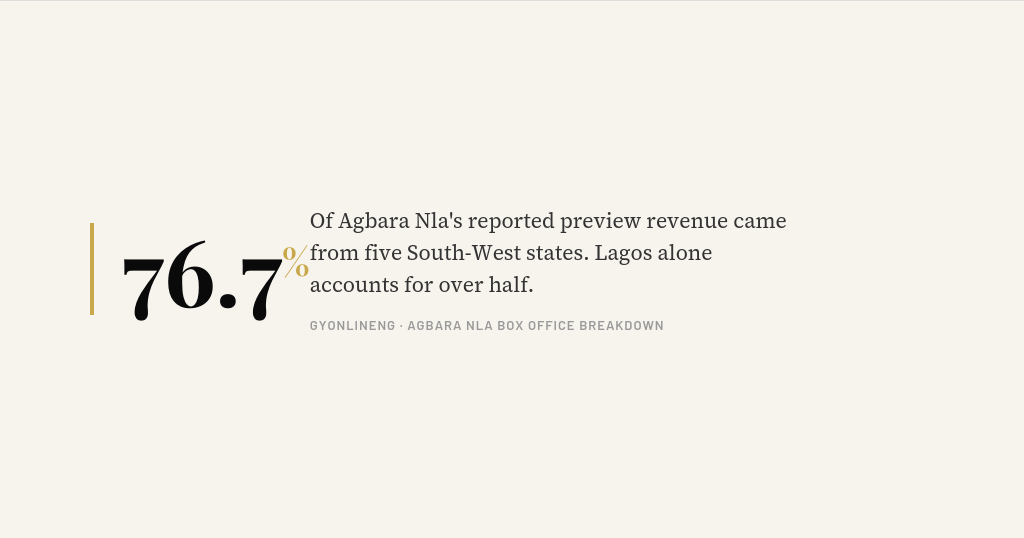
₦71 million is more than twice Onobiren’s opening and nearly three times What About Us’s opening weekend, based on the distributor-reported figures cited here. The accompanying state breakdown attributes 50.8% of reported revenue to Lagos, 13.2% to Oyo, 10.7% to Abuja and 6.2% to Ogun; the listed South-West states together account for 76.7% in that breakdown. These percentages are calculations from the reported figures, not an independently verified audience survey. The underlying state-level dataset has not been independently audited in the reporting reviewed, so it is safer to describe this as a concentration in reported revenue rather than a definitive map of the film’s audience.
And every number in this piece, for all three films, is self-reported by the distributors, relayed through press. Nobody independent is auditing these figures from the outside.
What the Old Audience Actually Looked Like
The character’s own history makes the point better than any campaign document could. A Nigerian woman told Legit.ng she watched Agbara Nla every Sunday as a child on OGTV, describing Ayamatanga and her “messengers” sent to torment happy homes, a memory specific enough, three decades on, that she could still narrate the plot mechanics. One of the film’s own 2026 remake crew, costume designer Kadiri, said she grew up without ever watching the original Mount Zion films and still knew the word “Ayamatanga” on reputation alone, which she called proof of “the original’s fame and impact.” When Joshua “JayMikee” Bamiloye tried to correct the record on social media in 2019, explaining the chant was actually “I Am At Anger,” not a demon’s name, it turned into its own small viral moment, people were still litigating the details of a line from a film three decades old.
No campaign built that. It’s a reflex that outlived the VHS tapes it was recorded on, passed to people who’d never even seen the original, the way you inherit a family joke nobody bothers explaining anymore.
What the New Partners Actually Built
That audience history didn’t put a 2026 film in a cinema, though. Sozo Films handled the production technique. Chris Odeh, identified as Sozo’s founder, produced it. Damilola and Joshua Mike-Bamiloye directed, after reportedly proposing the remake to their father years earlier and getting turned down before the idea came back around.
Distribution changed hands during the run-up. Blue Pictures was the distributor named when this was first announced in mid-2026. By the time the film actually premiered in September, Nile Entertainment had the job instead. Nobody’s explained publicly why that switch happened, and I’m not going to guess at a reason I can’t source.
Circuits is the newer piece, and the most telling one. Its co-founder and COO, Imade Bibowei-Osuobeni, is credited as an executive producer on the film itself, not a platform partner bolted on afterward. Circuits is a virtual cinema and VOD company, and its own public comments on the partnership describe Agbara Nla’s original run as having “transcended entertainment to become a movement,” language a pure distributor doesn’t normally use about a title it’s just carrying. That framing only makes sense one way: Circuits knew going in that the thing it was licensing wasn’t a new film, it was a relationship Mount Zion had already spent decades building. I couldn’t confirm any specific audience-recruitment campaign beyond that, so I’m not going to describe one.
The Iren Comparison, Corrected
I compared Agbara Nla to Pastor Iren’s films earlier and drew a cleaner line than the facts support: Mount Zion took partners, Iren kept it all himself. The actual picture is messier than that.
Onobiren, Laju Iren’s film, was produced with backing from Africa No Filter and CcHub’s Creative Economy practice. Africa No Filter’s published operational-support terms describe grants of up to $100,000 for storytellers working against stereotypical narratives about Africa. Those general programme terms do not establish the specific rights, conditions or revenue arrangements attached to Onobiren. I could not verify the film’s grant agreement or establish from the available credits whether either organisation has any rights in its earnings. What About Us, Iren’s earlier film, appears to have no outside funder credited in the sources reviewed; that absence alone does not establish its financing arrangements.

The real comparison is about the different partnerships around each film. Mount Zion’s remake involved commercial production and distribution partners, including Circuits, whose co-founder and COO is credited as an executive producer. That credit shows a production role, not an ownership share. Onobiren had support from Africa No Filter and CcHub’s Creative Economy practice, but I could not verify the specific grant conditions or any rights attached to the funding. The public information does not support a definitive comparison of who owns each film or how future earnings are divided.
What Mount Zion Actually Brought to the Table
Production credits tell you who worked on the film. They don’t tell you who owns what, and I was wrong earlier to treat an executive producer title as proof of an ownership share. Nobody’s published the contract, and I don’t have one. We’ve seen this shape before, Nollywood’s cinema split showed the same gap between the name attached to a hit and the money that name actually controls. A producer’s credit on a billion-naira film doesn’t tell you what lands in their pocket either.
What the public record establishes is that Circuits, Sozo and Nile are involved in the remake’s production or distribution, bringing different roles to its cinema release. The material reviewed here does not disclose each partner’s financial contribution or the terms of their agreements. In accounts of the original 1993 production, Bamiloye has described serious funding difficulties, including a cameraman who disappeared and periods when the ministry struggled to feed the crew. That history offers context, but it does not by itself explain the 2026 preview result.

The preview figures do not tell us how much of the audience came from marketing, distribution, the production partners or decades of familiarity with Mount Zion’s work. But that familiarity is a plausible part of the film’s starting advantage: people kept watching the original on television and VHS, and the name Ayamatanga remained in circulation long after its first release. Circuits, Sozo and Nile helped bring the remake to cinemas; the available public information does not show how the commercial value of that inherited recognition is divided among the partners. Mount Zion appears among several credited producers, but the contracts that would establish each party’s rights have not been published.
Somewhere, a woman remembers Ayamatanga from a Sunday afternoon on OGTV, decades ago. She never signed anything. Nobody asked what that memory would be worth once it showed up in a cinema with a ticket price attached. That’s the real cost of this film, and it isn’t in anyone’s budget.