Nigeria Has the Music, But Can It Ever Own the Platform?
Every conversation about a Nigerian music streaming platform ends the same way thousands of likes, zero hard questions, and everybody scrolling on feeling inspired.
Someone posted a tweet recently that got thousands of likes engagement on Twitter and zero real pushback, the idea that Nigeria should build a streaming platform to stand shoulder to shoulder with Spotify and Apple Music, and everybody agreed and kept scrolling feeling inspired and slightly patriotic.
I get it, I genuinely do. If you’ve spent any time watching what Nigerian music has done to the world in the last decade you understand why such feeling exists. Afrobeats is everywhere, and our artists are filling arenas, festivals across the world. The culture is being absorbed by everyone from Beyoncé to Drake and the numbers behind it are staggering.
But nobody is asking the hard questions. So let’s ask them.
You Are 12 Years Behind on Building a Nigerian Music Streaming Platform
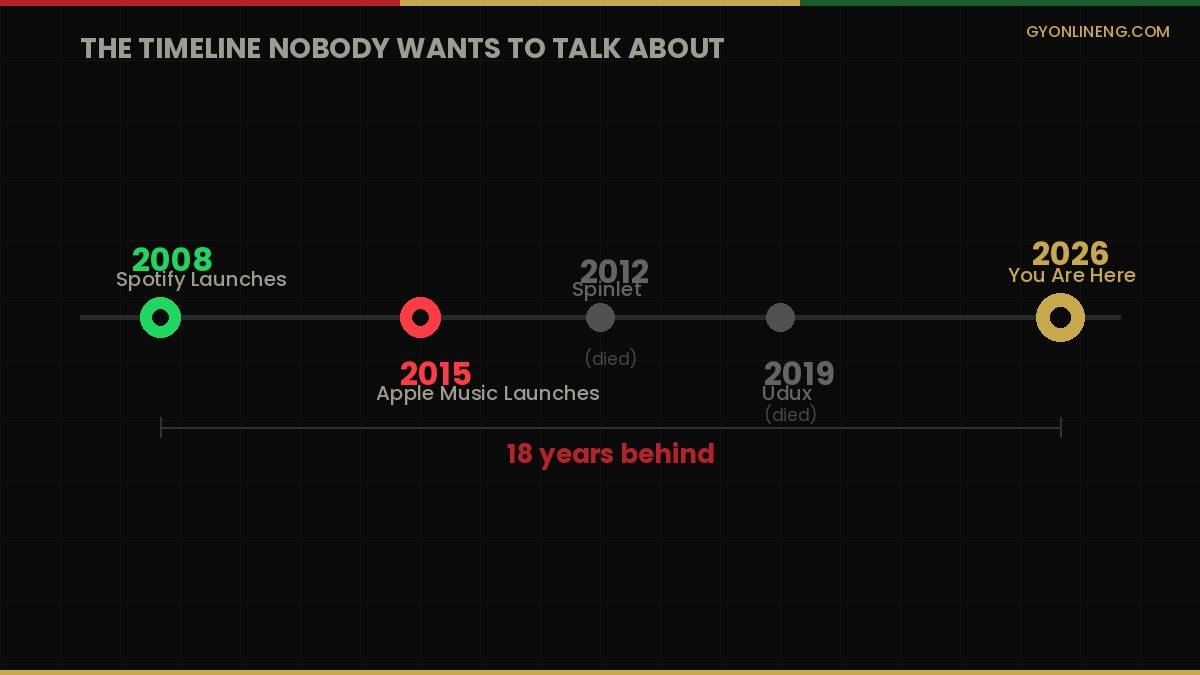
Spotify launched in 2008, spent five years burning through venture capital before turning a profit, and even then had to drag the major labels into deals through years of failed negotiations. This is a company that built a recommendation algorithm so technically sophisticated one of its core pieces of code had to be patented just to protect it from being copied.
Apple Music arrived in 2015 with the entire Apple ecosystem behind it, billions in reserves, and pre-existing relationships with every label that mattered.
You are starting in 2026.
I remember when Spinlet launched in 2012 and Nigerian Twitter genuinely believed it might work. There was real energy behind it, real users, real hope. And it still died quietly, without ceremony, the way most of these things do. Not because the founders were incompetent, but because the wall they hit was not a product problem. It was a structural one. And that wall has only gotten taller since.
I can’t wait for the day a Nigerian builds a streaming platform that can stand shoulder to shoulder with Spotify & Apple Music globally.
Nigerians are too creative for us not to own a piece of the global tech & music infrastructure.
— JBRANDY (@JbrandyOfficial) March 6, 2026
The Licensing Wall Nobody Mentions When They’re Clapping for the Dream
Building the app is honestly the easy part.
Getting the music onto it legally is where everything falls apart.
To compete with Spotify you need licensing agreements with Universal Music Group, Sony Music and Warner Music — three companies that together control roughly 70 percent of all commercially distributed recorded music globally. These companies have entire legal teams whose job is to make licensing as expensive and painful as possible for anyone without leverage.
Spotify spent years in failed negotiations before getting those deals done. And even then only cracked the US market after securing them first. Spotify had a product good enough to patent, a European user base proving demand, and investors willing to absorb the losses during the fight.
A Nigerian startup in 2026 walks into that room with what exactly.
The Top 50 Problem That Kills the Argument Completely
Here is the specific number that ends this conversation.
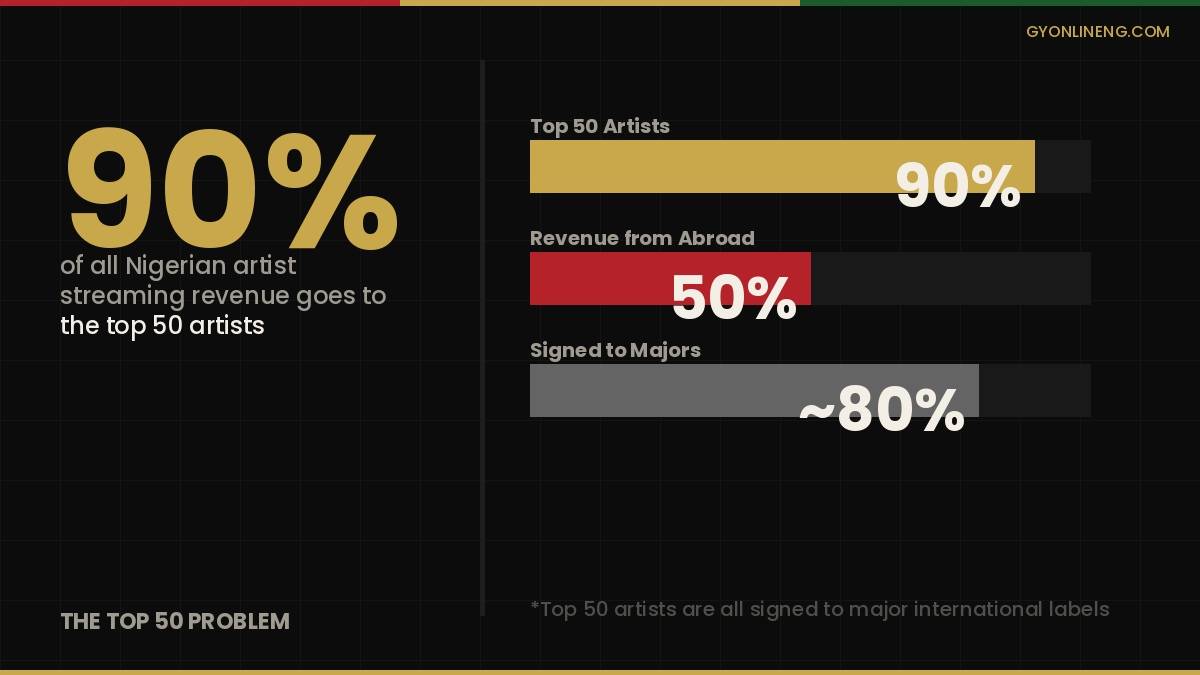
The top 50 Nigerian artists account for roughly 90 percent of all streaming revenue generated by Nigerian artists annually. And around 50 percent of that revenue comes from listeners outside Nigeria — fans in the UK, the US, Europe, the Caribbean, everywhere Afrobeats has spread.
Burna Boy is signed to Atlantic. Wizkid has his arrangement with Sony through Starboy. The list goes on. And every single one of those deals has recoupment clauses that give the label final say over distribution decisions.
You are not convincing those artists to pull their catalogues from Spotify to support a Nigerian platform. The label will block it. And the artists would honestly be making a bad decision even if they wanted to agree — because the fans streaming them in London and Atlanta are not downloading a separate Nigerian app when Spotify already has the music sitting right there.
Davido’s 5ive Alive Tour shows exactly how much revenue these artists generate outside Nigeria
Spinlet, Udux, MINO: The Graves Nobody Wants to Visit
This is not a new idea and the people who tried it were not fools.
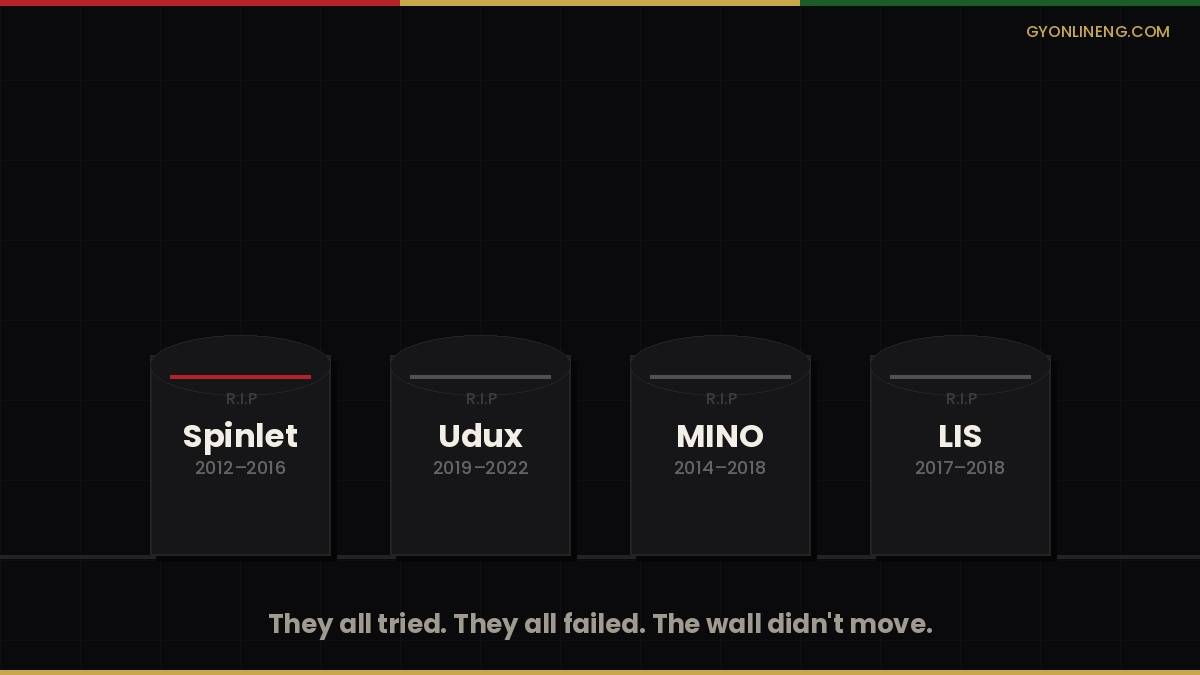
Spinlet had funding, had a product, had the timing of Nigeria’s smartphone boom behind it and still faded.
Udux came later with a stronger cultural positioning, leaned hard into the African identity angle, and is essentially a ghost today.
MINO came out of NotJustOk which had more cultural credibility in Nigerian music than almost any platform online at the time. The audience was already there, the trust was already built. And it still did not work.
These are not stories about bad execution. They are stories about a structural problem that keeps eating every attempt whole regardless of how good the team is or how real the passion behind it is.
The Three That Got Closest And What They Actually Prove
Before you cite Boomplay as proof that it can work, it is worth understanding what actually happened with the three platforms that came the closest.
iROKING: The First Real Attempt
iROKING launched in December 2011 as a free Nigerian music streaming service built by iROKO Partners — the same company behind iROKOtv. Jason Njoku had just come from an investor conference where he met the founders of Saavn, the Indian streaming platform doing for Bollywood what Spotify was doing in Europe. He saw the same opportunity in Nigeria and believed iROKO had the right infrastructure to attempt it.
The ambition was real. iROKO Partners was already YouTube’s biggest African partner, with distribution deals covering iTunes, Amazon, Dailymotion and Vimeo. iROKING had mobile apps on iOS, Android, Windows and Symbian, covering every major handset category in Nigeria at the time.
It still died. iROKING shut down in 2018 after losing $2 million over five years.
Njoku was brutally honest about why. Artists came into his office screaming. A-list acts called him a fraud. One sued iROKING for N200 million over a revenue dispute that amounted to less than $5,000. He had built a structured distribution system underwritten by iROKO’s own money and 90 percent of the artists turned on him the moment an opportunity arose. But the artist relations problem was only half the story. The deeper issue was the market itself. There was no viable paying audience for subscription digital content. Njoku eventually shut iROKOtv down in 2023 after admitting the same truth the music arm had already reached years earlier.
The iROKING story matters because Njoku had everything a Nigerian founder could reasonably have capital, an existing platform, diaspora reach, label relationships, technical infrastructure and it still was not enough.
Boomplay: The Closest Thing to Success, and Why It Doesn’t Count
Boomplay launched in Nigeria in 2015, developed by Transsnet Music Limited a joint venture between Chinese phone maker Transsion Holdings and Chinese internet giant NetEase.
This is the detail that gets glossed over every time Nigerians cite Boomplay as proof an African streaming platform can work. Boomplay is not an African company. It is a Chinese product built for an African audience.
The distribution strategy was the key. Boomplay comes preinstalled on Transsion smartphones such as Tecno, Infinix and Itel which are the best-selling phone brands across Africa. They did not have to convince users to download the app. The app was already on the phone when the user bought it. That is a distribution advantage no organic African startup has ever had and likely never will.
By 2018 Boomplay had secured licensing deals with Universal, Warner and Sony. Those deals were only possible because Transsion and NetEase had the balance sheet to absorb the costs and the corporate weight to sit across a negotiating table from the majors as credible long-term partners. By 2019 the platform had raised $20 million in Series A funding, was adding 2 million new subscribers monthly, and claimed 44 million app downloads. It currently claims over 75 million monthly users and a catalogue of more than 100 million songs.
But even Boomplay hit a wall. In late 2024 Sony Music pulled its full catalogue from the platform amid growing concerns at multiple rightsholders about late royalty payments. The company that cracked the licensing game with the three majors was struggling to keep those deals alive less than five years later.
Boomplay proved the African streaming market is real. It did not prove a Nigerian founder can build it.
Mdundo: The Unglamorous Model That Might Actually Work
Mdundo was founded in 2013 in Kenya. Worth noting immediately, the founders are Danish, not African. But the approach they built is the most honest response to African market realities that any platform in this space has attempted.
The insight was simple. Nielsen looked at the African music market and found over 150 million people downloading MP3 files from illegal websites every month. He did not try to convert them into subscription payers. He built a legal alternative to the piracy sites instead.
The model: Mdundo gets music legally from artists and labels, inserts ads into the first 5 to 10 seconds of each track, and splits the revenue 50/50 with the artists. No subscription required, no payment friction, no asking a user in Kano or Nairobi to enter card details for a monthly fee. Just free music with an ad before it.
By end of 2023 Mdundo had 30.8 million monthly active users. Between January and July 2025 alone the platform paid $1 million in royalties to over 300,000 African artists and is projecting $1.2 million in royalty payments by 2026. In 2025 it signed partnership deals with MTN Nigeria and Glo, using telco infrastructure to push deeper into the Nigerian market.
Those numbers sound small next to Spotify’s billions. But Mdundo is operating in markets where Spotify barely functions as a real option for most users, and it is actually paying artists consistently which is more than most platforms in this space have ever managed.
The limit of the Mdundo model is the ceiling. Their licensed catalogue is around 200,000 African tracks. They are not competing for the global listener. They are serving the African listener who was never going to pay for Spotify anyway, and they are doing it legally. That is a genuinely different and more honest strategy than anything iROKING, Spinlet or Udux attempted.
The Fragmentation Trap, We’ve Already Seen This Movie
There is a reason piracy exploded when music went digital in the early 2000s.
People did not pirate because they wanted to steal from artists they loved. They pirated because the legal options were fragmented, expensive and inconvenient different songs locked to different platforms, different subscriptions, different apps, the whole thing designed around corporate convenience rather than listener experience.
A Nigerian-only streaming platform in 2026 recreates that exact problem on purpose.
You are asking a fan in Toronto who listens to Afrobeats, UK drill and American R&B to pay for Spotify and also pay for your Nigerian platform just to access content that Spotify already has. That is not disruption. That is a customer inconvenience tax dressed up in a green-white-green flag.
Can a Nigerian Music Streaming Platform Ever Actually Work
Maybe one.
Not a Spotify competitor, because that war is lost before it starts. But something built around what Spotify fundamentally cannot do: direct artist-to-fan monetisation, exclusive content that never hits streaming, live experience infrastructure. The relationship between Nigerian artists and their fans is something no Silicon Valley platform has ever properly understood or been built to serve.
Mdundo showed that the free-access, ad-supported model can pay artists and grow users in Africa without fighting Spotify on its own turf. Boomplay showed the market is real. iROKING showed that passion and infrastructure alone are not enough without capital and label leverage.
Boomplay is the closest thing to what people are dreaming about and it is Chinese-owned. That tells you everything about where the capital and the will to execute actually lives right now.
The creativity is real. The culture is real. The global demand is real. What is missing is not the idea everyone has had the idea. What is missing is the honest conversation about what the idea actually requires, and the willingness to stop clapping for nationalism as a business strategy.
Building something Nigerian does not guarantee it is good. Wanting it to exist does not make it viable. Spotify had to be so good one of its engineers had to patent the code. That is the bar. And until someone is ready to clear it, the dream stays a tweet.