
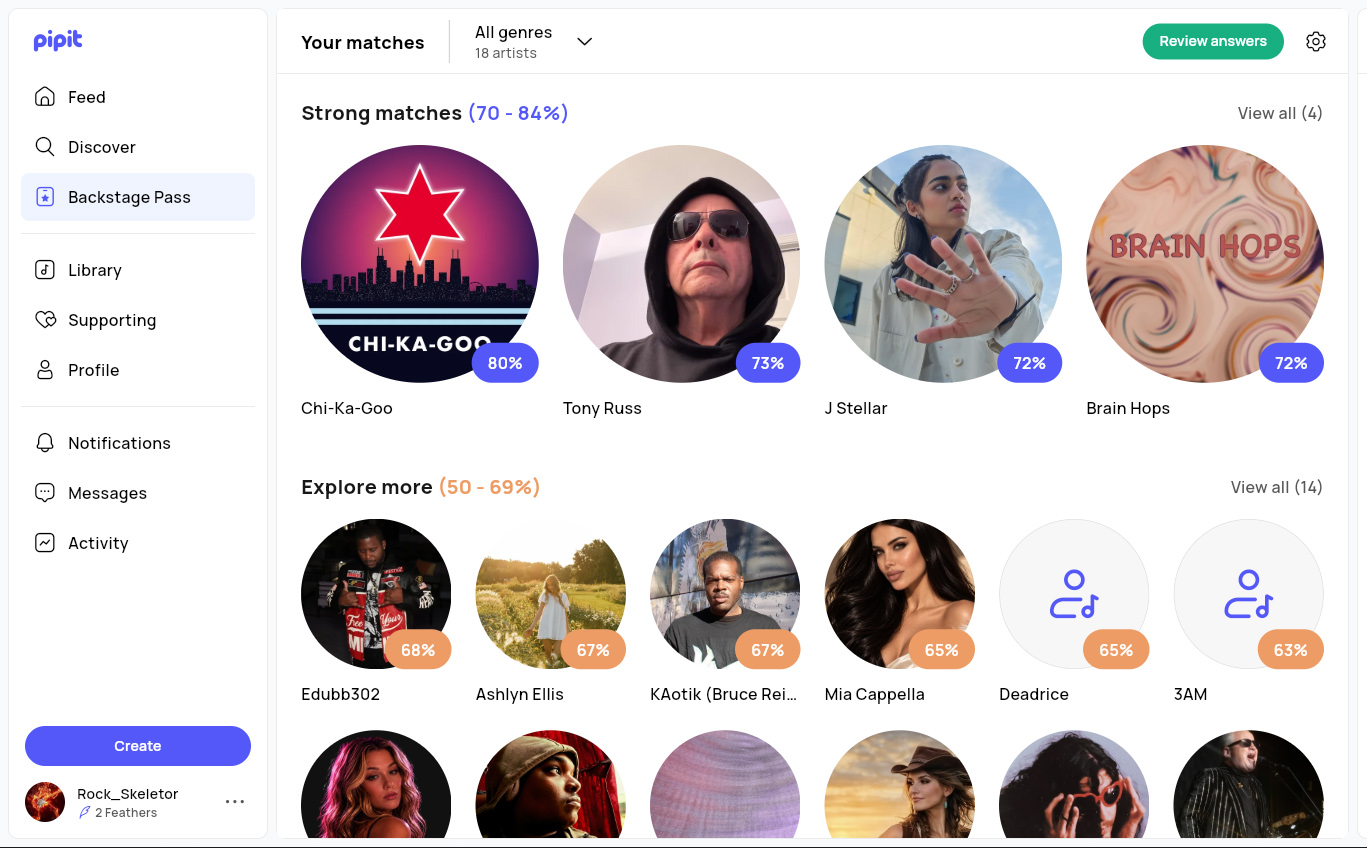
Getting a song onto streaming platforms is easy now. Getting paid for it is the hard part. Pipit, a US startup, says it has a different setup: fans pay a monthly fee, and part of it goes straight to an independent artist they pick.
We looked at how it works, what the numbers say, and whether it makes sense for artists in Nigeria and the rest of Africa. Short version: the idea is clear, the proof is missing, and several details nobody has nailed down.
What Pipit is
Pipit is a five-person company. Shingler lists the team as himself, his friend and co-founder Lee, tech lead Ed, and his two adult sons, Ian and Austin, who do front-end work and design. He says there are no outside investors.
The platform accepts only independent artists. Major-label acts are barred, and so is music made with AI. Artists can join free. Fans pay to listen and to support.
The money, line by line
A fan pays $3.99 a month. Pipit says $2 of that goes to the artist the fan chooses. The other $1.99 covers payment processing and running the platform.
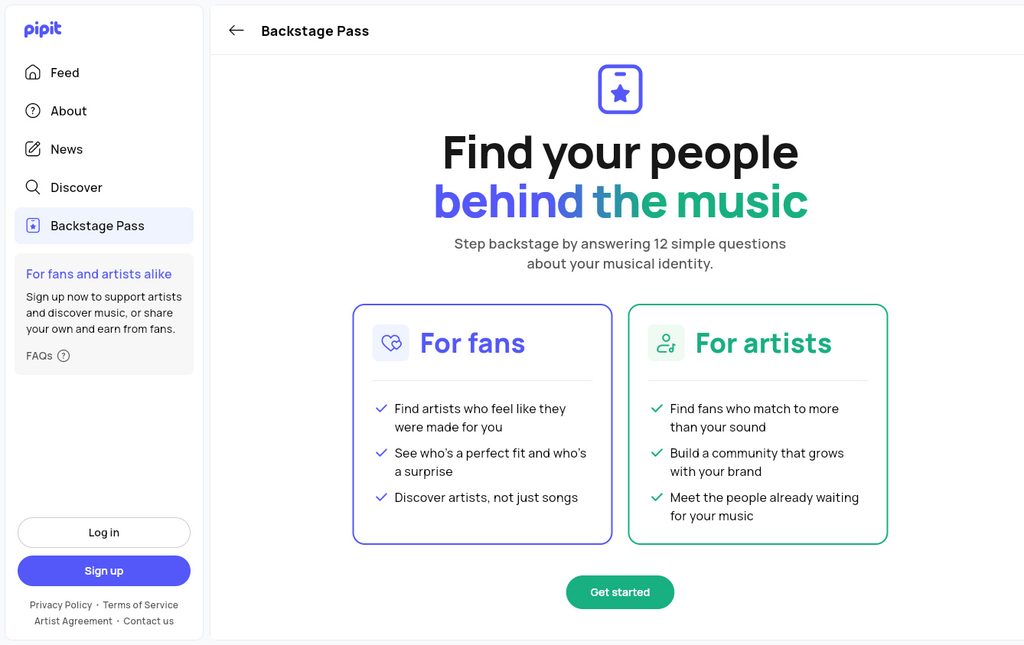
The terms add detail the press release skips. Fans get internal credits called Feathers, each worth $1 of artist support. Unused Feathers roll over, and a fan can split them across artists. So the $2 does not have to go to one artist.
Here is what Shingler’s own examples work out to, before any payout fees:
- 50 supporters: $100 a month
- 100 supporters: $200 a month
- 500 supporters: $1,000 a month
- 1,000 supporters: $2,000 a month
These are calculations, not reported earnings. They assume everyone stays subscribed and stays with the same artist. Shingler says as much, and also says Pipit has not yet proven the model.
Two numbers matter more than the examples.
First, the artist’s share is about 50%. $2 out of $3.99 is 50.1%, and Pipit’s site says “most” of what fans pay goes to artists. That is true by one cent. Bandcamp, by comparison, takes 15% of digital sales (10% once an artist passes $5,000), plus payment processing it puts at roughly 4 to 6%. Patreon takes a smaller percentage too, but its rates have changed over time, so check the current figure.
To be fair, Pipit’s fan also gets streaming access, so this is not a like-for-like comparison. But if you already have fans who would pay you directly, a lower-fee platform keeps more of that money. Pipit’s case rests on finding fans you do not already have.
Second, Pipit’s own cut is smaller than it looks. If Pipit pays standard US card rates on Stripe (2.9% plus 30 cents, about 42 cents on $3.99), it keeps roughly $1.57 per subscriber before its own costs. We could not confirm its actual rates.
Discovery: the part that could matter most
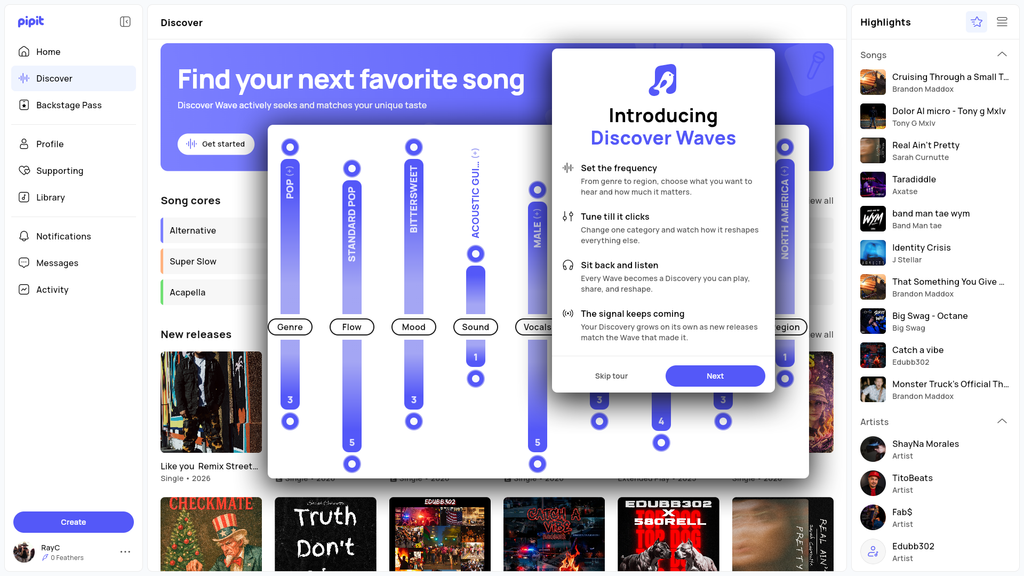
Discover Wave lets listeners build their own feed using nine categories: genre, flow, mood, sound, vocals, lyrics, tempo, production and region. New songs that match a listener’s settings join their Wave automatically.
The pitch is that a small artist can be found on the strength of the music, not the follower count. It is a fair idea. It only works if enough listeners use it. Pipit has not shared how many artists, tracks or paying fans it has.
There is also a per-play payment. Pipit’s terms say it pays artists $0.005 each time a track is played for 30 seconds or more. The press release describes $0.005 for “qualifying discovery streams” that will arrive as the discovery offering expands. Those two descriptions do not obviously match. At that rate, 1,000 plays pay $5, and 400 plays equal one supporter’s $2.
What Nigerian and African artists need to know
Shingler pitches Pipit as a bridge to fans in the US and other markets, paid in dollars. That is the attraction. Three things need checking first.
Payouts come first. Pipit pays artists only through Stripe Connect, and Shingler told us eligibility has to be confirmed country by country. Nigeria appears on Stripe Connect country lists published by other platforms, including one dated July 2026, which is encouraging. But every platform sets up its own version, and Pipit has not confirmed Nigeria. Nobody has said who pays cross-border fees, what the minimum payout is, or how naira withdrawals work.
Then the upload rules. The terms ban covers, remixes and interpolations, and samples must be cleared in writing. Artists guarantee every track is 100% original and that they hold all the rights, and they carry broad responsibility if a claim comes up. Pipit’s own liability in disputes between users is capped at $250, and disputes go to Indiana courts. If you make Afrobeats or gospel with samples, interpolations or outside collaborators, read this closely and probably show it to a lawyer.
Last, the AI rule is wider than advertised. The press release talks about generative AI. The terms say artists will not use any form of AI to create music, lyrics, arrangement or songs. Shingler told us synthesizers, drum machines and pitch correction are fine, which is a reasonable line. The written terms should say the same.
What we could not confirm
- Whether fan memberships are live. The press release says artist sign-ups are open ahead of a broader fan launch. Pipit’s terms, updated October 23, say no user accounts are created yet and that account creation starts with early access. Its support page describes memberships and payouts as if they exist.
- Audience numbers: registered artists, uploaded tracks and paying fans.
- Nigeria payouts and fees.
- How the $0.005 per play works.
- How the AI and sample rules are applied in practice.
All of these were still open when we published.
Our read
Pipit is a small, self-funded company with a clear idea and no proof yet. Its founder names the biggest risk himself: fans have to agree to add one more monthly bill on top of Spotify or Apple Music. He is right, and nothing we found answers it.
The math is the other problem. Half of each $3.99 reaches the artist, and only if a fan finds you, subscribes and stays. An artist with 100 supporters would earn about $200 a month. Getting 100 strangers to pay is the hard part, and Pipit has shared no numbers showing it can send them.
So treat it as a free extra channel, not a plan. A profile costs nothing but time. Income should not go into your budget until payouts to Nigeria are confirmed in writing and someone who reads contracts has been through the terms.