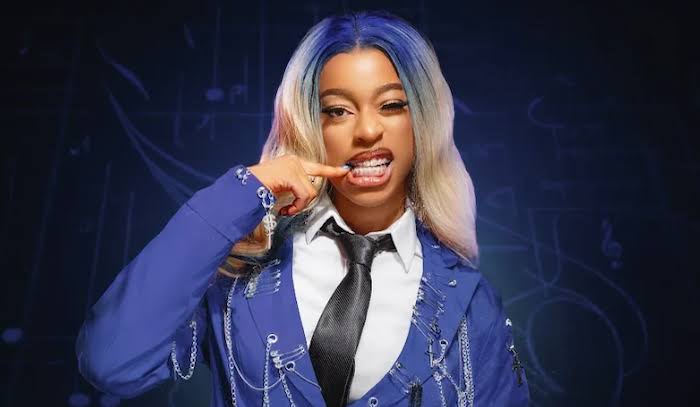
Chimamanda Pearl Chukwuma went on Instagram on April 21, 2026, and said something that most 19-year-olds should never have to say publicly.
“I just want to do music. I’m 19 years old bro. Let me be.”
By that point, the singer known as Qing Madi had already survived a $1 million to $2 million lawsuit filed against her by her former label. She had watched Pepper Me, her collaboration with Zinoleesky that was building genuine streaming momentum, disappear from Spotify without warning. She had seen multiple tracks from her new EP Barely Legal pulled from platforms she needed to reach her audience. And she had gone live on TikTok weeping, accusing Joy Tongo, the CEO of JTon Music, of forging her signature as a minor, stealing her revenues, and using digital takedowns as a weapon after losing a court battle.
The internet did what the internet does. Within hours the timeline was firmly on her side. TikTok creators posted compilations. The Cynthia Morgan parallel spread everywhere as the story became a clean moral narrative corporate executive versus teenage girl and nobody wanted to complicate it.
The problem is the story is considerably more complicated. And the complications are where the actual lesson for Nigerian music lives.
What Actually Happened Before the TikTok Live
Qing Madi signed her first deal with Richie Music Empire at 15 years old. Don Richie and producer Rhaffy funded her early development, housed her, recorded her foundational unreleased music, and took the full financial risk of developing an unknown teenager with no market value at the time.
The open secret in industry circles is what happened next. While Don Richie was on a business trip to Europe, Joy Tongo and JTon Music allegedly worked alongside the artist’s mother to pull Qing Madi away from Richie Music Empire and into their own management structure. The teenager went from one label relationship to another, with her original label receiving nothing for the investment they had made.
That move triggered a breach of contract lawsuit from Richie Music Empire against both Qing Madi and JTon. She spent her entire adolescence caught in corporate crossfire.
Under JTon Music, she released See Finish in October 2022, Why in May 2023, Ole in July 2023, and her debut self-titled EP through JTon Music in November 2023. That EP peaked at number 14 on the Nigeria Apple Music chart and established her as one of the most promising young voices in Afrobeats. Later came American Love, the collaboration with Columbia Records that gave her genuine international visibility.
Then she left JTon Music, and the machinery turned on her.
What Joy Tongo Actually Said
The public framing after the TikTok live presented this as a straightforward case of corporate abuse. Joy Tongo’s response, when it came, was more legally specific than the emotional counter-narrative suggested.
Tongo denied forging Madi’s signature or stealing from her. She explained that the case Qing Madi claimed to have won was still ongoing, adding that the injunction is why the record label can issue a legal takedown of her songs.
“Also, the injunction ruling is why we can issue a legal takedown now, what case have you won? Because last time I checked the case still hasn’t gone to trial,” Tongo stated.
That is a materially different set of facts from what Qing Madi described publicly. Either the case was won or it has not gone to trial. Both cannot be true simultaneously, the answer matters because if an active court injunction exists regarding unresolved copyright ownership, then Spotify and Apple Music are not being manipulated by a vengeful label they are complying with a legal order they are required to follow.

Digital aggregators do not pull chart-building records because someone sends them an angry email. They pull records when they are presented with documentation that creates a credible ownership dispute they cannot ignore without legal liability. JTon Music has maintained strategic silence on the specific reasons behind the copyright takedowns. That silence is not innocence but it is also not the same thing as guilt.
The full facts are in documents that neither party has published and that a court has not yet ruled on. Every public statement from both sides is adversarial positioning, not neutral testimony.
The Irony Nobody Is Talking About
Here is the part of the Qing Madi story that the emotional TikTok narrative completely swallows.
JTon Music allegedly built its current artist roster by pulling a 15-year-old away from the label that discovered and developed her, using the artist’s guardian to bypass a binding contractual relationship. The original label that took the financial risk and invested in an unknown teenager was left with nothing and filed a lawsuit.
Four years later, Qing Madi has done the same thing to JTon Music. She left the Lagos-based label that developed her commercial career to release music independently under a collective called KFMD. JTon filed a lawsuit. The injunction froze her catalog.
The label that allegedly taught a teenage artist that contracts can be walked away from is now on the receiving end of a contract exit and is using every legal mechanism available to protect its asset equity. The artist who learned early that you can leave a label if the right opportunity presents itself has applied that lesson again, this time to the label that taught it to her.
This is not a coincidence. It is a systemic cycle and the Nigerian music industry has been running it for years.
The Minor Signing Problem Nigerian Music Has Not Solved
Shallipopi and Crayon exited their deals earlier this year with similar structural complaints. Labels understand that digital platforms provide the only reliable way to reach an audience. They know a young artist cannot afford endless litigation. By striking a song from Spotify, a label cuts off the revenue an artist needs to fund their legal defence.
That is the specific cruelty of the digital takedown as a weapon. It is not just removing a song, it is removing the income stream that would allow the artist to keep fighting. A teenager with no catalogue income, mounting legal bills, and songs disappearing from streaming platforms is significantly more likely to accept an unfavourable settlement than one whose music is generating revenue and building an audience. The timing of the Pepper Me takedown during a rollout week when the track was gaining traction is not coincidental. It is the calculation.
The deeper problem is the contract environment that creates these situations. When labels sign 15-year-olds, the contracts are almost never negotiated at arm’s length. The artist has no bargaining power, no industry knowledge, and often a guardian who is more dazzled by the opportunity than equipped to assess the legal terms. The label has lawyers, precedent, and a standard contract designed to maximise its equity position. The result is an agreement that looks fair on paper and operates as a trap once the artist develops commercial value.
Qing Madi is not the first Nigerian artist to discover at 19 that the contract she or her guardian signed at 15 does not reflect the career she has built. She will not be the last.

The Cynthia Morgan Reference and Why It Landed
When Qing Madi invoked Cynthia Morgan‘s name, she was not making a random comparison. She was pulling on a specific wound in Nigerian music’s collective memory.
She wrote:
“My ex label, the same people that tried to destroy Cynthia Morgan, are trying to do the same to me.”
The Morgan situation is documented. An artist at the height of her commercial power losing access to her stage name, her social media accounts, and her music distribution because of a contractual dispute with the same management entity. The public response at the time was outrage, the structural changes that should have followed that outrage did not happen.
By naming Morgan in her TikTok live, Qing Madi was making an argument the Nigerian music industry does not want to hear: that nothing changed after Cynthia Morgan. That the same structures that enabled that situation are still operating a decade later, with a new artist, new platforms, and the same fundamental power imbalance between a management company with institutional resources and a young artist whose only leverage is her audience’s emotional investment.
The internet responded to that argument viscerally because it is true. The structures did not change.
What the Industry Needs to Actually Build
The Qing Madi situation is the fourth significant artist-label ownership dispute this publication has covered in the past two months. Burna Boy‘s early catalogue in litigation over an alleged unauthorised transfer. Joeboy‘s copyright case collapsing in a US federal court because emPawa could not prove clean ownership under discovery. Asake buying out his YBNL contract to form Giran Republic. And now Qing Madi watching her songs disappear from Spotify while a court injunction sits unresolved.
These are not isolated incidents. They are symptoms of an industry that has built global commercial success without building the legal and contractual infrastructure to sustain it safely.
The specific things that would change this are not complicated. Mandatory independent legal representation for any artist under 18 before signing any contract. Standard cooling-off periods between when a contract is presented and when it is signed. An industry body not a government agency, an industry-funded institution that provides free contract review for emerging artists who cannot afford entertainment lawyers. Clear protocols for what happens to digital catalog ownership when a contract is disputed before a court has ruled.
None of these exist in any meaningful form in Nigerian music. The Tiwa Savage Foundation and Berklee partnership announced last month is the most significant structural investment in artist education the industry has seen. But training the next generation of music professionals takes years. Qing Madi needs a solution now.
Qing Madi’s rise has been one of the more closely watched in recent Afrobeats history. Since breaking out with See Finish in 2022 and later releasing her debut album, she has steadily built momentum as one of the genre’s most promising young voices.
She is 19 years old. She has already survived more industry machinery than most artists encounter in a full decade. She is still making music, still releasing projects, still building. The resilience is real.
What should also be real, and is not, is an industry structure that does not require that level of resilience from a teenager in the first place.
This article has been updated following the release of an official statement by KFMD Label Management on behalf of Qing Madi, dated June 5, 2026. The statement sets out the court record in detail and directly contradicts how JTON Music characterised the ruling in its own press release.
The facts below come from the KFMD statement and the public record of Suit No. LD/5242CMW/2025 before the High Court of Lagos State.
The first fact the public record establishes: JTON brought this case. Qing Madi did not. JTON Entertainment Limited is the Claimant and Applicant. Qing Madi is the Defendant. JTON cannot file a lawsuit, lose the substance of it, and then position itself publicly as the party seeking calm.
What Justice T.B. Sunmonu actually held on May 25, 2026:
The management contracts JTON relies on were executed when Qing Madi was 16 years old. Under the Child’s Rights Law of Lagos State 2015, the age of majority is 18. The Court found these contracts to be infancy contracts, found them voidable, and found that Qing Madi validly repudiated them on reaching adulthood.
The Court affirmed her right to choose her own manager, to negotiate and enter new agreements, and to release and perform music under brands and platforms not connected to JTON.
The Court dismissed JTON’s application to freeze her revenue.
The Court dismissed JTON’s attempt to silence her and her family.
The Court dismissed JTON’s application to benefit from her relationship with Riot Games on the grounds that JTON could not prove it facilitated that relationship.
The single narrow order JTON now presents publicly as a win covers only specific recordings financed under the repudiated contracts while the substantive case is heard. It does not touch Qing Madi’s independent catalogue. It does not touch her new music. It does not touch her freedom to build her career on her own terms. JTON is presenting a holding order as a victory. It is not.
Why Qing Madi terminated the relationship:
She terminated her relationship with JTON in May 2025 on two grounds. First, she signed the contracts as a child and elected to void them as an adult which the law permits and the Court confirmed. Second, she lost confidence in JTON’s stewardship of her career and her money.
JTON was contractually required to conduct a yearly audit of the parties’ accounts. It never did. The Court found JTON in breach of that obligation.
The expenses JTON cannot account for:
JTON’s own income and expense schedule for October 2022 to December 2023 records expenses of more than 43 million Naira and roughly 38,000 US dollars, set against income of about 6 million Naira and 8,650 US dollars. JTON has produced no receipts, no invoices, and no verified breakdown for those claimed expenses. At one point JTON asserted the artist owes it 200 million Naira. No documented basis was provided for that figure.
A portion of Qing Madi’s earnings as a minor was legally required to be protected in a blocked Coogan account she could not access until adulthood. She has been denied access to that account, denied its login details, and denied any verified statement of its balance.
The conflict of interest at the heart of the Columbia Records arrangement:
When the recording agreement with Columbia Records, a division of Sony Music Entertainment, was put in place, $25,000 was paid to The Okunnu Law Group as a counsel fee. The Okunnu Law Group is described as JTON’s own attorney. That fee was characterised as JTON’s legal costs, advanced against the artist’s account.
Qing Madi was a minor. She was entitled to genuinely independent legal advice on a contract that would shape her entire career. The New York order approving that minor’s contract was granted on the stated basis that the minor was duly represented by qualified counsel. The lawyer connected to that deal was JTON’s lawyer, paid by JTON, from money attributable to the artist.
A child cannot be said to have been independently advised by the same lawyer acting for the company on the other side of the table. KFMD states this is a fundamental conflict of interest that goes to the validity of the entire arrangement and is being examined in ongoing proceedings.
The copyright takedown that did not work:
JTON sent notices to Spotify, Audiomack and other streaming platforms asserting that it holds copyright in Qing Madi’s recordings and that a court order restrains her releases. KFMD states both assertions are false.
Audiomack reviewed the notices, recognised them as a contractual dispute dressed up as copyright infringement, and declined to act requesting a court order that JTON does not have. The Lagos State High Court has no copyright jurisdiction. Copyright in Nigeria falls to the exclusive jurisdiction of the Federal High Court. On termination of the repudiated contracts, the rights in Qing Madi’s works reverted to her. JTON holds none.
The campaign against her live performances:
JTON has sent cease and desist notices to media houses, event organisers and promoters demanding that Qing Madi be dropped from their bills and that her music not be performed. The notices assert that a court order bars her from appearing under the name “Qing Madi” and from performing her own catalogue.
KFMD states this is a misrepresentation of the ruling.
“Qing Madi” is her own professional name. No court handed that name to JTON. The Court affirmed her right to release and perform music under brands and platforms not connected to JTON. The single holding order is limited to specific recordings financed under the repudiated contracts. It does not touch her name, her independent catalogue, or her right to take a stage.
KFMD states it will treat any cancellation procured by these misrepresentations as actionable interference with the artist’s contracts and livelihood, and that JTON and its advisers will be held accountable.
The legal distinction JTON’s notices ignore:
A song exists as two separate properties. There is the sound recording the master. And there is the musical work the composition, the melody and lyrics the songwriter creates. These are different rights, owned and licensed separately.
When an artist performs live she is not playing a master. She is performing the composition. The right engaged is the public performance right in the musical work, which belongs to the writer and is licensed through the relevant collecting society. JTON’s Schedule is a list of sound recordings. A claim over a recording cannot control a live performance of the underlying song. You do not need a master to sing your own song.
Qing Madi wrote these songs. As their author she holds the writer’s share in her compositions. That share belongs to her as the creator. It is not a management asset. No contractual dispute can strip an author of it.
The position as of June 5, 2026:
KFMD states that Qing Madi is free, she is releasing music, and she is building her career with a team of her choosing. The releases promoted under KFMD, including her work with featured collaborators, are lawful and will continue.
Her position is stated simply in the closing line of the KFMD statement:
“She was a child when she signed. She is an adult now. She owns her voice, her name, and her future.”
This publication will continue to update this story as the substantive case proceeds in Lagos and in New York.