
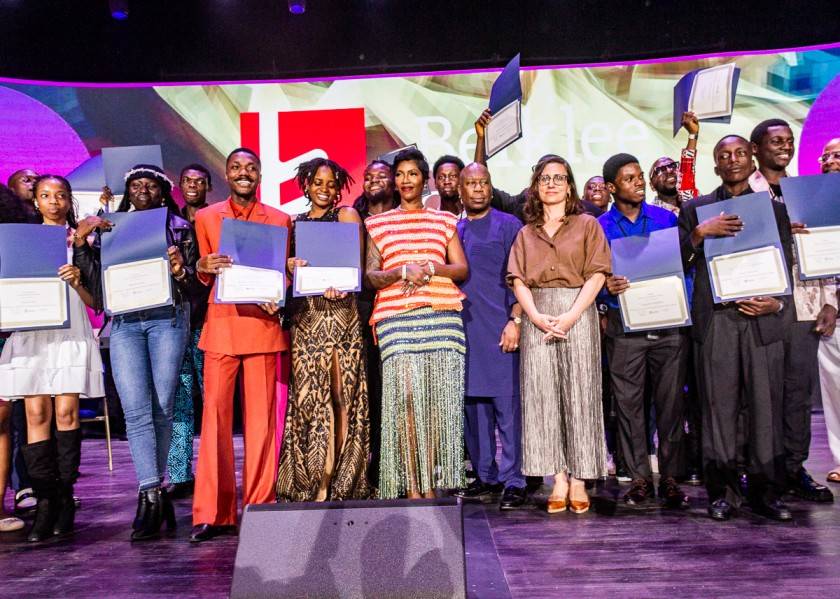
On April 26, 2026, the Tiwa Savage Music Foundation announced the results of its first Berklee in Nigeria programme. The five-day initiative brought together 120 young Nigerian musicians, producers, songwriters and engineers for instruction from six Berklee College of Music faculty members. Eighteen participants received full three-year undergraduate scholarships to study at Berklee in Boston.
Eighteen participants received full three-year undergraduate scholarships to study at Berklee in Boston. This is separate from the Lagos intensive, which had no tuition fee but required participants to cover their own travel, housing and meals.
The total scholarship value awarded at that ceremony was more than $2.1 million.
| Programme measure | Figure stated in this article |
|---|---|
| Applications | More than 2,100 |
| Participants selected | 120 |
| Three-year Berklee scholarships | 18 |
| Total scholarship value | more than $2.1 million |
Tiwa Savage studied at Berklee College of Music and graduated in 2007. The foundation she established with Berklee has brought a short intensive programme to Lagos, while 18 selected participants received scholarships for undergraduate study in Boston. The two opportunities are different in length and scope, but both are intended to widen access to professional music education.
🚨Tiwa Savage Launches her Music Foundation and Partners with Berklee College of Music to Empower the Next Generation of African Talent 👏🏽 pic.twitter.com/c6viWlfs7w
— HYPETRIBE (@hypetribeng) February 25, 2026
The significance is not only the number of scholarships. It is that the programme directs resources toward training the wider workforce behind music, not just the performers whose names appear on stage.
What the Tiwa Savage Music Foundation Actually Is
The foundation was announced on February 25, 2026, and described from the beginning as a philanthropic initiative dedicated to discovering, developing and empowering the next generation of African music creatives. The framing was deliberate and specific. Not just performers. Not just artists. The full ecosystem.
Tiwa Savage said at the launch:
“Afrobeats has captured the world’s attention, but attention alone is not enough to sustain an industry. Behind every global hit are producers, songwriters, sound engineers, music executives, and creative professionals whose work shapes culture. Yet across Africa, access to structured, world-class training for these careers remains limited.”
That statement is the most precise articulation of Nigerian music’s infrastructure problem that any major artist has made publicly. It is the same structural gap this publication has been documenting across multiple pieces in the Spotify plateau analysis, in the IFPI Africa revenue breakdown, in the Joeboy copyright case, in the Burna Boy catalogue dispute. The problem is not the talent. The problem is the ecosystem around the talent. Nigeria has been producing world-class artists for two decades without building the world-class support infrastructure that allows those artists to fully monetise, protect and sustain what they create.
Tiwa Savage put it directly:
“I wanted to build something that opens people’s eyes to the full scope of what’s possible in music. The person who composed the score for a film, who creates music for global campaigns, or who uses music as a tool for healing — these are meaningful, sustainable careers that don’t always exist in the spotlight.”
The Numbers Behind the Programme
The inaugural Berklee in Nigeria: Class of 2026 drew more than 2,100 applications, according to the programme announcement, and selected 120 participants. The programme ran from April 22 to 26 in Lagos, with Berklee faculty delivering instruction in live performance, songwriting, music production and the business of music. The application figure indicates strong demand for the opportunity, although it does not by itself measure the scale of music-training access across Nigeria.

Berklee faculty members who led the programme included Dennis Montgomery, Academic Director and Professor of Ensembles; Yoron Israel, Chair of Percussion; Tyrone Chase, Assistant Chair of Ensembles; Nichelle Mungo, Associate Professor of Voice; Anthony Nembhard, Assistant Professor of Ensembles; and Jason Camelio, Programme Director and Assistant Vice President of Global Programs and Partnerships.
The Grand Finale Concert and Award Ceremony was hosted by Darey Art Alade and Kie Kie at the National Theatre, with Teni the Entertainer among the guest performers. The ensembles performed everything from Stevie Wonder and Miles Davis to Masego, Ayra Starr and Ne-Yo, alongside original compositions developed during the week.
The programme was made possible through the support of Flutterwave as main sponsor, alongside PepsiCo, The Delborough Lagos, MUSON Centre, Mich and Harry, and the Noella Foundation. The Tiwa Savage Music Foundation also collaborated with the Bank of Industry and the Lagos State Government.
That partnership list is significant. Flutterwave bringing fintech infrastructure to a music education programme. The Bank of Industry as an institutional partner. Lagos State Government engagement. This is not a celebrity charity initiative. It is a properly structured institution with government and corporate backing.
What Made This Historically Significant
The programme marked the first Berklee College of Music event in West Africa and a milestone for a region driving rapid growth in the global music economy.
Berklee is not a minor institution. It is the largest independent college of contemporary music in the world, with alumni including Quincy Jones, John Mayer, Diana Krall, Melissa Etheridge, Branford Marsalis and hundreds of other major figures across every genre. Its Production and Engineering programme trains the people who make the records. Its Music Business and Management programme trains the people who run the labels. Its Film Scoring programme trains the people who score the films.
Berklee President Jim Lucchese described the programme as continuing to increase access to Berklee’s curriculum around the world through the generosity and collaborative spirit of one of the school’s most accomplished and dedicated alumni.
That is a useful distinction. The programme is being presented as an education partnership, not simply a celebrity donation. Whether it becomes a lasting institution will depend on what happens after this first cohort.
Jason Camelio said:
“There is no better way to connect with the music community in Nigeria than with Tiwa Savage. We see this programme and relationship as a historic pathway forward to enrich our educational and artistic experiences, inspire our students and teachers, and open doors for the next generation of emerging artists.”
Where the Foundation Wants to Go
The four-day intensive is the first visible piece of a larger plan.
Beyond the Lagos intensive programme, the foundation’s long-term goals include awarding scholarships for Nigerian students to study at Berklee in Boston and ultimately establishing a permanent music school in Nigeria. Tiwa Savage described it as the bigger vision:
“To build something that outlives me — something that creates structure, opportunity, and ownership for future generations of African creatives.”
The long-term ambition is larger than another annual workshop: a permanent music school in Nigeria that can train musicians alongside producers, engineers, lawyers and music executives. That would address a gap the industry has mostly filled informally.
The Nigerian music industry has operated without a world-class formal training institution for its entire history. Artists learned by doing. Producers built their ears in bedrooms and small studios. Engineers figured out signal chains by trial and error. Music business professionals learned by making expensive mistakes in poorly documented contract environments. This is part of why the ownership documentation gaps that cost emPawa $465,000 in the Joeboy case exist. It is part of why Alaba Market was the only distribution infrastructure available for two decades. It is part of why Nigerian music generates cultural influence far beyond what the economic returns would suggest.
Why Tiwa Savage Can Build It
There are Nigerian artists who have more streaming numbers than Tiwa Savage. There are artists Wizkid, Burna Boy, Davido who have performed on bigger stages. But there is a specific combination of factors that made her the person positioned to build this particular thing.
She is a Berklee alumna who understands from direct experience what that education unlocked. She has managed the Nigerian music industry at the highest level across three decades from signing with Sony Music to building an independent career through Savage Reign Entertainment, from the Mavin Records era to her current position. She has experienced the industry’s contractual complexities firsthand, having managed a high-profile dispute with her former label. She understands both the opportunity and the structural failures from the inside.
She also chose to base the foundation in Lagos while many of Nigeria’s biggest artists spend much of their working lives abroad. That gives the project a practical connection to the ecosystem it is trying to strengthen.
She said at the foundation launch:
“I know this personally because at the age of 24, I was awarded a scholarship to attend Berklee. That opportunity changed my perspective. It expanded my understanding of global systems, and the power of knowledge behind creativity. It showed me that talent is universal but access is not.”
What Could Change If It Lasts
The foundation is attempting something the Nigerian music industry has largely had to build informally: a direct training pipeline connected to an established international music school. The Berklee partnership gives it credibility, but the real test is whether the pipeline survives beyond the first programme and scholarships.
The 18 students who received full three-year Berklee scholarships on April 26 are the first clear evidence that the programme can move beyond workshops. It is too early to know what this cohort will produce, but the pathway is now visible.
Those professionals will be the people who negotiate better contracts. Who engineer records to the standard that international sync placements require. Who score the films. Who run the music publishing companies. Who build the royalty collection infrastructure that COSON has failed to build properly. Who understand intellectual property law well enough to protect the next Joeboy and emPawa from the kind of documentation failure that cost them a federal case.
The talent was never the difficult part to prove. Access was. This foundation is an attempt to close that gap, starting with education and scholarships.
The National Theatre event therefore mattered less as a celebrity appearance than as a demonstration of what the foundation is trying to build: a pipeline around Nigerian music talent, not another music release.
This connects to our broader Nigerian music industry analysis: developing talent is one part of the problem; building the legal, financial, technical and distribution systems around that talent is another.